The test for a medieval Christmas market takes four seconds: look at the lights, then at the trader. If the lights are electric and the trader is in a fleece under a fake-fur hat, you are in a Christmas market in an old square, which is a fine place to be, and not the thing on the sign. Twelve markets in Europe pass the test with 2026 dates we have checked, and the two big free ones are the Esslingen Medieval Market & Christmas Market in Esslingen am Neckar, Germany, 24 November–22 December 2026, and the Mittelalterlicher Markt zu Siegburg, 20 November–22 December 2026. Six more (Nuremberg, Tallinn, Rothenburg ob der Tauber, Prague, Óbidos, York) are ordinary markets in genuinely old squares. By the end you’ll know which is which, which suits a pushchair, and where to stand at four when it goes dark.
Checked 13 September 2026; “square only” means an ordinary Christmas market in an old setting; “expected” means the organiser has not yet announced 2026
What makes a Christmas market “medieval”?
Costumed traders, period crafts and food, hand-powered rides, and no electric lights in the costumed section. That is the whole definition. A market earns the word by what the stallholders do and wear, the forge and the glass furnace working in public, and a Ferris wheel someone has to crank. The square it stands in earns it nothing.
History, though, is on the side of the old squares. Advent markets are late-medieval: Dresden’s Striezelmarkt claims a start in 1434, and Vienna points to a “December market” licence of 1296, both claims the cities make about themselves rather than facts anyone has settled. So a Christmas market on Tallinn’s Town Hall Square is a direct heir of the tradition, and not a reenactment of it. Esslingen is the reenactment. Both are worth your evening, one for the tradition and one for the costume; only one of them needs the word on the sign.
Which Christmas markets are actually medieval?
Esslingen Medieval Market & Christmas Market, Esslingen am Neckar, Germany
Esslingen runs two markets in one. On the Marktplatz is a conventional Christmas market; around the Rathausplatz and Hafenmarkt is the costumed one, where traders and performers work in period dress, and it has grown from nine stalls in 1998 to a large share of the roughly 200 stands. The 2026 market runs from Tuesday 24 November to Tuesday 22 December, daily 11:00–20:30 and until 21:30 on Fridays and Saturdays, with the opening ceremony on 24 November at 17:00. Entry is free.
The programme is the point, not the shopping: around 500 scheduled slots across three stages, with fire-eaters, stilt-walkers and storytellers, and some twenty craftspeople at work, blacksmithing, tin-casting, felt-making, basket weaving and glass-blowing. Everything you have seen on video is real: the heated wooden bathing tub on the Hafenmarkt (an activity you pay for, and one that needs a towel you didn’t pack), the hand-cranked miniature Ferris wheel, a storytelling tent, a living nativity at the Postmichelbrunnen and a torchlit procession up to the castle walls.
The catch is the crowd. Its organiser counts around a million visitors over the four weeks, and weekend evenings after the S-Bahn from Stuttgart empties are the crush. Go on a weekday afternoon: the blacksmith is working, a child can stand at the front of the felt-maker’s table, and the bathing tub has a queue you can see the end of. Esslingen is about 15 minutes from Stuttgart main station on the S1, and the market is a five-minute walk from the station.
Mittelalterlicher Markt zu Siegburg, Siegburg, Germany
Siegburg’s market has filled the square below the Michaelsberg abbey for the whole of Advent since 1991, and it is the one that runs the day as a play: every trader and craftsman in period dress from wooden stalls, jesters and musicians between them, and the night watchman’s call closing each evening. The 2026 market runs 20 November–22 December, Sunday to Thursday 11:00–20:00 and Fridays and Saturdays to 21:00, free; on Totensonntag, 22 November, it opens only from 18:00 to 20:00. Its organiser has already published 2027, 19 November–22 December, which is more than most festivals manage. Siegburg is about 20 minutes from Cologne by train, which makes it the easy add-on to a Rhineland Christmas.
Mittelalter-Weihnacht im Stallhof, Dresden, Germany
Dresden’s takes the tournament yard of the Residenzschloss, built in 1586–91 for jousts, and fills it with around fifty costumed traders and craftspeople working with late-medieval tools, musicians and a bathhouse, from 25 November to 23 December 2026, daily 11:00–21:30. Weekdays are free; on the Advent weekends, from Friday afternoon, adults pay €5 and children €3.
Then it does the thing nobody else does: it reopens as the Dresdner Rauhnächte, 27–30 December 2026 and 2–6 January 2027, the one costumed market on this list you can visit after Christmas. The Striezelmarkt, which claims 1434, is five minutes away, so Dresden gives you the heir and the reenactment in one walk.
Munich, Pforzheim, Lübeck and Durlach
Four more German markets pass the test, and one sentence each is enough to choose. Munich’s, on Wittelsbacherplatz north of Odeonsplatz, has run since 2005 with costumed traders, crafts and staged sword fights, 20 November–23 December 2026, daily 11:00–21:00, closed on Totensonntag, free. Pforzheim’s, in the Blumenhof beside the Stadtmuseum, runs longest, 23 November–30 December 2026, free, with a wooden-tub bathhouse, axe-throwing, a hand-cranked chain carousel and a stage of bands.
Lübeck’s stands in the Marienkirchhof between St Mary’s and the Rathaus, 23 November–23 December 2026, free, with coppersmiths, pewter casters and other forgotten trades under candles and a canopy of red paper stars, the costumed one among the Hanseatic city’s eleven markets. Durlach’s, on the Schlossplatz before the Karlsburg in Karlsruhe, has run since 2002 with the knights of the Badische Schwertspieler; the 2026 dates were not published when we checked, and 25 November–20 December is the expected window.
Historischer Weihnachtsmarkt Burg Ronneburg, Ronneburg, Germany
The 13th-century hilltop castle of Ronneburg, east of Frankfurt, opens its halls and towers on the first three Advent weekends, 28–29 November, 5–6 and 12–13 December 2026, Saturdays 11:00–20:00 and Sundays to 18:00: stalls in the castle rooms, a costumed market with jesters, taverns and craftspeople outside the walls, and a living nativity play. Adults pay €10, children €7, and anyone in full historical costume also €7, which is the cheapest reason on this page to own a cloak. Parking is €3 and the castle rooms are warm, which matters more than it should in December.
Marché de Noël médiéval de Ribeauvillé, Ribeauvillé, France
On the first two weekends of December, 5–6 and 12–13 December 2026, Saturdays 10:00–19:00 and Sundays to 18:00, the whole Grand’Rue of Ribeauvillé, a walled wine town in Alsace under three ruined castles of the lords of Ribeaupierre, goes into costume: beggars, peasants, dancers and jugglers work the street, the Three Kings arrive with camels, wild boar turns on spits and cervoise is poured from barrels.
Entry is free; the park-and-ride at Bergheim was €10 a car in 2025, shuttles included, and it is the only sensible way in. Ribeauvillé is the one on this list to combine with the wine route.
Advent na hradě Křivoklát, Czechia
The royal Gothic castle of the Bohemian kings, in the wooded Berounka valley west of Prague, opens on the second and third Advent weekends, 5–6 and 12–13 December 2026, for a craft fair with historical entertainment: jugglers, stilt-walking angels, a rope-walker, a nativity play with carols and children’s workshops, with free-flow access to the castle interiors and their Advent crib. In 2024 the ticket was CZK 160 and the 2026 price was not yet published when we checked. Křivoklát is a day trip from Prague by train, and the castle is the point; the market is the excuse.
Medeltida Jul, Visby, Sweden
The winter offshoot of Visby Medieval Week is three days on the first weekend of December, 4–6 December 2026, when the roofless S:t Nicolai church ruin fills with a costumed market of craft stalls, warming fires and music, opened by a torchlight procession from the Österport gate. Its market is free; the concerts, workshops and city walks are ticketed in advance. It is dark by three on Gotland in December, which is the argument for it. Visby in winter is the town without the August crowd, and the ferry still runs.
Alletiders Julemarked, Middelaldercentret, Nykøbing Falster, Denmark
Middelaldercentret’s Christmas market opens the museum’s reconstructed town of around 1400 for one weekend, 28–29 November 2026, 10:00–16:00, with stalls of local crafts and food among the timber-framed houses and pony rides for a small extra fee; admission was DKK 59 for adults and DKK 29 for children in 2025. The people selling you things have been doing the year 1400 since May. It is about one and a half to two hours from Copenhagen by train to Nykøbing Falster, then 4 km across the Guldborgsund bridge. Two days only, and there is no other.
One more, with a caveat: the Midwinter Fair at Archeon in the Netherlands, 12–13 December 2026, is held in an open-air museum with a reconstructed town of the period, and it is a fantasy fair with elves in it. The town is real and the fair is not; the fantasy fairs piece has it.
Which Christmas markets are in medieval towns but aren’t medieval?
Nuremberg, the Christkindlesmarkt
The Nürnberger Christkindlesmarkt is the Christmas market the guidebooks put first, and it is not what they imply: it is first recorded in 1678, not 1628, and the city’s own archive made that re-dating. Its square is another matter. The Hauptmarkt is 14th-century, the Frauenkirche beside it was built as Charles IV’s court chapel, and the Christkind speaks her prologue from its gallery at 17:30 on the opening Friday. In 2026 it runs 27 November–24 December, free, with 168 red-and-white stalls and around two million visitors. Go for the square and the bratwurst; Nuremberg has the castle for the Middle Ages.
Tallinn, Town Hall Square
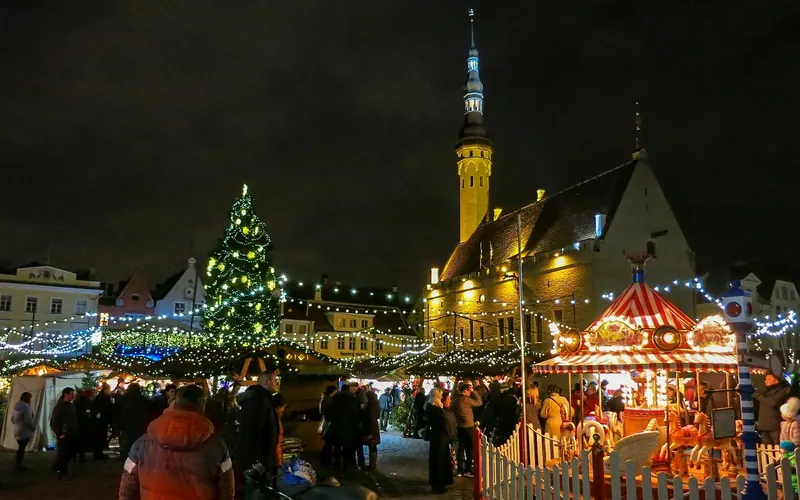
The square is the real thing: the Town Hall was finished in 1404 and is, by the city’s own description, the only intact Gothic town hall in northern Europe. Around its spruce, the Tallinn Christmas Market runs 20 November 2026–6 January 2027, daily 10:00–20:00, in what the organisers count as its 25th edition, with traders selling modern Estonian crafts and food in ordinary dress. Tallinn claims a public Christmas tree on this square from 1441, which Riga disputes. Come at dusk, when the Town Hall is lit behind the stalls and the tree does the work the costumes would; the Tallinn guide covers the walls for the daylight hours.
Rothenburg ob der Tauber, the Reiterlesmarkt
The Reiterlesmarkt sits on the market square of a near-complete ring of walls, a free imperial city from 1274. Rothenburg has published its 2026 dates, 20 November to 23 December, sixty-one stalls, shut on Remembrance Sunday. Coaches leave by about five, which is the tip: Rothenburg ob der Tauber after six belongs to the people sleeping inside the walls, and the Rothenburg guide says which stones are 1400.
Prague, Óbidos and York
Prague’s Old Town Square market sits under the astronomical clock of 1410 and usually runs from late November into early January; check the 2026 dates. Its stalls sell trdelník, a spit-roasted sugared pastry that is not period and entirely delicious, which is the correct order of importance at minus two, and Prague is quiet two streets away.
Óbidos builds its Vila Natal inside the town walls each December, a ticketed show aimed squarely at under-tens; the walls are genuine, the show is not, and the Óbidos guide explains why the wall is the thing to walk. York’s St Nicholas Fair fills Parliament Street in the weeks before Christmas, and the old part is the town; the York guide has the Viking layer underneath. Do the Shambles before nine.
Which medieval Christmas markets suit children?
Esslingen on a weekday afternoon, Ronneburg for the warm rooms, Middelaldercentret for the ponies. A costumed market suits a child in proportion to how much of it happens at their height and how close the warm room is.
- Under-fives: Esslingen on a weekday afternoon, for the hand-cranked wheel and the storytelling tent, with the S-Bahn home in fifteen minutes; Óbidos’s Vila Natal is the one built for them, if the dates hold.
- Six to ten: the smith at any of the German markets, Ronneburg’s castle rooms and living nativity, the camels at Ribeauvillé, Middelaldercentret’s pony rides.
- Skip it if: Esslingen on a Saturday night with a pushchair. A million visitors over four weeks feel as if they have chosen your Saturday.
What are they called locally?
The organisers’ pages are in their own languages, and searching in them finds dates a week earlier than the English press does.
- German: Mittelalterlicher Weihnachtsmarkt, Mittelalter-Weihnacht, or simply Mittelaltermarkt; Esslingen’s own name is Mittelaltermarkt & Weihnachtsmarkt.
- French: marché de Noël médiéval.
- Danish: julemarked, which is what Middelaldercentret calls its weekend.
- Dutch: middeleeuwse kerstmarkt, though the Dutch tend to hold a Midwinter Fair instead.
- Czech: adventní trhy. Swedish: Medeltida Jul, which Visby uses as a name.
Which one should you choose?
Under-tens: Esslingen on a weekday afternoon. Flat, free, a Ferris wheel a child can watch being cranked, a storytelling tent to thaw in.
Couples: Tallinn. Dark by four, a tree in a Gothic square and glögi. Skip it if you want costume; there isn’t any.
Craft-watchers: Esslingen for the twenty trades, Lübeck for the ones nobody practises any more. Skip the weekend.
Purists: Middelaldercentret’s weekend, 28–29 November, or Ribeauvillé, where the town rather than a square is in costume. Skip both if you can’t make the dates; neither has a second chance.
The one who missed December: Dresden’s Rauhnächte, 27–30 December and 2–6 January. Skip it if you wanted the Advent version; it is the same yard, quieter.
The coach-tour avoider: Rothenburg after six, or Siegburg on a weekday, twenty minutes from Cologne.
The Christmas category, the Germany round-up and the November and December month pages have the rest.
What should you eat and drink at a medieval Christmas market?
Mead at Esslingen is sold from the costumed stalls and mulled wine from the conventional ones. Buy the mead once, for the cup, and then switch: at 19:00 in December, standing on cobbles, hot wine wins, and mead at minus two is a sweet thing you drink faster than you meant to. The bread-and-fire stalls, flatbread cooked on a stone in front of you, are the period food, and the one thing at Esslingen I’d queue for twice; at Ribeauvillé it is the boar off the spit, and at Ronneburg whatever is being ladled in the courtyard.
Gingerbread is fine, and old enough not to need defending. Candyfloss is not, trdelník is not, and anything with a fairy light in it is 19th-century at best. Nobody will check, and the felt-maker will not judge your candyfloss. The fuller account of what is period and what is a Victorian invention is in medieval festival food, and if you’re planning to dress up for the evening, what to wear has the wool-not-polyester argument, which matters twice as much next to a fire-eater.
It is dark at four. Stand where you can see the torches being lit, hold the hot thing with both hands, and stop worrying about whether the market is medieval; the cold is.