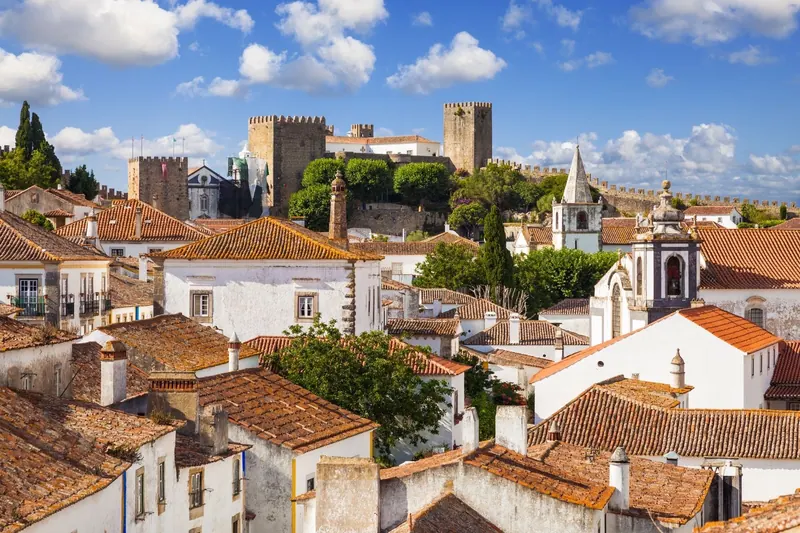
Óbidos, in Portugal, about 80 km north of Lisbon, was handed to a queen as a wedding present in 1282 and stayed in the queens’ hands until 1834, which explains its condition better than any amount of whitewash. What is medieval is the roughly 1.5 km of 13th- and 14th-century wall, the castle keep at the top, the Porta da Vila and the church where a nine-year-old king was betrothed in 1441 (the wedding itself came six years later, at Santarém). The Mercado Medieval de Óbidos fills the castle enclosure for about eleven days in the second half of July; the 2027 edition is expected on 15–25 July. By the end you’ll know what is original, why the wall has no railing, and whether to come for the market or for a quiet Tuesday in April. We’d come twice.
Why is Óbidos called the town of queens?
Because it belonged to them. In 1282 King Dinis gave the town to his bride, Isabel of Aragon, and from then until 1834 Óbidos formed part of the queens’ own estate, the Casa das Rainhas, its income going to the royal consort rather than the crown. Six centuries of being somebody’s personal property, and a queen’s at that, meant the town was kept, repaired and never sold to anyone with ambitions.
The hill had been fortified long before Dinis. The name is the Latin oppidum, a walled town; the Romans and then the Moors held it, and Afonso Henriques, Portugal’s first king, took it from the Moors in 1148. Dinis rebuilt the keep, and it is his wall, patched after the earthquake of 1755, that you walk today.
Isabel was later made a saint, which the town mentions less than you’d expect. The gift is the thing it remembers.
What is medieval in Óbidos, and where do you stand to see it?
The wall, the keep, the gate and Santa Maria. The whitewashed houses along Rua Direita are old in plan and much younger in paint, and the big aqueduct outside the walls is 16th-century and has nothing to do with any of it.
The walls
About 1.5 km of wall runs round the town, 13th- and 14th-century in the main, and nearly all of it can be walked along the top. There is no railing on most of the circuit. The walk is narrow, with a drop on one side and a parapet on the other, and in places it is neither. Hold children by the hand, wear shoes with grip, and do not attempt it in rain or in the last half-hour of a market evening when the lanterns are lit and the walk is full of people holding ginjinha.
Climb up by the steps just inside the Porta da Vila and go clockwise, with the town on your left and the Atlantic plain and the lagoon off to the west on your right. The keep is the far end. Allow forty minutes and stop where you like; every few metres is a different roofscape.
The castle and the pousada
Dinis’s keep at the top of the hill was restored in the 20th century and in 1951 became Portugal’s first pousada in a historic monument, which means the castle is a hotel and the courtyard is for guests. You can see the walls and towers from the wall-walk and from the enclosure below; you can sleep inside if you book well ahead, and you cannot simply wander through. The Cerca do Castelo, the walled enclosure beneath the keep, is empty ground for eleven months of the year and, in July, the most crowded field in the Oeste.
Porta da Vila and its 18th-century tiles
The main gate is a dog-leg, built so that nobody could ride straight through it, and the inside of the bend is lined with blue-and-white azulejos from the 1740s forming an oratory to Nossa Senhora da Piedade, the town’s patron. The gate is Dinis’s century and the chapel inside it is four and a half centuries younger, which is Óbidos in one doorway. Stand in the gate at nine in the morning before the coaches and look up.
Igreja de Santa Maria
In 1441 the church of Santa Maria hosted the wedding of King Afonso V, aged nine, to his cousin Isabel of Coimbra, aged eight. The marriage was politics, the children were cousins, and the church took the whole thing seriously enough to keep the record. Inside are paintings by Josefa de Óbidos, the 17th-century painter who lived in the town and is its second-most-famous woman after the queen who owned it. Go in; it is the coolest building in town at three in the afternoon in July.
The aqueduct is not medieval
The Usseira aqueduct that marches about 3 km across the fields outside the wall was built in the 1570s for Queen Catherine of Austria to feed the town’s fountains. It is handsome enough to be in every photograph, and it is two hundred years too late for this page. Look at it from the wall and move on.
When is the Mercado Medieval de Óbidos, and what is it like?
The second half of July, for about eleven days. In 2026 it ran 16–26 July, the 24th edition since it began in 2002, and the 2027 market is expected on 15–25 July; the organisers had not announced it when we checked. It lives inside the Cerca do Castelo, the walled enclosure under the keep, and spills into the lanes.
Each year follows a storyline from Portuguese history; 2026’s was King Fernando I and his much-resented queen Leonor Teles. Inside the enclosure there are craft and food stalls, a tournament field with mounted knights, a camp, falconry, musicians and fire shows, and costumed parades through the streets daily. In 2026 a day ticket was €12 for anyone aged 12 and over and €8 for children of four to eleven, and visitors in 12th- to 14th-century dress paid €10 and €6, with costume-hire stands at the entrance. Whether the costume discount is repeated is up to the organisers each year, so check the official site before you invest in a wimple.
The town was tiny before the organisers’ 150,000 visitors a year arrived, and on Saturday nights the gates close when the enclosure is full. Go on a weekday evening. In 2026 weekday hours were 17:00 to midnight, the heat drops after seven, and the queue at the gate moves. The rest of the country’s summer is under Portugal and August.
If you want the bigger one, the Viagem Medieval at Santa Maria da Feira runs for twelve days from late July, expected 28 July to 8 August 2027, and our Viagem Medieval guide explains why people do both in one trip: the Óbidos market is the one you can see in an evening, and the Viagem is the one you can’t.
What else happens through the year?
None of it is medieval, and two of them are worth a detour anyway.
Óbidos has been a UNESCO Creative City of Literature since 2015, with bookshops installed in a former church (the Livraria de Santiago) and in the old market hall, and the FOLIO literary festival takes over the town each autumn. The Vila Natal, a Christmas village for children, runs from late November into early January; listings give 27 November 2026 to 3 January 2027, which we haven’t confirmed with the town. And there has been an International Chocolate Festival each spring since 2002, which is the one we’d skip unless you are travelling with someone under twelve, because it is a chocolate fair that happens to have a castle behind it.
The bookshop in the church is open all year and costs nothing to walk into. Start there.
When should you go?
Summer evenings for the market, spring and autumn weekdays for the walls, and never August at noon.
- Second half of July: the market, the crowds and the heat. Arrive after 17:00 on a weekday, walk the wall before dark, then go in.
- August outside the market: the hottest month, the coaches still coming, the wall-walk in full sun with no shade at all. We mean it about the wall.
- April to June and late September to October: the walls to yourself before ten, the plain green or gold, ginjinha at a table instead of standing up. Our pick is a Tuesday in May.
- December: the Vila Natal if you have children, and the only time the town is lit after dark without a ticket.
Whatever the month, come early or stay late. The coaches from Lisbon arrive late morning and leave by five, and Rua Direita in between is a queue with shops.
What to eat and drink
Ginjinha de Óbidos first, and yes. It is a sour-cherry liqueur, sold everywhere along Rua Direita, and the Óbidos version comes in a small chocolate cup that you eat once the glass is empty. It is cheap enough to have two and strong enough that you shouldn’t before the wall; the stalls that push the big bottles at the gate are for the coach trade. Drink it at a table in the evening, with a cherry in it, and the chocolate cup stops being a gimmick and becomes the right container.
At the market, the roast pork is the thing to queue for: a whole animal over coals, sliced into bread, and the smell that reaches you on the wall-walk before you’ve bought a ticket. What is not worth the queue is anything described on a chalkboard as a period drink; it is usually sweet, warm and priced like a souvenir. Outside the market, the cafés at the castle end of Rua Direita are quieter and cheaper than those at the gate, which is the rule in every walled town in Europe. For what is on the stalls and why, our festival food guide goes through it dish by dish.
Getting there and around
Óbidos is about 80 km north of Lisbon, an hour by car on the A8, and express buses from Lisbon’s Campo Grande terminal stop at the town; the bus is the better choice on market days, when the car parks outside the walls fill and the road in is a queue. There is no parking inside the walls and the lanes are pedestrian. Park below the Porta da Vila and walk up.
Sleeping: inside the walls is a handful of guesthouses and the pousada, all small, all booked out for the market months ahead, and all worth it because the town after the coaches leave is the point. Caldas da Rainha, the spa town about 10 km north, has more beds and a railway station, and is the sensible base for anyone who didn’t book in February.
Walk the wall in the morning, drink the ginjinha in the evening, and sleep inside if you can. Óbidos was kept by six centuries of queens who never needed it to earn a living. Give it one night and it will behave the same way for you.