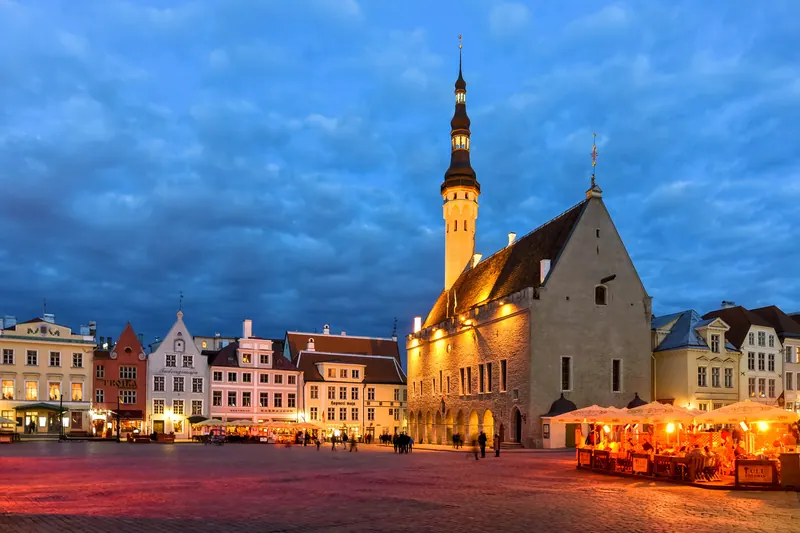
The market stands on the Raekoja plats in front of Tallinn’s Gothic Town Hall, completed in 1404, in the middle of the UNESCO-listed old town. The 2026 season runs from Friday 20 November 2026 to Wednesday 6 January 2027, open daily 10:00–20:00, with hot drinks served until 22:00 and until 23:00 on Fridays and Saturdays, as published on the market’s own site, which bills it as 25 years of Christmas in the heart of Tallinn. There is no admission charge.
It is not a medieval market and does not pretend to be. The wooden stalls sell Estonian handicrafts and Christmas food — black pudding and sauerkraut, gingerbread, hot glögi — from traders in ordinary winter clothes; there are no period crafts, costumes or programmes of the kind the German medieval Christmas markets stage. What is medieval is the setting: the Town Hall, the Raeapteek pharmacy on the square’s corner (trading since 1422), the merchants’ houses around it and the walled town behind. For an actually medieval-themed Christmas market on the Baltic, Visby’s Medeltida Jul across the water is the nearest.
The tree is the story. Visit Estonia and the city say that in 1441 the Brotherhood of Blackheads, the guild of unmarried foreign merchants, set up a tree on this square and danced around it — the world’s first public Christmas tree, a claim Riga contests with a date of 1510. The historian Gustavs Strenga has pointed out that the records do show the Blackheads holding midwinter tree ceremonies in both towns, but that the link to a decorated Christmas tree as we understand it was made by 19th-century historians, not by the 15th- and 16th-century sources. The honest version, then, is a documented late-medieval midwinter custom of the Blackheads on this exact square, with the ‘first Christmas tree’ label attached later; the single spruce in the middle of the market stands for it.
The square is a ten-minute walk from Balti jaam station and about fifteen from the ferry port; temperatures are usually below freezing and the season runs past Epiphany, so a January visit is practical and quieter than the weekends before Christmas. The opening day moves slightly from year to year (the 2025 season opened in the third week of November, and sources disagree on its closing date), so treat the 2027 dates as an estimate until the organisers publish them.