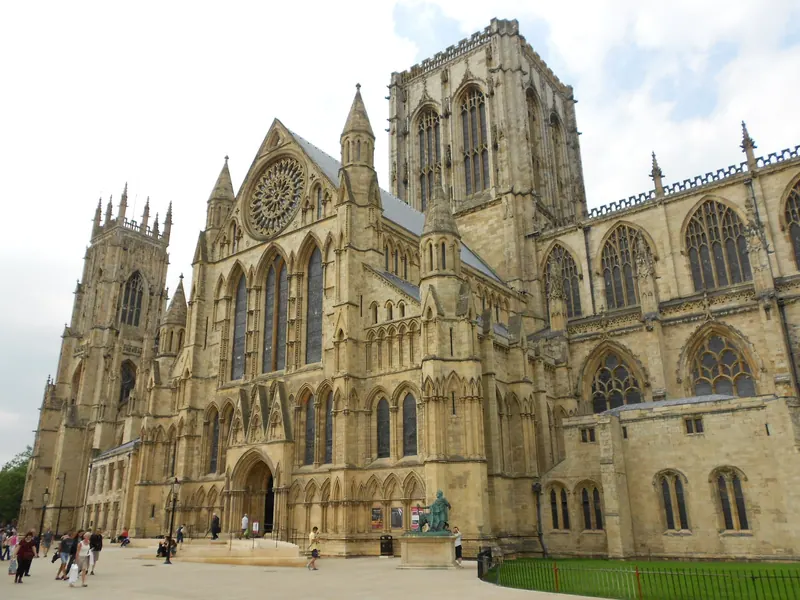
York, in England, has 3.4 km of city wall that a child can walk along without a grown-up saying “careful” more than twice, and that is why it is the family city on this site. The walls are mostly 13th- and 14th-century on Roman and Viking banks, the longest circuit in England; the Minster inside them went up between about 1220 and 1472, and the Shambles is a street of 14th- and 15th-century butchers’ shops that has been in a book since 1086. Jorvik Viking Festival takes over the centre every February half-term, with the 2027 edition expected around 13–21 February. By the end of this you’ll know whether to come in February for the Vikings or in May for the walls, and which order to do the day in so that nobody is crying before lunch.
What is actually medieval in York?
Most of what you can see from the wall. The wall itself and its four bars, the Minster, the Shambles, Clifford’s Tower on its Norman motte, the Merchant Adventurers’ Hall of 1357, Barley Hall and about 20 parish churches are all 13th- to 15th-century, on a street plan that is older still. York did not get rich enough in the 18th century to knock itself down, which is the usual reason an English town still looks like this.
The walls
Start at Bootham Bar, beside the Minster, at nine. The walkway here runs along the top of the wall with the Minster on one side and the gardens of the Dean’s Park on the other, and it is the prettiest stretch, so do it first while the light is low and the children still have opinions about where to go. The four bars are the gates: Bootham; Monk Bar, which still has a working portcullis; Micklegate Bar, the monarch’s ceremonial entrance, where the heads of traitors were put on spikes for the city to look at; and Walmgate Bar, which keeps the only surviving barbican on an English town gate, the walled yard in front of the gate where an attacker was meant to get stuck. Children get the barbican immediately. Adults take a diagram.
The full circuit is about 3.4 km. With a seven-year-old and a stop at each bar, allow two hours, and expect to come down to street level where the wall was lost by the rivers. The steps at the bars are steep and there is no lift, which is the one place a pushchair has a bad morning.
Bootham to Monk Bar is enough if the day is short. It has the Minster view and the portcullis, and the rest of the circuit will still be there in May.
The Minster
York Minster was built between about 1220 and 1472, which means the people who started it never saw the towers, and their grandchildren didn’t either. It is usually called the largest Gothic cathedral in northern Europe. The thing to find is the Great East Window, glazed in 1405–08 by John Thornton: the largest single expanse of medieval stained glass in Britain, roughly the size of a tennis court, and the thing a child will actually look at if you tell them to count the faces. Admission is charged for adults; the rules for children change, so check the Minster’s site before you promise anyone it’s free.
It is also the one reliably dry, warm, large space in the middle of the day, which in a York February is not a small point.
The Shambles
The Shambles appears in Domesday Book in 1086, and the overhanging timber fronts are 14th- and 15th-century, built for butchers: “shamel” meant the bench the meat was laid on, and the story goes that the upper floors lean in to keep the sun off it. It is, genuinely, a medieval street. Unfortunately it is also the most photographed one in the north of England, and from about eleven until the shops close it is a one-way shuffle in which you will see hanging signs and the back of a phone.
Be at the top of it at nine, before the shops open. The street is empty, the timbers are doing what they were built to do, and you can stand in the middle and look up without being walked into. By the time the first queue forms you are on the wall.
Clifford’s Tower
The stone keep on the grassy mound is Clifford’s Tower, built in 1245–70 on the motte William the Conqueror threw up in 1068–69, one of two castles he put on York’s rivers. The name comes from Roger de Clifford, hanged there in 1322. Children like it because it is a castle on a hill with a spiral staircase; it is also the site of the worst thing in York’s history, and the honest way to do it with a child is two plain sentences. On 16 March 1190 about 150 members of York’s Jewish community died in the wooden tower that stood here, trapped by a mob. The stone tower was built afterwards, and there is a plaque at the foot of the mound that says so.
Climb it for the view, read the plaque on the way down, and answer the questions you get asked.
Merchant Adventurers’ Hall and Barley Hall
The Merchant Adventurers’ Hall of 1357–61 is one of the best-preserved medieval guildhalls in Europe because the guild that built it still owns it, and a great timber hall that has never been anything else is rarer than a cathedral. Barley Hall is the other sort of survival: a 14th- and 15th-century townhouse found behind later buildings and restored by the York Archaeological Trust in the 1990s, so what you walk through is a reconstruction over real bones. Say so to the child, and they will spend the visit trying to spot the joins, which is a better use of twenty minutes than most museums manage.
Barley Hall is indoors, small and in the middle of the route, which makes it the rain plan.
Where do the Vikings come in?
Underneath. The Viking Great Army took the Anglo-Saxon town on 1 November 866 and made it Jorvik, capital of a Scandinavian kingdom until Eric Bloodaxe was driven out in 954, and almost nothing of that city stands above ground. What you see of it came out of the Coppergate excavations of 1976–81: waterlogged houses, workshops and more than 40,000 objects, with the Jorvik Viking Centre opened on top of the dig in April 1984. It is a ride through a reconstructed street with smells, and every child I have taken has asked to go round again. The exhibit they remember is the Lloyds Bank coprolite, a 20 cm fossilised 9th-century stool found under the bank on Pavement in 1972, which tells you more about what a Viking ate than any saga.
The festival grew out of the museum. Jorvik Viking Festival started in February 1985 to bring people to York in the quiet winter weeks, is run by York Archaeology, the charity that dug Coppergate, and is timed to the February school half-term. The 2026 edition ran 16–22 February; the organisers have confirmed half-term 2027 but not the dates, so expect around 13–21 February 2027 and check before you book a train. Around 40,000 people come across the week, and the organisers call it the largest Viking festival in Europe.
What is free: the living-history encampment and the traders’ market on Parliament Street, the daily walks and talks, the family craft sessions, the Best Beard contest, and the march of hundreds of warriors to Coppergate on the final Saturday, 450 of them in 2025. Ticketed: the finale battle between the Wolves and the Boars at the Eye of York below Clifford’s Tower, the Evening Spectacular with pyrotechnics, the feast and the workshops. Finale tickets have been around £20 a head in recent years and most ticketed events sold out in 2025. They no longer burn a boat; the battle and the fireworks are the ending now.
The autumn that ended the Viking age in England started 11 km east of here: King Harold beat Harald Hardrada at Stamford Bridge on 25 September 1066, marched south, and lost everything at Hastings three weeks later. The Battle of Hastings Reenactment replays that ending each October; the 2026 edition is 10–11 October.
Buy finale tickets the day they go on sale, and take the free march instead if you miss them: the warriors walk past at arm’s length and nobody needed a ticket.
Can you do medieval York with children in a day?
Yes, if you start at nine and accept that the Minster is the lunch stop rather than the climax. Everything is inside the walls and the walk between any two of these is under twenty minutes.
- 09:00 Top of the Shambles, while it is empty. Ten minutes, then out the bottom end.
- 09:20 Up onto the wall at Monk Bar, portcullis first, then walk the stretch to Bootham Bar with the Minster on your left. Forty minutes with stops.
- 10:15 The Minster. Find the east window, count faces, use the loos. An hour is plenty.
- 11:30 Barley Hall, because it is small and warm and on the way.
- 12:15 Lunch somewhere with a table, not a bench. Shambles Market has food stalls and public loos nearby; check they are open in winter.
- 13:30 Jorvik. Book a timed slot online; the queue without one can eat an hour.
- 15:00 Clifford’s Tower. The climb, the view, the plaque.
- 16:00 Stop. Whatever is left is for next time.
The one tip that saves the afternoon: Jorvik after lunch, not before. It is the thing a child most wants, so it is the bribe, and a bribe spent at ten in the morning buys you nothing at three.
Rain cover is the Minster, Barley Hall and Jorvik, in that order of size. Shade barely matters; this is York.
When should you go?
February for the Vikings, and you will be cold. The encampment is outdoors on Parliament Street, the finale is on a grass arena below Clifford’s Tower in the dark, and the wind that comes up the Ouse in February has nothing between it and Norway. Wear the coat you would wear to a Saturday football match, and put the children in one layer more. The what to wear piece has the list.
April, May and September for the walls: the walkway is narrow, the steps are wet in winter, and the circuit is pleasant when the trees in the Dean’s Park are out and miserable in sleet. Summer holidays are the Shambles at its worst, a shuffle from ten until six, and York’s hotel prices at their highest.
If you have one trip, make it the final Saturday of the festival and the Sunday after: the march and the battle on the Saturday, the walls on a quiet Sunday morning when the warriors have gone home.
What to eat
A Yorkshire pudding the size of a plate, filled with something, from any pub with a carvery; it is not medieval but it is what the county considers lunch and it will hold a child until four. The fat rascal, a scone-like bun with currants and a cherry face, is the York tea-room thing and travels well in a coat pocket. The festival sells mead tastings, and the honest verdict is that mead at a Viking market tastes like a cough sweet dissolved in white wine; buy one cup to say you have, and give the children hot chocolate.
For the argument about what a Viking actually ate, the coprolite has the answer, and the festival food piece has the polite version.
Getting there and around
York is about two hours from London King’s Cross by train and under an hour from Leeds, and the station is a ten-minute walk from the wall at Micklegate Bar, so you can do the whole thing without a car. If you drive, use one of the park-and-ride sites on the ring road; parking inside the walls is scarce at the best of times and during half-term it is theoretical. The England list has the country’s other dates if York is a stop on a longer trip, and the first-timer’s guide covers what to expect at a festival if this is your first one.
Sleep inside the walls if you want to walk out of the door onto the Shambles at nine, and expect to pay for it in February half-term. Bootham, just outside Bootham Bar, is the usual compromise: guesthouses ten minutes from the Minster. The streets around the station, across the river, are cheaper and still under fifteen minutes from everything. The York page has the city for the rest of the year.
Walk the wall before the shops open, save Jorvik for after lunch, and let the Minster be the warm hour in the middle. If everyone is still speaking at four o’clock, you did it right; if they are asking to go back on the wall, you did it better.