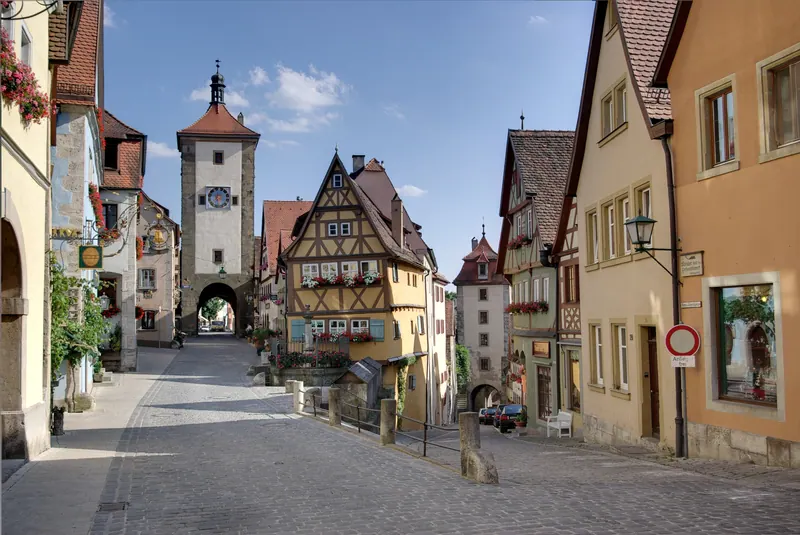
Rothenburg ob der Tauber, in Franconia, Germany, is about two-thirds original and one-third 1950s, and the join is easier to find than the town would like. A free imperial city from 1274, it peaked around 1400, lost a war in 1631 and spent the next two centuries too poor to replace anything, which is why the walls, the gate towers and St Jakob’s are still the ones the late-medieval merchants paid for. Its big festival, Der Meistertrunk, re-stages a drink from 1631 every Whitsun; the 2027 edition is expected on 14–17 May. By the end you’ll know which stones are old, which were bought by donors after March 1945, and whether to come in May, September or December. We’d say September, and stay the night.
Is Rothenburg ob der Tauber real?
Mostly. The wall circuit, the gate towers, St Jakob’s, the town hall’s Gothic half and the whole street plan are late medieval, kept by poverty rather than policy. The eastern third of the old town was bombed on 31 March 1945 and rebuilt over the following decade, faithfully in outline and more loosely in detail. The shops selling Christmas in July are neither.
What is medieval
Start with the wall, because it is the reason the rest survived and the one thing you can walk on. The circuit runs almost unbroken round the town with a covered wall-walk along most of it, and the gate towers still stand: the Rödertor, Galgentor, Klingentor, Spitaltor, Kobolzeller Tor and the Burgtor. Guidebooks put the walkable stretch at about 2.5 km; we haven’t paced it. Go up at the Rödertor and walk clockwise towards the Spitaltor at the southern end, and you pass the old hospital quarter, which was the town’s answer to old age before anyone had thought of pensions.
St Jakob’s is the other reason to come. Tilman Riemenschneider carved the Altar of the Holy Blood between 1500 and 1505 to frame a rock-crystal capsule said to hold drops of Christ’s blood, and the pilgrims who came to see it paid for a good deal of the town. Stand in the west gallery, where the altar is, and look at the apostles’ hands. Riemenschneider left the limewood unpainted, and five centuries have coloured it better than any workshop could.
The town hall is 14th-century Gothic at the back and 16th-century Renaissance at the front, and the tower climb is narrow, steep and worth it for the roofs, which you cannot see properly from anywhere else. Mayor Heinrich Toppler, who ran the town at its peak and died in its own prison in 1408 after falling out with King Rupert, built himself a retreat in the Tauber valley below: the Topplerschlösschen of 1388, a stone tower house on stilts, one room wide, a folly four centuries before anyone had the word. Walk down to it through the Burggarten, where the Blasius chapel is all that remains of the 1142 castle after the earthquake of 1356.
Give the Medieval Crime Museum (Mittelalterliches Kriminalmuseum) two hours. It is Germany’s principal museum of legal history, and the shame masks and court records tell you more about how a free city actually governed itself than any wall does.
What is the 1945 rebuild
On 31 March 1945 bombing destroyed about a third of the town, nearly all of it on the eastern side; an American assistant secretary of war, John J. McCloy, is credited with stopping the artillery that would have finished the rest. The rebuild kept the medieval outline and let the detail go, so the eastern streets have the right roofs and slightly wrong windows. The wall-walk there was rebuilt with donations from around the world, and the donors’ names are cut into the stones.
Read a few. The names are the honest part of the postcard: this is a town that was bought back.
What is marketing
Käthe Wohlfahrt’s year-round Christmas shop is a business that happens to be in an old street, and the Schneeballen shops claim a 300-year pedigree for their pastry, a figure we haven’t found a source for; treat it as a shop sign, not a date. The Night Watchman tour is real and runs most evenings in season, and it earns its reputation because the man does the history straight and the jokes in passing, which is the right way round. Check the start time on the market square rather than trusting a leaflet.
Why did the town stop in the 17th century?
Because it lost, and then could not afford to modernise. On 30 October 1631 General Tilly’s Catholic League army took the Protestant town during the Thirty Years’ War. Plague and occupation followed, the trade never came back, and for two hundred years nobody had the money to put a Baroque front on anything. Around 1400 some 5,500 people lived inside the walls and 14,000 more in the town’s territory, which made it one of the larger cities of the Holy Roman Empire; by the time it passed to Bavaria in 1802–03 it was a backwater with a very good wall.
The drink came later. The story that ex-mayor Nusch saved the town by draining a 3¼-litre tankard of wine in one draught first appears in chronicles more than a century after 1631 and is almost certainly invention. The play that made it famous, Der Meistertrunk, was written in 1881, which is also roughly when the Romantic painters found the Plönlein corner and put it on every print in Europe. The legend and the postcard are the same age.
On the market square the mechanical Tilly and Nusch on the Ratstrinkstube clock replay the wager on the hour through the day. Watch it once, at an hour when the coaches have gone.
Which festivals happen here, and which are actually medieval?
None of them, strictly, and the town is honest about it if you read the programme.
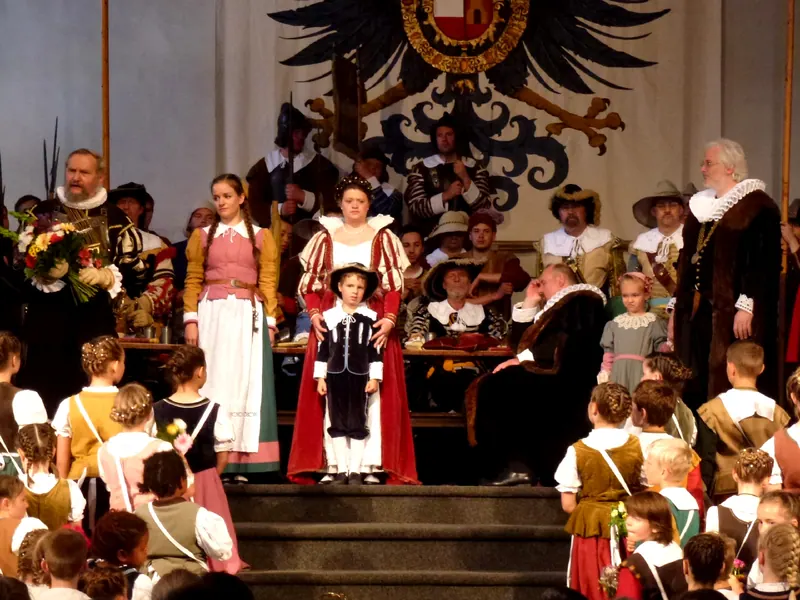
Der Meistertrunk is a 17th-century story told in 19th-century form, and it fills the town from the Friday to the Monday of Whitsun: in 2026 it ran 22–25 May, and the 2027 festival is expected on 14–17 May, Pentecost Sunday being 16 May. The play is performed by townspeople in the Kaisersaal of the town hall and sells out well before Whitsun. A festival badge (Festzeichen) is needed to enter the old town on festival days; play tickets are separate, on the official site.
Outside the theatre, a Sunday procession of more than 800 costumed participants with horses and wagons moves through the streets, a 17th-century military camp sits outside the walls, and the Schäfertanz, the shepherds’ dance the town traces to the late Middle Ages, is danced on the market square. The dance is the oldest thing on the bill. Stand at the square’s edge for it, near the Ratstrinkstube, and you have the one medieval hour of the weekend.
The Reichsstadt-Festtage (Imperial City Festival Days) in early September are the same cast with cooler weather and fewer coaches. In 2026 they ran 4–6 September, with the play on the Saturday at 15:30 and 18:00 and a free “long night of the Meistertrunk” at the town hall on the Friday at 18:00; 2027 dates had not been published when we checked. The play is given once more on 3 October. September is on our calendar; the rest of the country’s festivals are under Germany.
The Reiterlesmarkt, the town’s Christmas market, runs on the market square and the church square from late November until just before Christmas; listings give 20 November to 23 December 2026, which we haven’t confirmed with the town. The square is 14th-century and the market does not claim to be. For a market that does make the claim and earns it, Esslingen Medieval Christmas Market, 24 November to 22 December 2026, is a couple of hours south by train, and our Christmas markets guide puts the two side by side. Esslingen has the smiths; Rothenburg ob der Tauber has the square.
When should you go?
September, and on a weekday if you can.
- Whitsun: the festival, the procession, the camp. Beds inside the walls go months ahead, and the town is as full as it ever gets.
- June to August: day-coach season. Between about 10:00 and 16:00 the main streets belong to tour groups; before and after they belong to you. No season avoids this entirely.
- Early September: the Reichsstadt-Festtage, fewer coaches, the Tauber valley still green. Our pick. The September and October guide has the rest of that month.
- Late November and December: the Reiterlesmarkt. Come early afternoon on a weekday; by dark on a Saturday the square does not move.
- January and February: cold, shut in places, and the wall entirely yours.
Whatever the month, sleep inside the walls. The town at 08:00, with the bakeries open and the gates empty, is the one the Romantics painted.
What to eat
Schneeballen once. They are strips of shortcrust pastry wound into a ball, deep-fried and rolled in sugar, and one is a pleasant thing to carry along the wall; a second is a mistake you will make for the photograph. Franconian wine is the better local argument: the Tauber valley grows it, it comes in the squat Bocksbeutel bottle, and the dry Silvaner is what the locals are drinking while you eat the pastry. Bratwurst is Franconia’s other export and the market-square stalls do it properly, in a roll with mustard and nothing else. We’d skip anything on a menu with a picture of Nusch on it.
Getting there and around
By train, change at Steinach for the branch line; the station is a ten-minute walk from the walls. From Nuremberg or Würzburg allow roughly an hour and a half with the change, and from Munich or Frankfurt nearer three; check the connection, because the branch line does not wait. The Romantic Road coach stops here too, which is how most of the midday crowd arrives. Driving, park outside the walls and walk in; the gates were not built for anything wider than a cart and have not changed their minds.
Inside, everything is on foot. The old town is fifteen minutes corner to corner, and the wall-walk takes an hour if you stop at the towers, which you will. Sleep inside the walls if there is a bed: the choice is guesthouses in old merchants’ houses or a few larger places near the market square, and for Whitsun they are taken by the previous winter. Outside the walls is cheaper and a ten-minute walk, and fine for anyone who does not care about the early morning. You should care about the early morning.
Come in September, walk the wall at eight before the first coach, and read the donors’ names on the eastern stretch. A town that was knocked down, paid for by strangers and put back is a better story than the tankard, and unlike the tankard it is true.