Britain’s festival year starts in the dark, on a Shetland slipway in January, with a longship on fire, and ends on a wet slope in Sussex in October where a king loses. In between are the ones the family car will actually reach. Eight festivals in England and Scotland have 2027 dates we have checked: five confirmed by their organisers, three expected on their usual weekends. By the end you’ll know which are free, which are Viking rather than period and say so, which is a show with a cast, which is fantasy with a castle attached, and which you can do by train without anyone crying before lunch.
Checked 13 September 2026; “expected” means the organiser has not yet announced 2027
January: two galleys on fire in Shetland
Shetland burns two longships in January, and neither is older than Queen Victoria. The Scalloway Fire Festival opens the islands’ fire-festival season on the second Friday of January, which in 2027 is Friday 8 January, confirmed: a Guizer Jarl and a squad of men, women and children in Norse dress lead a torchlit procession through the village to the boating club slipway at Port Arthur, where the galley is lit and cast adrift on the sea. Its procession is free; the hall performances afterwards are ticketed and sell out well in advance.
Up Helly Aa in Lerwick, Tuesday 26 January 2027, confirmed, is the one everyone has seen a photograph of, and it is an 1880s invention that has never claimed otherwise: first torches in 1881, first galley in 1889. The Jarl Squad marches from 08:15, about a thousand guizers carry torches down to the burning site from 19:30, and the halls afterwards are private, which is the catch nobody mentions before you book the 12-hour ferry from Aberdeen. Beds go many months ahead. Skip both if you wanted the Middle Ages rather than Victorian Norse, and go anyway if you wanted a ship on fire.
February: York at half-term
The JORVIK Viking Festival (York Viking Festival), 8–14 February 2027, confirmed, is a museum’s festival on a real 10th-century site, timed to York’s half-term. Its living-history encampment and traders’ market on Parliament Street are free all week, the warriors’ march on the final Saturday is free to watch, and the finale battle at the Eye of York is ticketed, around £20 a head in recent years, and sold out in 2025. Half-term weeks differ by council; York’s is the festival’s.
Our York in February piece has where to warm a child up between Vikings, and the Viking festivals in Europe 2027 round-up has the rest of the Norse year. York is about two hours from London by train, and the queue for the Shambles starts at eleven.
July: the free one, on the real field
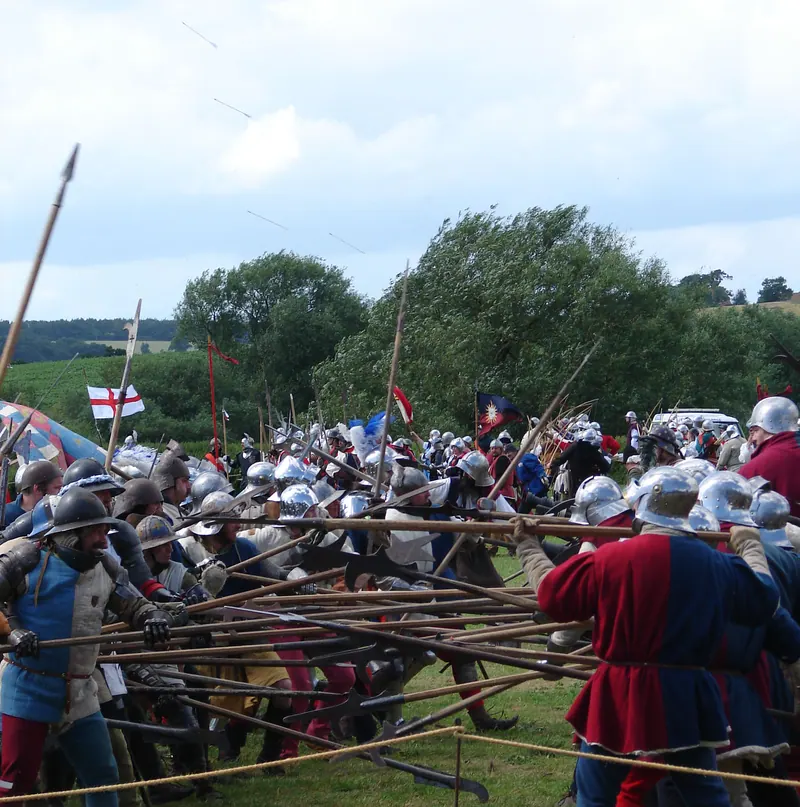
Tewkesbury Medieval Festival (the Battle of Tewkesbury Re-enactment) is free, and it is the largest battle reenactment in England by the organisers’ count of around 2,000 reenactors. The 2027 dates, 10–11 July, are confirmed: the battle of 4 May 1471 is refought at 16:00 on the Saturday and 15:00 on the Sunday on fields beside the Bloody Meadow, which is the original ground, with a camp you can walk through and a market you can eat your way along. Parking is £10 a car and cash only, and the nearest station is Ashchurch for Tewkesbury, about 3 km away, so a bus or a taxi finishes the trip.
Wren’s tests: the food is a sausage and it is fine; the loos are festival loos, so go before the battle; and the crying happens at the cannon, so warn anyone under six that there will be bangs. The honest guide from the field has the campsite and where to stand.
And a fantasy one the same month
Fantasy Forest Festival at Sudeley Castle in Winchcombe, 16–18 July 2027, confirmed, is not a period festival and does not pretend to be: folk and fantasy bands, a fantasy market, LARP, workshops and a campsite in the grounds of the 15th-century castle where Katherine Parr is buried. It sold out at 21,000 in 2026; a weekend camping ticket was £96.95 that year, with day tickets reported from £18.95 the year before, and the 2027 prices were not yet published when we checked. Elves outnumber knights. The fantasy fairs in Europe piece has the rest of that circuit.
August: the show
The Loxwood Joust (Kingdom of Loxwood), on Loxwood Meadow in West Sussex, is a produced show rather than a reenactment: a cast in role all day, a daily joust, an executioner, a knight school for children, and bars it calls taverns. It runs three weekends across late July and August; the 2027 dates were not announced when we checked, and 31 July to 15 August is the expected window. In 2026 day tickets were £27 for adults and £8 for children aged four to fourteen, both early Saturdays sold out in advance, and parking had to be booked with the ticket.
There is no station; a taxi from Billingshurst or Horsham finishes the trip. The pushchair test: the meadow is flat and the queue for the joust is not, so arrive before the first show. What a produced festival is, against the real thing, is in medieval festival or renaissance faire.
August bank holiday: the one that moved
England’s Medieval Festival ran in the grounds of Herstmonceux Castle from 1993 to 2022, which is why searchers still type “Herstmonceux Medieval Festival”, and since 2023 it has been at The King’s Grove, Pippingford Park, near Nutley in the Ashdown Forest. It is expected on the August bank holiday, 28–30 August 2027, and it has the fullest programme on this list: jousting, living-history camps, archery and falconry, a medieval and fantasy market, a Kid’s Kingdom, and a weekend ticket that includes four nights’ camping.
Prices are on the official site, because they are not in our data. The site is off the A22 with almost no public transport, so it is a car or the festival shuttle. Bring the tent and the wool; the what to wear piece explains why polyester and a bank-holiday camp do not mix.
October: the king who loses
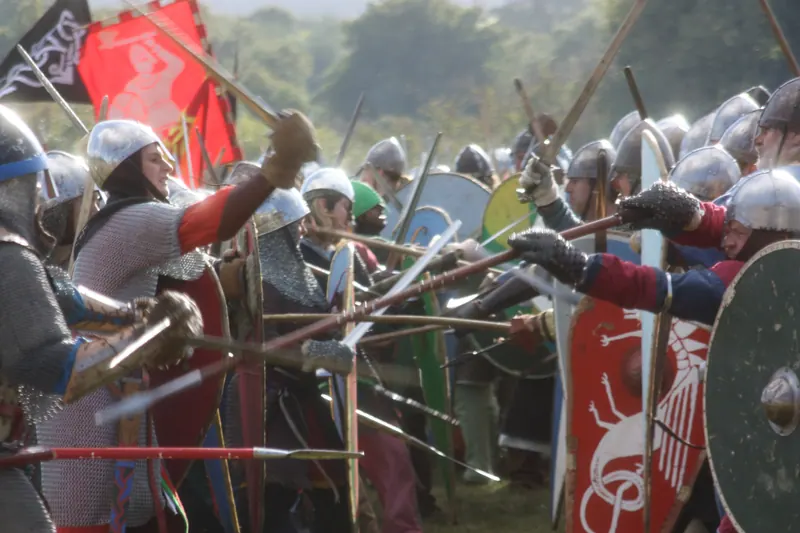
The Battle of Hastings Re-enactment is in Battle, not Hastings, on the slope below the abbey where Harold’s shield wall broke on 14 October 1066; the 2026 edition is 10–11 October and the 2027 one is expected on 16–17 October, the weekend nearest the anniversary. English Heritage runs it and charges for it: £24 an adult booked in advance in 2026, with the abbey ruins and the battlefield walk in the ticket. Battle station is on the Charing Cross to Hastings line and the gate is ten minutes’ walk, which makes this the easiest festival on the list without a car and the muddiest with one. The guide to the field has where to stand and what the ticket buys.
Which other UK events are worth checking?
Three we know are real and have not yet dated for 2027, each hedged to its usual month with a link to the organiser, and one that has gone.
Herstmonceux Castle, the festival’s old home, now runs its own Medieval Heritage Weekend, usually over the early-May bank holiday, with combat, reenactors and crafts in the castle grounds; the 2027 dates were not published when we checked. Arundel Castle in West Sussex holds an international jousting tournament in late July that is scored rather than staged, riders in national teams and a judge with a flag; 2026 ran 21–26 July. Largs Viking Festival on the Clyde coast marks the battle of 1263, when a Norwegian king’s fleet last fought on the Scottish mainland, and usually runs from the end of August into early September.
The Ludlow Medieval Christmas Fayre, which people still search for, ended in 2022 after 23 years, and its old address should be left alone. Wales and Northern Ireland have nothing on our list yet, which is a gap in our research rather than a verdict on either. Everything we do have is on the United Kingdom page, and the months are under February, July, August and October.
How to choose
A family with under-tens: York at half-term, where the free bit is in the middle of town and the warm rooms are five minutes apart, or Tewkesbury for a free day with a battle at four. Skip Up Helly Aa; it is a Tuesday night in January and the halls are private.
A Londoner without a car: Battle in October by train from Charing Cross, York in February by train from King’s Cross, Tewkesbury with one taxi at the end. Skip Loxwood and Pippingford Park unless someone is driving.
The reenactor: Tewkesbury for the camp and the size of the field, Battle for the ground. Skip Loxwood; the people in armour there are working.
The costume-and-show reader: Loxwood, then Pippingford Park’s fantasy market, then Sudeley. Skip Battle, where nobody dresses up but the armies.
The once-in-a-lifetime: Lerwick, or Scalloway if you cannot get a Lerwick bed. Skip both if a 12-hour ferry in January sounds like the problem rather than the point. The full split, reenactment against jousting, is in the category pages.
A British July on a river meadow is grass to the ankle, a sausage in one hand, a child on your shoulders asking when the cannon goes, and rain at some point that everyone pretends not to notice. It is the best of the year. Bring the boots anyway.