Medieval Booker

Bavaria (Franconia) ◆ Germany

Medieval Rothenburg ob der Tauber

Walled Franconian town above the Tauber valley, a free imperial city from 1274 and one of the most complete medieval townscapes in Germany. Its Whitsun festival re-enacts the legendary 'Master Draught' of 1631.

1 festival 8 places 1 article next event 4 September 2026

Why is Rothenburg ob der Tauber a medieval destination?

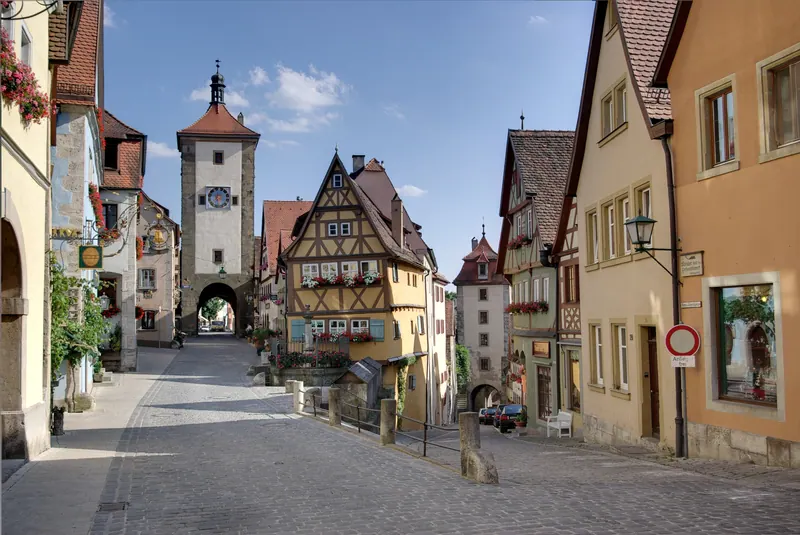
Rothenburg ob der Tauber sits on a spur above the Tauber river in Franconia, and for visitors it is the textbook image of a German medieval town: a near-complete ring of walls with covered wall-walks, gate towers, steep roofs and the crooked Plönlein corner that appears on most postcards. Rothenburg was granted the status of a free imperial city in 1274 under King Rudolf of Habsburg, which meant it answered to the emperor rather than a local lord, and it ran its own affairs and a sizeable rural territory through the later Middle Ages.

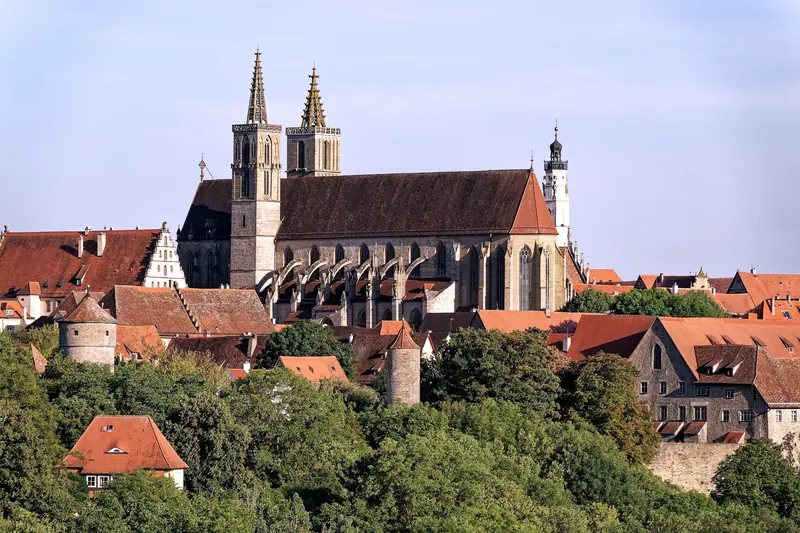
The town’s golden age was the fourteenth and fifteenth centuries. Under mayor Heinrich Toppler (died 1408) it was one of the larger cities in the Holy Roman Empire, and the buildings that survive from that era include the Gothic town hall, St. Jakob’s church with Tilman Riemenschneider’s Altar of the Holy Blood (carved 1500–1505), and the hospital quarter at the southern end of the walls. Economic decline after the Thirty Years’ War meant there was no money to rebuild in later styles, which is the main reason so much of the old fabric survived.

The event that still defines Rothenburg’s calendar is the siege of October 1631, when the Catholic League army under General Tilly took the Protestant town. According to a legend first staged as a play in 1881, the town was spared when former mayor Nusch accepted Tilly’s wager to drink a huge tankard of wine in one draught — the ‘Meistertrunk’. The story is probably later embroidery, but the play, the Whitsun procession and the mechanical figures on the Ratstrinkstube clock keep it alive every year.

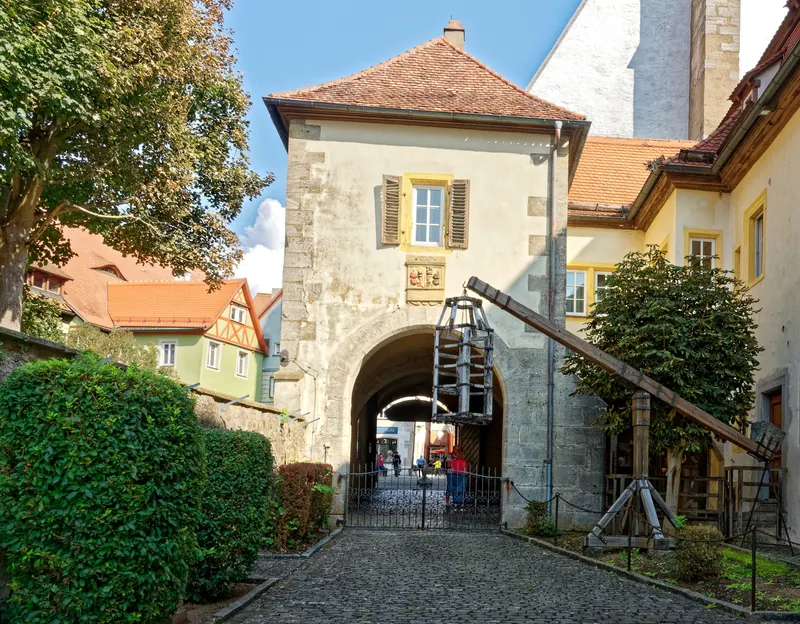
What survives today is extensive: the wall circuit can be walked for most of its length, the old town is compact enough to cross on foot in fifteen minutes, and the Medieval Crime Museum and the Imperial City Museum cover justice and daily life in the former free city. Part of the eastern old town was destroyed by bombing in March 1945 and rebuilt afterwards with donations from around the world, which is why many wall stones carry donors’ names.
Medieval festivals in Rothenburg ob der Tauber

Featured
Living History & Museums Historic City Celebrations

Der Meistertrunk (Rothenburg Whitsun Festival)

Rothenburg ob der Tauber, Germany

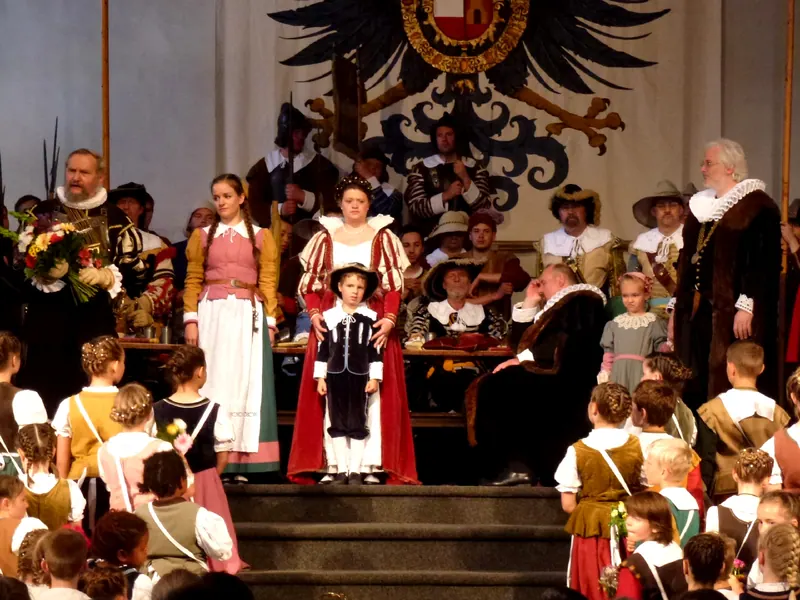
Rothenburg ob der Tauber's Whitsun festival re-enacts the legend of 1631, when former mayor Nusch supposedly saved the town from General Tilly's army by emptying a tankard holding more than three litres of wine in one draught. Citizens have performed the play 'Der Meistertrunk' since 1881, framed by a four-day festival with a costumed procession, military camp, shepherds' dance and crafts market.

2026
Family

Months with a festival are linked. Expected dates say so. September

What else to see in medieval Rothenburg ob der Tauber

Short list on purpose. Everything here is somewhere we'd actually send you, checked and still standing.

Landmarks & bridges

Landmark Start here

The Town Wall and the Covered Wall-Walk

Circuit largely 13th–14th century; Spitalbastei finished 1537; the wall-walk rebuilt 1948–53 after the bombing of 31 March 1945

About four kilometres of wall, six gates and more than forty towers around an old town you can cross on foot in fifteen minutes — and roughly 2.5 km of it walkable on a roofed timber gallery five metres up, free and at any hour. Walk the eastern run from the Spitalbastei to the Klingentor, and read the names carved into the stones: they are the donors who paid to rebuild it after 1945.

Free or cheap Best in the evening Works in the rain
Walking directions

Views & walks

View

The Rathaus Tower

Gothic range and tower, 13th century; Renaissance front 1572–78 after fire; Baroque arcade 1681; tower 60 m

220 steps up a 60-metre tower for the one view that shows you the whole plan of Rothenburg at once — the wall circuit, the gate towers, the Tauber valley, and the roofline running south to the Plönlein. €4.00, opens at 09:30 in season, and closes to weekends only for most of the winter.

Free or cheap
Walking directions
View

The Burggarten and the castle that is not there

Site of the Hohenstaufen imperial castle begun in 1142, destroyed in the 14th century and quarried for the town wall; the surviving Blasiuskapelle is now a memorial; the garden is a later English landscape park

The best view in Rothenburg stands on the site of the Hohenstaufen imperial castle begun in 1142, and the reason you cannot see the castle is that it is in the town wall. Free, open round the clock, ten minutes from the market square — go at sunset, because the garden faces west down the Tauber.

Free or cheap Quiet corner Best in the evening
Walking directions
View

The Röderturm and the 1945 exhibition

14th-century gate tower on the wall; burnt out in 1945 and rebuilt with the Alt-Rothenburg association

The only tower on the town wall you are allowed to climb: 103 steps, €3.00, and on the way up the Alt-Rothenburg society's exhibition on the night of 31 March 1945, when this tower was burned out to its walls. The window is 11:00–14:00 and that is the whole day.

Free or cheap
Walking directions

Museums & collections

Museum

Medieval Crime and Justice Museum

Collections span a thousand years of European law; the building is the Order of St John's commandery, 1393–1410

Not a torture-shock attraction: the town's own tourism office calls it Europe's largest museum of legal history, and it is arranged as legal procedure — courts, evidence, church and imperial law, the executioner as a licensed trade. More than 2,000 objects over four floors of the Order of St John's commandery of 1393–1410, with the instruments kept in the cellar where they belong.

Works in the rain
Walking directions
Museum

RothenburgMuseum, in the Dominican convent

Dominican convent 1258–1554; convent kitchen 13th century (dendro-dated 1262); museum in the buildings since 1936

Eight centuries of the town's own things inside a Dominican convent founded in 1258 — with a 13th-century convent kitchen that is called the oldest surviving in Germany, and in Room 10 a Hebrew memorial stone to the victims of the 1298 pogrom that spent the Third Reich as the pedestal for a Nazi eagle. €6.00, and the one major sight here with no coach problem.

Works in the rain Quiet corner
Walking directions

Churches & ossuaries

Church

St Jakob's Church and the Holy Blood Altar

Built 1311–1484, consecrated 1485; Riemenschneider's Holy Blood Altar 1500–05

The parish church built between 1311 and 1484, whose west choir is carried on an arch over a public street, and whose gallery holds Tilman Riemenschneider's Altar of the Holy Blood, carved 1500–05. Go up to the gallery and look at the middle of the Last Supper: the figure at the centre is not Christ but Judas, and he lifts out.

Works in the rain Quiet corner
Walking directions

Tours & workshops

Experience

The Night Watchman's Tour

Re-enacts a real municipal office, obsolete by the 19th century; run in its present form since April 1991

Sixty minutes behind a man with a halberd, a horn and a lantern, through streets the coaches left three hours earlier. Be at the town hall by 19:50 for the English round at 20:00 and bring cash — and know that Hans Georg Baumgartner, who has walked this round since April 1991, is on the official schedule only until the end of October 2026.

Best in the evening Good with children Free or cheap
Walking directions
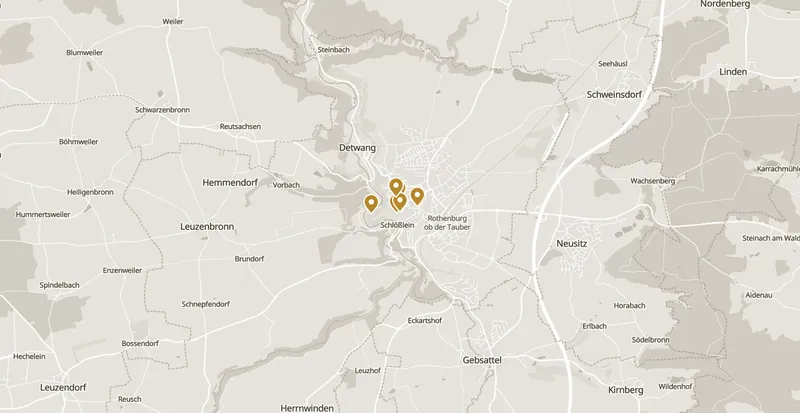
Map of the places worth your time in Rothenburg ob der Tauber
Everything above, on one map. Tap a link to open it in Google Maps on your phone. © MapTiler © OpenStreetMap contributors

Stories from medieval Rothenburg ob der Tauber

All articles

More medieval festivals in Germany

All festivals in Germany
Featured
Medieval Markets & Fairs Medieval Christmas

Esslingen Medieval Market & Christmas Market

Esslingen am Neckar, Germany

Esslingen am Neckar's combined medieval market and Christmas market fills the half-timbered old town from the last week of November until just before Christmas. Around 200 stalls and roughly 500 programme slots of jugglers, fire artists, craft demonstrations and music make it the largest event of its kind in southern Germany.

2026
Free Family
Medieval Christmas

Nürnberger Christkindlesmarkt

Nuremberg, Germany

Nuremberg's Christkindlesmarkt fills the Hauptmarkt and the Rathausplatz from the Friday before the first Advent to Christmas Eve with 168 red-and-white wooden stalls and about 180 traders, opened each year by the Christkind's prologue from the gallery of the Frauenkirche and drawing around two million people; the 2026 market runs 27 November to 24 December. It is not a medieval market: the square is 14th-century and the Frauenkirche was Charles IV's imperial court chapel, but the market itself is first documented in 1678 — a date the market's own historians revised from 1628 — and t...

2026
Family
Featured
Jousting & Tournaments Living History & Museums +1

Landshuter Hochzeit 1475

Landshut, Germany

Every four years about 2,500 costumed citizens of Landshut restage the 1475 wedding of Duke Georg the Rich and Princess Hedwig of Poland over three and a half weeks of processions, tournaments, camp life and plays. First performed in 1903, it is Europe's largest historical costume festival; the next edition runs 25 June–18 July 2027.

2027
Family

Other medieval cities in Germany: Esslingen am Neckar · Kaltenberg · Landshut · Nuremberg