The German for what this site does is longer than the English and more exact, which is why the English pages about it are so bad. A Mittelaltermarkt is a market; a Mittelalterfest is a festival; a Ritterturnier is a knights’ tournament; and Germany runs more of all three than any other country in Europe, by our count. The Kaltenberger Ritterturnier (Kaltenberger Ritterspiele), at Schloss Kaltenberg near Munich, is confirmed for 9–25 July 2027, and the Landshuter Hochzeit 1475, the Landshut Wedding, which happens once every four years, is confirmed for 25 June–18 July 2027, which makes 2027 the year to come. By the end you’ll know the words, the dates we have checked, which of the big ones we have not, and what to book on 9 January.
What do Mittelaltermarkt, Mittelalterfest, Ritterturnier and Spectaculum mean?
Six words, each once, because the organisers’ pages are written in them and the search results are too.
Mittelaltermarkt (plural Mittelaltermärkte): a medieval market. Wooden stalls, craftspeople and traders in period dress, taverns, music and shows, usually over a weekend, in a castle ground, a park or a square. The commonest form, and usually free or a few euros.
Mittelalterfest: a medieval festival, the bigger version, often taking over a whole town with a procession, camps and a market in the streets over several days.
Ritterturnier: a knights’ tournament, which in practice means a jousting show in an arena with a market around it. Ritterspiele, knights’ games, is the same thing with a slightly older ring; Kaltenberg uses both.
Spectaculum: a Latin-flavoured brand name that dozens of markets have adopted, from Friesach over the Austrian border to the touring one below. It promises a market with shows; it guarantees nothing about the century.
MPS, the Mittelalterlich Phantasie Spectaculum: Germany’s touring medieval-fantasy market, on the road every summer since 1994 with more than a dozen stops a season, bands, camps and a tournament, and honest about the word Phantasie in its name.
Two more in passing: a Burgfest is a castle festival, and Lagerleben, camp life, is what the reenactment groups do between the shows, and the part worth walking through.
Germany’s festivals 2027 (checked 13 September 2026; “expected” means not yet announced by the organiser)
May: Rothenburg drinks, and the tour begins
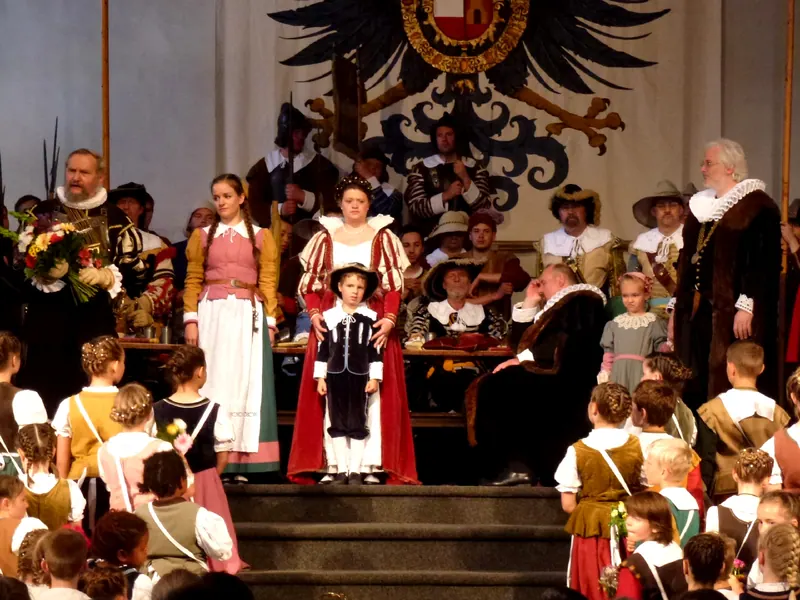
Der Meistertrunk at Whitsun, 14–17 May 2027, confirmed, re-enacts a legend of 1631: the former mayor Nusch saving the town from General Tilly by emptying a tankard of more than three litres of wine in one draught. The citizens of Rothenburg ob der Tauber have performed the play since 1881, and around it runs a four-day festival with a costumed procession on the Sunday, a soldiers’ camp outside the walls, a shepherds’ dance and a crafts market; a Festzeichen badge admits you to the old town for the weekend, and the play is ticketed separately.
It is early modern, not medieval, and it is on this list because it is what the town does, inside walls that are. The Rothenburg guide sorts the 1400 stones from the ones paid for after 1945. Rothenburg plays the Meistertrunk again at the Reichsstadt-Festtage in early September, expected 3–5 September 2027 on the organiser’s calendar, and on 3 October.
Ascension, the same weekend of the church calendar, opens the MPS tour: MPS Rastede, 6–9 May 2027, confirmed, four days in the Schlosspark of the Oldenburg grand dukes’ summer palace, on the site of a 1091 abbey, with around 120 stalls, more than fifty camps and tournament arenas for mounted and foot combat. A four-day pass is €82 in advance and about a third more at the gate. It is the longest stop on the tour and the one to pick if you want the camp as much as the market.
June–July: the wedding of 1475
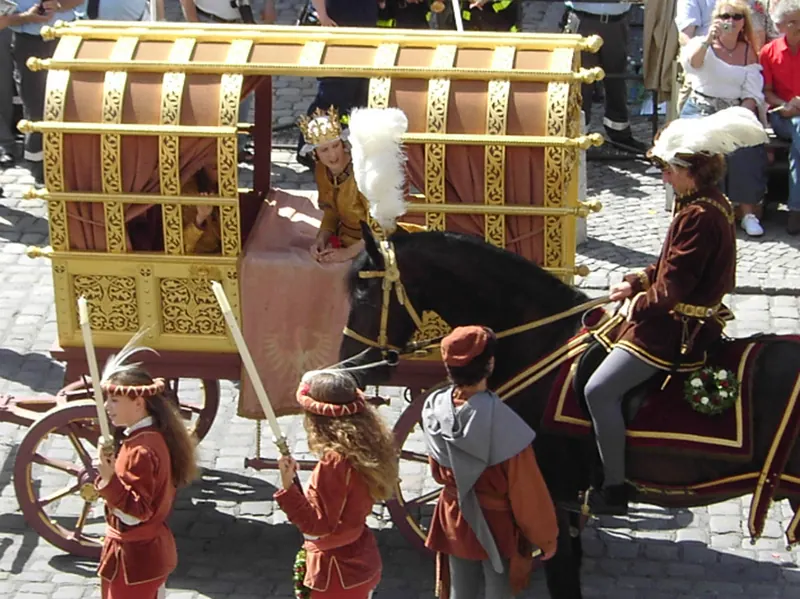
Every four years about 2,500 citizens of Landshut restage the wedding of Duke Georg the Rich of Bavaria to Princess Hedwig of Poland, first held in 1475 and first restaged in 1903, and 2027 is the year: 25 June–18 July, confirmed, with the next after it in 2031. Four Sunday processions are free to watch from the street.
The grandstand seats, the tournaments, the camp evenings and the festival play are ticketed and sell out fast, and sales open on 9 January 2027 at 09:00, which is the date to write down; check the organiser on the day. Around 600,000 visitors came in 2023, by the organisers’ count. Landshut is about 45 minutes from Munich by train, and the Landshut guide explains why the bed is booked a year out and which days are free.
July: the arena
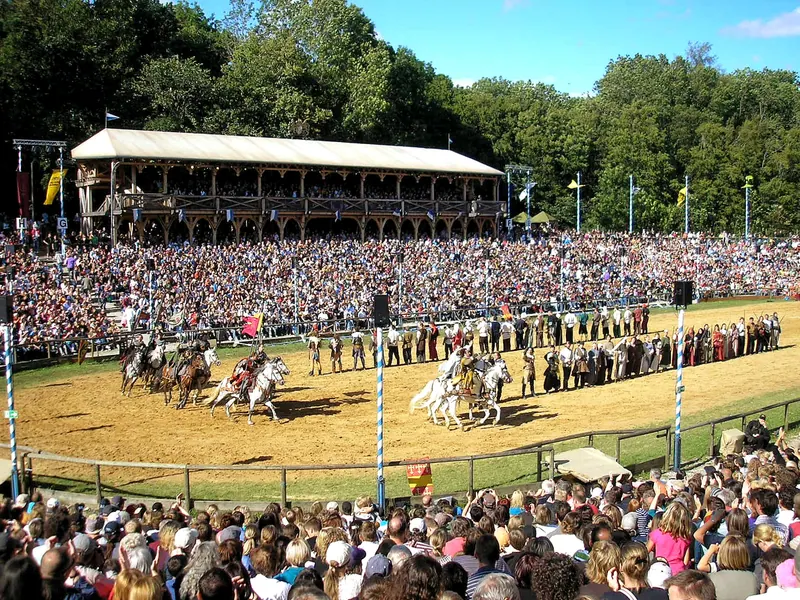
The Kaltenberger Ritterturnier is a professional show, and the honest word for it is spectacular. Prince Luitpold of Bavaria founded it in 1980 at Schloss Kaltenberg, about 50 km west of Munich, and it runs over three weekends in July, 9–25 July 2027, confirmed: a scripted story with full-contact jousting, horse stunts, fire and pyrotechnics ridden by the French troupe Cavalcade under Mario Luraschi, in an arena the organiser puts at about 13,000 people, with a market of more than a hundred stalls and five stages outside it.
Tickets started at €34.90 a day in 2026 and the Gauklernacht, the jugglers’ night, at €44.90; nothing inside is free, the market included. The S4 to Geltendorf is the train. How jousting works explains what the stunt riders are doing and why it is harder than it looks.
The tour’s flagship stop, MPS Bückeburg in the grounds of Schloss Bückeburg, takes the two weekends either side of the month’s end, 24–25 July and 31 July–1 August 2027, confirmed, with a two-day pass at €40 in advance and children under seven free across the whole tour. From 2027 the MPS drops its music arena and headline bands, by the organiser’s own account in the regional press, so the market and the camps are the reason to go.
August: the game you cannot watch
ConQuest of Mythodea at Rittergut Brokeloh, 4–8 August 2027, confirmed, is the world’s largest live-action role-playing game by its organiser’s count: up to 10,000 costumed players building camps, markets and armies on an estate near Hanover and fighting over an invented continent. It is on this list to say what it is. Day visitors are admitted only in costume, only in the market area, only on the Thursday to Saturday, and only 200 of them a day, sold on site. You play, or you do not go. The fantasy fairs piece has the rest of that world.
November–December: the Advent markets in costume
Germany’s winter is where the vocabulary matters most, because a Mittelalterlicher Weihnachtsmarkt is a specific thing: costumed traders under real fire, wooden stalls, a bathhouse tub, a hand-cranked wheel, and no electric lights in the medieval part. Six on our list pass that test, and the Christmas round-up has each in full.
The Siegburg medieval Christmas market below the Michaelsberg abbey has already published 2027, 19 November–22 December, confirmed, and it is free. Dresden’s Stallhof market fills the 16th-century tournament yard of the Residenzschloss, 2027 expected 24 November–23 December, weekdays free and €5 on weekend afternoons in 2026, and reopens as the Rauhnächte between Christmas and Epiphany, the only one of the six open in January.
Munich’s, on Wittelsbacherplatz, is expected 22 November–23 December 2027 and free; Pforzheim’s runs to 30 December; Lübeck’s stands in the churchyard between St Mary’s and the Rathaus; and the Esslingen Medieval Market & Christmas Market, the largest of them, is expected 23 November–22 December 2027, free, 15 minutes from Stuttgart on the S1, and best on a weekday afternoon.
The Nürnberger Christkindlesmarkt, 26 November–24 December 2027, confirmed, is not medieval. It is first recorded in 1678, not 1628, a re-dating the city’s own archive made and the market now prints, and it stands on a 14th-century square beside the Frauenkirche that Charles IV built as his court chapel. Around two million people come. Go for the square, the Christkind’s prologue at 17:30 on the opening Friday and the bratwurst; do not go for the Middle Ages, which left the Hauptmarkt three centuries before the first stall.
Which big German festivals have we not dated yet?
Four that are real and large, each printed as the organiser’s own calendar shows it and flagged for our researcher, so treat the dates as a plan and the link as the source. The Peter-und-Paul-Fest in Bretten, north of Karlsruhe, is a town festival for the feast of Saints Peter and Paul on the first July weekend, with camps, a procession and a market inside the old town; the organiser’s calendar gives 2–5 July 2027. Burg Satzvey near Mechernich runs Ritterfestspiele, knights’ games with a market and a show, on several dates a year, Whitsun among them, and its ticket shop already lists 16 May 2027.
The Burgfest Burghausen, on the longest castle in Europe by the town’s measure, falls on the second July weekend, 9–11 July 2027 on the town’s calendar. And the Spectaculum zu Friesach, an hour over the Austrian border, runs in even years only, so there is no 2027 edition; the next is expected in late July 2028, and the Austria page has the country’s others.
Everything we have dated is on the Germany page, the months are under May, July and December, and the types are under jousting tournaments, medieval markets and medieval Christmas markets.
How to choose
The once-in-four-years ticket: Landshut. Skip it if you cannot be at a keyboard on 9 January, because the ticketed evenings go, and take the free Sunday processions instead.
The show: Kaltenberg, on a Saturday, with a coat, because the arena is open and the programme runs past midnight. Skip it if you want anything free.
The town: Rothenburg ob der Tauber at Whitsun, for the camp outside the walls and the walls themselves. Skip it if you need the festival to be medieval; the legend is 1631 and the play is 1881.
The camp and the market: an MPS stop, Rastede for the length of it, Bückeburg for the castle. Skip it if you came for the bands; from 2027 there is no arena.
The winter: Esslingen on a weekday afternoon, Dresden for the January reopening. Skip Esslingen on a Saturday night. The festival-or-faire explainer sorts the German scene for a reader who arrived expecting a renaissance fair.
A Ritterturnier is where you sit and watch; a Mittelaltermarkt is where you stand and eat afterwards. Germany does both better than anyone, and the only mistake is to book the first and skip the second.