Tallinn, in Estonia, was two towns on one hill that did not like each other, and the wall between them is still there. Above, on Toompea, sat the bishop and the knights; below, the Hanseatic merchants, who had Lübeck law from 1248 and a seat in the League from 1285. Each town had its own walls, its own government and its own gates, and the two streets that joined them, the Long Leg and the Short Leg, were locked at night. Roughly 1.9 km of wall and about 20 towers still stand, begun in 1265; the Town Hall on the square below was finished in 1404. By the end you’ll know both towns on foot, which one piece the 20th century took out, and the two windows that matter: Old Town Days on the first weekend of June, and the costumed Medieval Days in July.
Why is Tallinn’s Old Town so well preserved?
Money, then no money, then luck. The Hansa paid for the walls, the churches, the guild halls and the merchants’ houses with their high gables and hoists, because Reval, as the Germans and Scandinavians called it until 1918, was where the Russian trade met the Baltic. After the Swedish takeover of 1561 the trade drifted elsewhere, and a town that cannot afford to rebuild keeps what it has. The 19th century added some fronts and the 20th added a railway, but nobody had the cash to do to Tallinn what Paris did to Paris.
The luck was partial. In March 1944 Soviet bombing destroyed a swathe of the lower town along Harju street, at the south end of Town Hall Square, and the open ground and lawns there today are the gap where the houses were. Stand at the top of Harju with the square behind you and you can read the edge of the bombing in the line of the buildings. Everything else inside the wall is, by the standards of a city that has been Danish, German, Swedish, Russian, Soviet and Estonian, remarkably intact, and UNESCO inscribed it in 1997.
Look at the hoists under the gables on Pikk street: a house that still has its crane is a warehouse that never got rich enough to become something else.
What is medieval in Tallinn, and where do you stand to see it?
Almost everything inside the wall, and the wall itself. The five places below are where the fabric is clearest; the lanes between them are the connective tissue, and they are where most of the 1.9 km of wall hides behind back gardens.
The wall walk and the towers
At their peak the walls ran about 2.4 km with 46 towers; today roughly 1.9 km and about 20 towers survive, which is among the best-preserved circuits in northern Europe, and the row of them along Tornide väljak, the Towers’ Square park on the north-west side, is the place to see that at a glance. Short stretches of wall-walk are open between some towers with a ticket; there is no continuous circuit, and the best view is from outside, looking up.
Three towers to find. Kiek in de Kök, “peep into the kitchen”, is the artillery tower of 1475 on the slope of Toompea, named for what its gunners could see into; cannonballs from the Livonian War siege of 1577 are still embedded in its walls, and it is the one tower that shows you what the wall was for. Fat Margaret, at the harbour end of Pikk, is the squat early-16th-century gun tower that guarded the sea gate, and her name is the only honest architectural criticism the city has ever recorded. The Viru Gate, two round towers at the east end of Viru street, is the photograph, and by mid-morning the flower stalls in front of it have more visitors than the towers.
Find the cannonballs at Kiek in de Kök before you pay for any view; they are on the outside, and free.
Town Hall Square and the Raeapteek
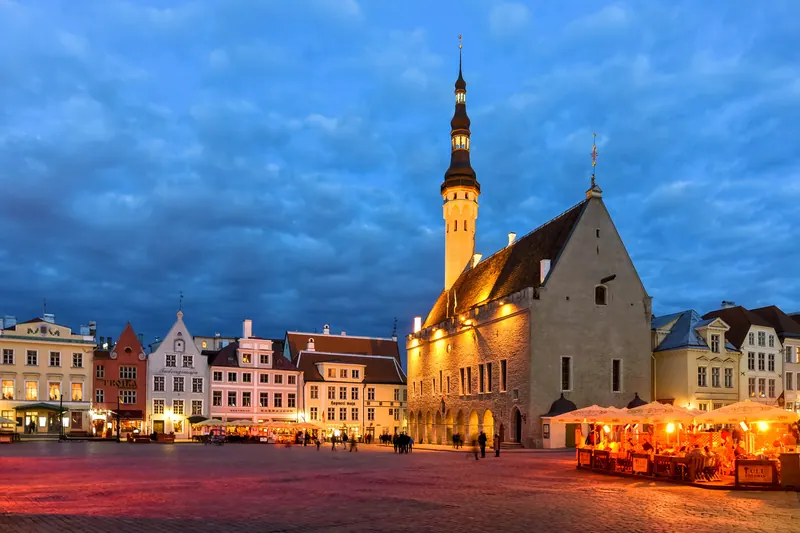
The Town Hall, completed in 1404, is the only intact Gothic town hall in northern Europe, and Old Thomas, the weathervane on its spire, has stood there since 1530 and outlasted every government beneath him. Across the square, the Raeapteek, the Town Hall Pharmacy, was already on its third owner in 1422 and is one of the oldest continuously operating pharmacies in Europe; the Burchart family ran it for ten generations, from about 1582 to 1911. Its stock in the period included mummy powder, burnt hedgehog, bat powder and “unicorn horn”, which tells you what the merchants’ money bought when it got ill. It is still a pharmacy, with a small museum at the back, and it will sell you a paracetamol under a 15th-century vault.
Come at 08:00 in summer, before the terraces are out, and the square is a 15th-century market place with the stalls missing. By 11:00 it is a terrace with a square missing.
St Olaf’s
St Olaf’s church, first mentioned in 1267, is the spire you navigate by. A craftsman of the period recorded its height as 84 fathoms, and if he meant Rhineland fathoms that is 159 m, which would have made it the tallest building in the world between 1549 and 1625; he probably meant local fathoms, so the world’s-tallest claim is disputed, which the city, to its credit, mostly admits. The spire is 123.8 m today, has been struck by lightning about ten times, and the church has burned three times, which is what comes of being the tallest thing on a flat coast. Its tower is open for a climb in the warmer months, and the view down onto the wall is the best way to understand how the circuit runs.
Climb it on a clear morning. In the afternoon the haze off the gulf flattens everything.
Toompea: the castle, the cathedral, the view
Go up the Long Leg, Pikk jalg, under the gate tower, and you cross the old frontier into the upper town. Toompea Castle on the west edge is the Danish and Teutonic stronghold with the Estonian parliament now inside it and a pink Baroque front that hides the older back; walk round to the Tall Hermann tower to see the old masonry. The Dome Church, the Lutheran cathedral, was the knights’ church and is lined with their coats of arms. Patkuli and Kohtuotsa, the viewing platforms on the north and east edges, are where every photograph of the lower town’s red roofs and the wall is taken, and in summer they are also where every tour group is at once.
In 1346 Denmark sold northern Estonia to the Teutonic Order, whose Livonian branch ruled from up here until 1561. Up here, in other words, was the government; down there was the money. The locked gates make more sense once you know that.
Come down by the Short Leg, Lühike jalg, the stepped lane, and look back up at the gate: the lower town kept the key.
St Catherine’s Passage
Katariina käik runs from Vene street along the south wall of the Dominican monastery of St Catherine, founded in 1246, and is the narrowest, oldest-feeling lane in the lower town, with craft workshops in the old buildings and the monastery’s old gravestones propped against the wall. It is short. Walk it slowly, then go into the monastery courtyard beside it, which is where the quiet is.
Why were there two towns?
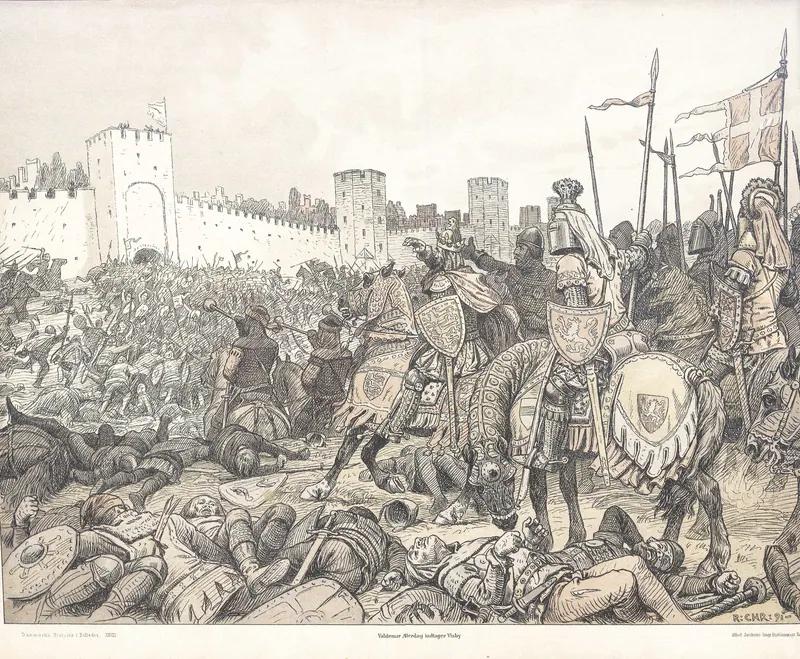
Because the conquerors took the hill and the traders took the harbour, and neither trusted the other. In 1219 King Valdemar II of Denmark captured the Estonian stronghold of Lyndanise on Toompea; legend says the Danish flag, the Dannebrog, fell from the sky during the battle on 15 June, and the Danish King’s Garden on the slope below the castle remembers it. That is a legend, and it is the national flag legend of Denmark, so the Danes take it seriously and so should you, politely. The popular explanation of the name, Taani linn, “Danish town”, is also a folk etymology; it might be right.
The lower town grew up below the hill as a German merchants’ settlement, got Lübeck law in 1248 and Hansa membership in 1285, and from then on answered to its own council, not to the castle. Toompea had the bishop, the knights and whoever held the castle; the lower town had the guilds, the Great Guild hall of 1410 and the Brotherhood of Blackheads, a guild of unmarried foreign merchants founded by 1399 and named for St Maurice, whose house on Pikk street still carries its 1597 facade. Two walls, two sets of gates, two legal systems, one hill.
Stand at the top of the Long Leg at dusk and you are standing on a border that was policed for six hundred years.
Which medieval events happen in Tallinn?
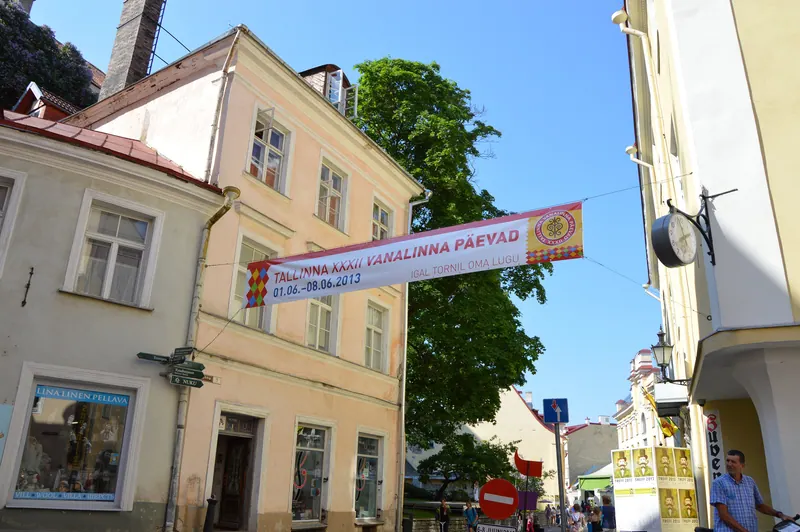
Two, and they are different kinds of thing. Tallinn Old Town Days (Tallinna vanalinna päevad) is the city festival, run by the City of Tallinn every year since 1982 except 2020, on the first weekend of June. The 2026 edition ran 5–7 June, from Friday afternoon to Sunday night, with around 300 events: open-air and balcony concerts, street theatre, children’s workshops, craft demonstrations, guided walks, and open doors to towers, courtyards and buildings that are shut for the rest of the year. The 2027 edition is expected 4–6 June, dates not yet announced. Most of it is free; some concerts, tours and workshops are ticketed or need registration, and the programme appears a few weeks ahead on the city’s site.
It is a celebration of the old town, not a reenactment of it. Nobody is in a gambeson unless they came in one. The open-doors programme is the reason to time a trip to it, because a tower you can otherwise only look at is a tower you can stand in for one weekend.
The costumed one is Tallinn’s Medieval Days (Keskaja päevad), organised by the Estonian Folk Art and Craft Union on Town Hall Square from Thursday to Sunday in the first full week of July, held since 2000; the 2026 edition was 10–12 July. That is the market with traders in period dress and a children’s knights’ tournament. It is not yet on our list; the Estonia page will carry it when it is.
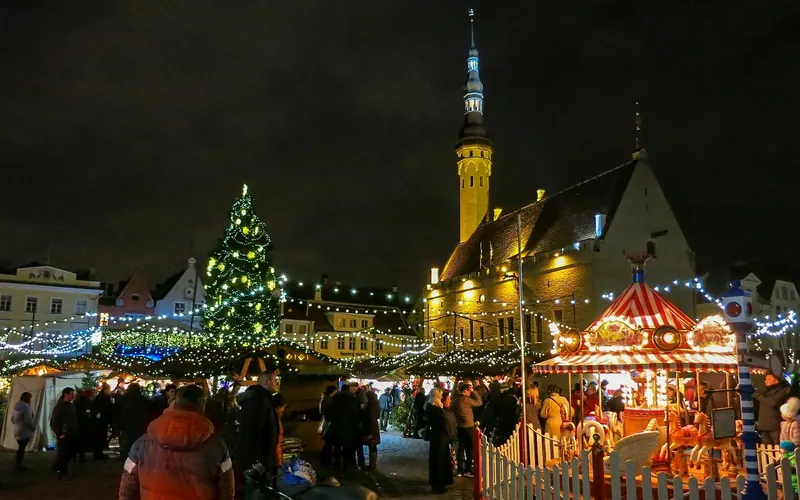
The winter market on Town Hall Square, usually from late November into early January, is a Christmas market of wooden huts, mulled wine and a tree, and Tallinn claims the first public Christmas tree stood on this square in 1441, a claim Riga disputes with some heat. That market is not medieval. The square is, and dark by 16:00 with the Town Hall lit behind the stalls is a fair trade for the cold; the medieval Christmas markets guide ranks it against the ones that actually try.
Tallinn’s Hansa sibling is Visby, and Visby Medieval Week in the first full week of August is the costumed festival Tallinn does not have; medieval Visby makes the comparison.
Time the June trip for the Friday evening opening in Toompark and the open towers on the Saturday morning, before the crowds have worked out which doors are unlocked.
When should you go?
June, for the festival and the light: sunset after 22:00 at this latitude, the wall towers pale against a sky that never quite goes dark, and a city that has been indoors since October and is pleased to see you. July adds the Medieval Days market and the cruise ships, which is the honest downside: on a ship morning the lower town between the harbour and the square is a slow procession of lanyards, and the way out is uphill to Toompea or sideways into the monastery courtyard.
December is the other answer. It is dark by 16:00, the cobbles ice over, and the market on the square is lit from mid-afternoon; if you came for the square rather than a programme, this is the season that shows it best. Bring the boots you would wear to a Scandinavian Christmas, because that is where you are.
If you have one weekend, take the first weekend of June and leave the December market to people who live closer.
What to eat
Marzipan, because the Raeapteek claims to have sold it as a medicine, and the story that it was invented in the pharmacy is one Tallinn and Lübeck have been arguing about for a long time; neither can prove it, and the Tallinn version comes in a box with a picture of the Town Hall, so it wins on packaging. Kama is the genuinely Estonian thing: a flour of roasted barley, rye, oats and peas, stirred into kefir or soured milk, eaten since before anyone wrote recipes down, and tasting, to be fair to it, of the inside of a mill. Try it at breakfast. Nobody has ever finished one on a terrace.
Olde Hansa, the candle-lit restaurant on Vana turg below the square, is the one everyone asks about. The verdict: the elk soup is good because it is slow-cooked and thick and the room has no electric light, and the bill is a tourist bill because the room has no electric light. Go once, at lunch, for the soup and the bread; do not make it every night. The medieval festival food piece covers what a Hansa table actually held, which was more herring than elk.
Eat kama once, marzipan on the way home, and elk soup when it is raining.
Getting there and around
Ferries from Helsinki take around two hours and run several times a day; the terminals are a 10–15 minute walk from the wall, as are the railway station, Balti jaam, and the bus station. The airport is a short tram ride from the centre. Inside the walls you walk: the lower town is flat, Toompea is a climb by the Long Leg or the stepped Short Leg, and the cobbles are the honest kind that hurt through thin soles by the second afternoon.
Sleep inside the walls if you want the square at 08:00 and the lanes at midnight, and accept that the rooms are in old houses with stairs and that June and December are the expensive months. Sleep just outside, in the streets south of the Viru Gate or north towards the station, and you are 10 minutes from everything at a lower price. The Tallinn page has the city for the rest of the year.
Stand at the top of the Long Leg on the Friday evening of Old Town Days, with the lower town’s roofs below and the towers along Tornide väljak catching the last of the light at ten, and you will see what two towns that never trusted each other built between them. Go in June for that hour; December is for the square. Do not go expecting a costume; this is a city that was the thing, not one that dresses as it.