The market takes over Siegburg’s Marktplatz, the square below the Michaelsberg abbey where the town has held markets since 1069, for the whole of Advent. The 2026 edition runs from Friday 20 November to Tuesday 22 December 2026, open Sunday to Thursday 11:00–20:00 and Friday and Saturday 11:00–21:00, with the food and drink stalls open an hour longer. On Totensonntag, the German Sunday of the dead (22 November 2026), the stalls open only from 18:00 to 20:00 and there is no stage programme. Entry is free.
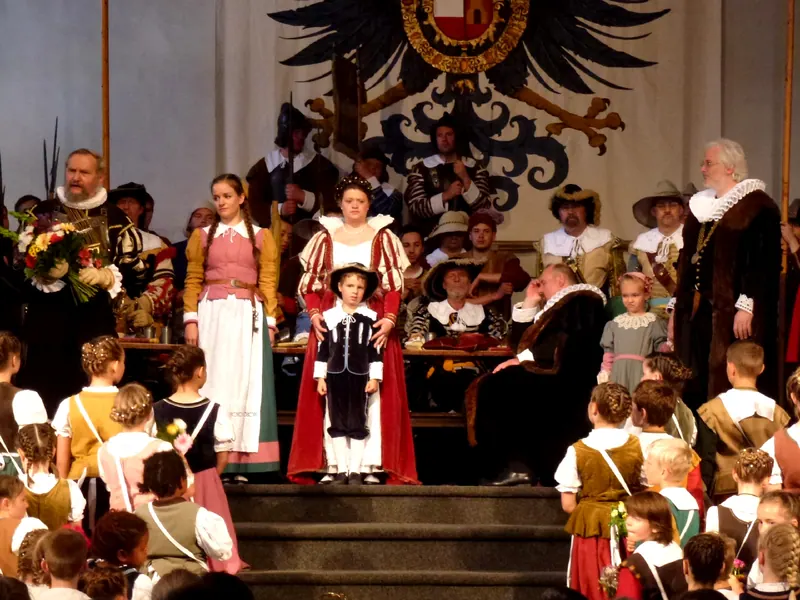
Everything on the square is played in period. The traders (Krämer) and guild craftsmen (Zünftler) work in medieval dress from wooden stalls: blacksmiths, stonemasons, bakers at open-fire stone ovens, and trades that have otherwise vanished, such as felt makers and rope makers. In 2025 the organiser added workshops where visitors could try spinning, pottery, needle binding and drawing. Each day is staged as a medieval town day — the ceremonial opening of the market, a musical lesson for visitors, juggling and jesters’ shows on period instruments through the afternoon, an evening spectacle and, at closing time, the night watchman’s call that sends everyone home. Food is cooked in the open: spit-roasted suckling pig, flatbreads, dishes from the Orient, mulled wine and mead.
The medieval market first came to Siegburg in 1991, staged by the town with the group Kramer Zunft und Kurtzweyl, and has been run for many years by the town’s marketing company, now Stadtmarketing Siegburg GmbH. It opens on the Friday before Totensonntag and always closes on 22 December; the 2027 dates, 19 November to 22 December 2027, follow the same rule and are already published. The market’s own site reports rising visitor numbers and a public vote as ‘favourite Christmas market of the year 2025’.
Siegburg/Bonn station is on the Cologne–Frankfurt high-speed line, about 20 minutes from Cologne main station by regional train and half an hour from Bonn by tram line 66; the Marktplatz is a ten-minute walk from the station. Weekend evenings are the busiest; weekday afternoons are the calmest time to watch the craftspeople.