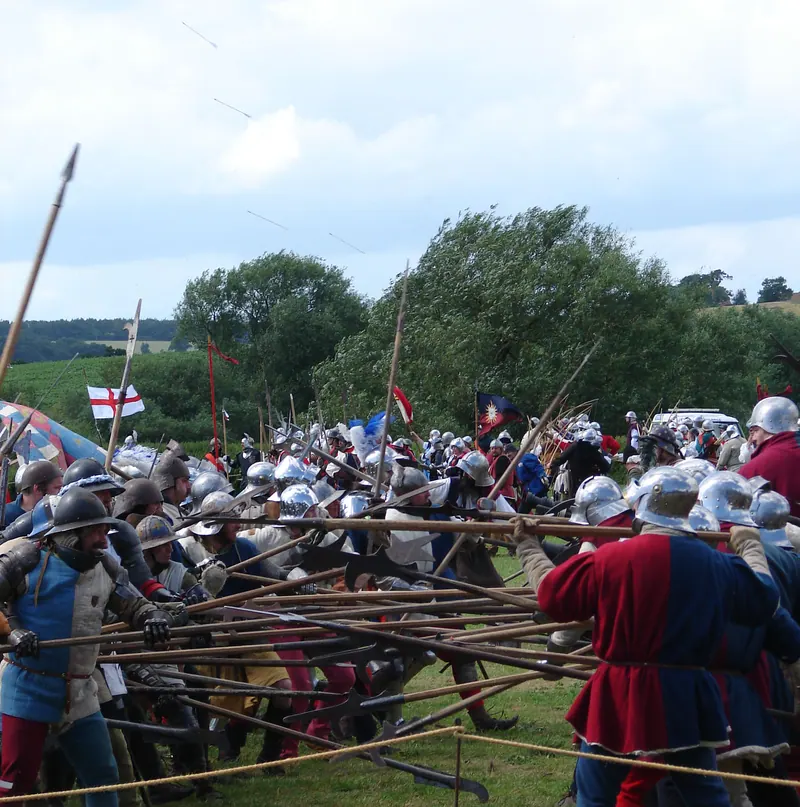
The man in the gambeson at Tewkesbury is not being paid, and that is most of the difference. A European medieval festival is a real town or field, at the place and often on the date of a real event, run by reenactment groups who came in their own vans. By contrast, a renaissance faire is a produced show on a fixed site with a paid cast in character. Living history is a place that keeps one year all season and answers questions in it. By the end of this you’ll know which of the three you want and where to stand for it.
Europe has no faire circuit; the nearest things are The Loxwood Joust (Kingdom of Loxwood) in Loxwood, England, three August weekends at £27 a day in 2026, and England’s Medieval Festival at Pippingford Park near Nutley, England. I have done all three kinds in a single summer and come home with opinions about each, none of which is that you chose wrong.
What is the difference between a medieval festival, a renaissance faire and living history?
A festival borrows a place for a weekend; a faire builds one and keeps it; living history keeps a year. Festival armour is worn by unpaid reenactment groups and the date is usually an anniversary. Faire armour is worn by a paid cast, loosely Elizabethan, and by the visitors. Living-history staff work a trade in one fixed year, in front of you.
Festival, faire and living history at a glance (prices are 2026 gate prices from the organisers; dates checked 2026-09-12)
What actually happens at a European medieval festival?
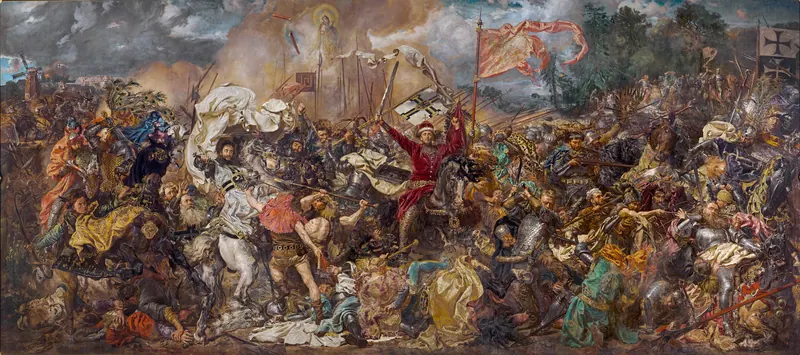
The market and the camps open late morning, one set piece happens at a fixed hour in the afternoon, and the rest of the day bends around it. At Tewkesbury Medieval Festival, in Tewkesbury, England, that is the battle: 16:00 on the Saturday, 15:00 on the Sunday, about an hour long, with cannon. For the Jornadas Medievales de Ávila (Mercado Medieval de Ávila), in Ávila, Spain, it is the Grand Parade of the Three Cultures at 12:00 on the Saturday. At the Battle of Grunwald Reenactment, in Grunwald, Poland, it is the battle at 15:00 on the Saturday nearest 15 July, and in 2026 the organisers put about 1,300 to 1,400 armoured fighters on the field.
Everything else on a programme can be missed and caught later. Those cannot, and the rope along the field fills an hour before.
The people in armour are not staff. They belong to groups with a name and a van, nobody is paying them a wage, and between the set pieces they are cooking their own lunch behind a rope. Tewkesbury draws around 2,000 of them by the organisers’ count, and Grunwald had more than 3,500 people in its camp in 2026. Walk the camp, stop at the rope and ask what the thing on the trestle is. Someone will tell you, at length, and it will turn out to be a sallet. The manners for this are in how to behave at a medieval fair.
Dates are fixed because the events were. Grunwald restages 15 July 1410 on the Saturday nearest the anniversary; 17 July 2027 at 15:00 is confirmed. The Battle of Hastings Re-enactment, in Battle, England, refights 14 October 1066 on the slope below the abbey on the weekend nearest the date, 10–11 October 2026, £24 an adult booked ahead. Landshut goes further and restages a wedding of 1475 every four years; the next Landshuter Hochzeit 1475 is confirmed for 25 June–18 July 2027.
Tewkesbury bends the rule: 4 May 1471 is refought on the second full weekend of July, 10–11 July 2027 confirmed, but on fields beside the Bloody Meadow, which is the half of the rule that matters.
There are two shapes. The free town festival puts everything in public streets and squares: Tewkesbury and Grunwald cost nothing to enter, and Ávila spreads 310 stalls and close to 150 shows across some 20 sites inside and outside the wall without a ticket anywhere. Tewkesbury’s parking is £10 a car, cash, and that is the bill.
The ticketed enclosure fences a castle precinct and sells a storyline: the Mercado Medieval de Óbidos, in Óbidos, Portugal, charged €12 in 2026 for about 11 days of themed market inside the Cerca do Castelo, and the Viagem Medieval em Terra de Santa Maria, in Santa Maria da Feira, Portugal, charged €6 to €8 a day for 12 days built around one chosen slice of Portuguese history. These two are the ones a faire-goer will recognise first. The rest of the money is in the first-timers guide.
What happens at a renaissance faire, and why is it different?
A faire is a show, and the site is built for it: a village of timber booths in a wood or a field, open for a run of consecutive weekends, with a paid cast who stay in character, loosely Elizabethan, from the gate to the car park. Visitors are the other half of the costume, and a faire where nobody in the queue is wearing a bodice has gone wrong. The usual origin story puts the first one in Southern California in 1963, and the food is a turkey leg, eaten walking. A faire is theatre with the fourth wall taken down, and it is good at it, because the cast never breaks. It is not the place where anything happened; that is the festival’s job.
What is living history?
Living history is a site that keeps one year and works in it, all season, with staff who answer questions from inside it. The two clearest examples on our list are a castle in Burgundy that has been under construction since 1997 and a Danish town that has been living in about 1400 since 1992.
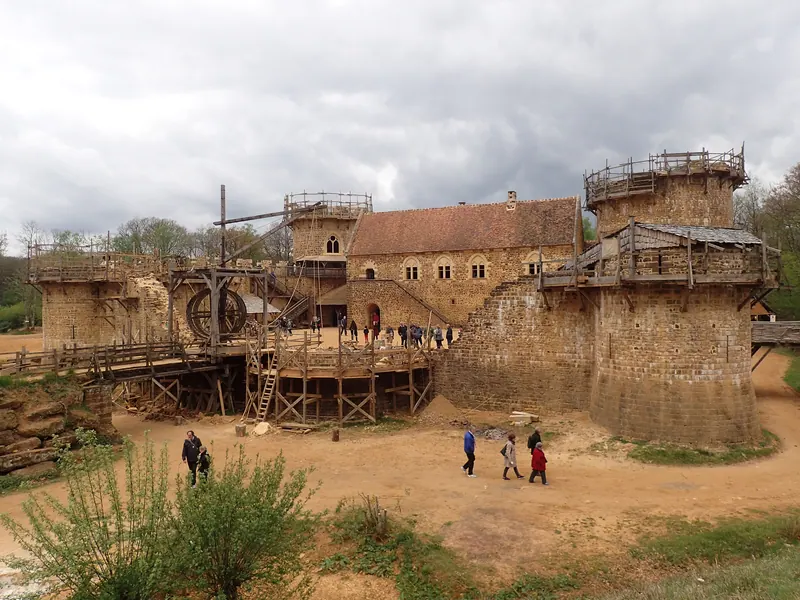
Guédelon Castle (Chantier médiéval de Guédelon), near Treigny, France, is a 13th-century castle going up in a sandstone quarry with the tools and methods of the 1230s. Work began in 1997 on the premise that a minor lord starts building in 1228, and the builders’ calendar advances a year each season, so the current job, nearly thirty years in, is the gatehouse and its portcullis. Around forty masons, carpenters, blacksmiths, tilers, rope-makers and carters work in front of you and answer questions as they go; the carpentry rehearsed here went into the new roof of Notre-Dame.
The 2026 season ran 2 April to 1 November, adults €19 to €21. Allow three to four hours, and drive: there is no bus.
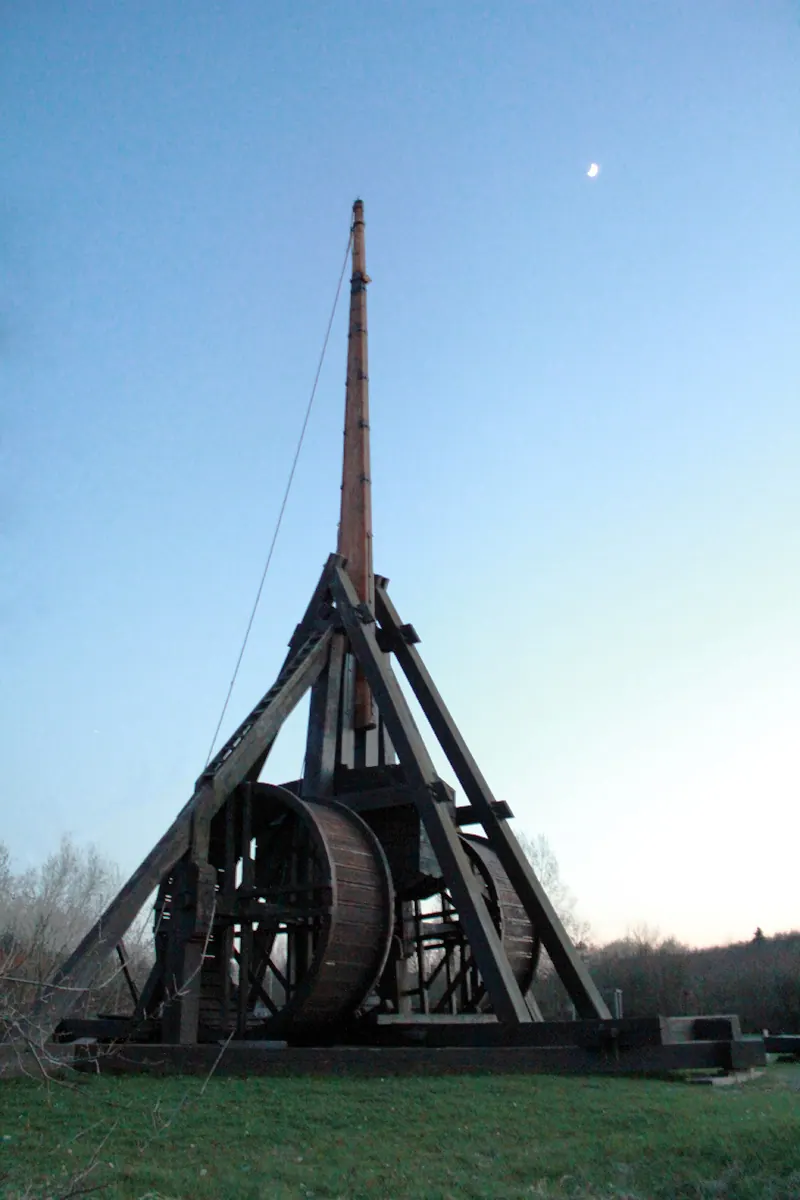
Middelaldercentret (The Medieval Centre), at Nykøbing Falster, Denmark, keeps the year 1400 in a reconstructed market town on the Guldborgsund. Staff and volunteers do not step out of character during opening hours, so you are addressed as a traveller arriving in Queen Margrethe’s Denmark, and the trebuchets are fired daily, which is not a sentence you get to write about many museums. The 2026 season ran 6 May to 20 September at 179 to 209 kr for adults by season, and a ticket is valid for seven days, so do two short visits rather than one long one.
Then there is the festival version: the camp. Grunwald had more than 3,500 people living in its knights’ camp in 2026, and at the Festival of Slavs and Vikings (Festiwal Słowian i Wikingów), in Wolin, Poland, the organisers count around 2,000 reenactors from some 30 countries living for four days in a reconstructed 9th-to-11th-century port on Ostrów island, the one the sagas call Jomsborg; a day ticket was 35 zł in 2026. A camp is living history for a weekend rather than a season. At Wolin the smith goes home on Sunday; at Guédelon he is back in the morning.
Are there renaissance faires in Europe?
Not as a circuit. Europe has no chain of permanent faire sites with paid casts and consecutive-weekend runs. It has a handful of produced, ticketed events a faire-goer will recognise: two in Sussex, a stunt joust in Bavaria, a touring market in Germany and the Dutch fantasy fairs. Each gets a label, because none is quite a faire.
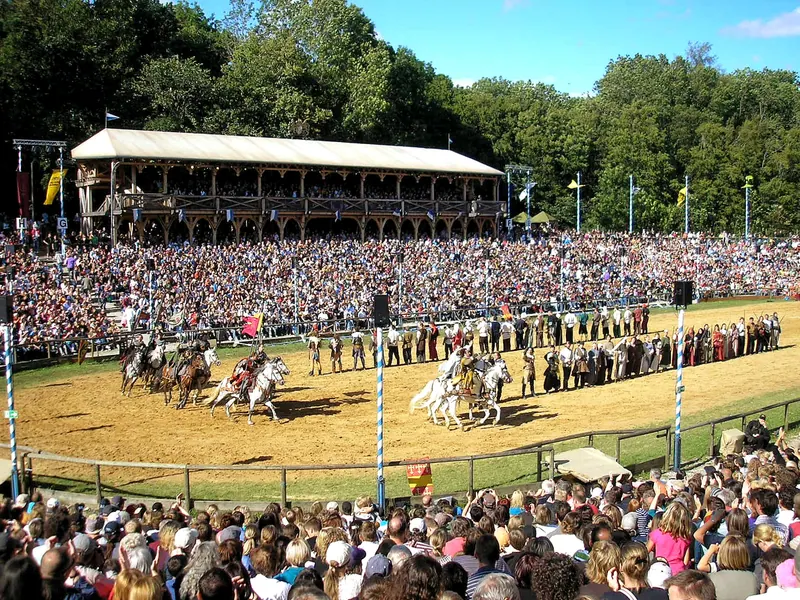
The Loxwood Joust is the nearest thing, and it is near. Legend Presents has produced it on Loxwood Meadow, between Guildford and Horsham, every summer since 2012 as a kingdom rather than a reenactment: a royal court, a living-history village, a market, several stages and costumed characters who stay in role all day, plus a daily joust, an executioner’s show, a forge and a knight school for children.
In 2026 it ran on 1–2, 8–9 and 15–16 August, the first two Saturdays sold out in advance, day tickets were £27 for adults and £8 for children aged 4 to 14, and parking had to be booked with the ticket. The 2027 dates had not been announced when we checked. If you want a faire in England, this is it.
England’s Medieval Festival, EMF to its regulars, is the other Sussex answer. The name searchers still type is Herstmonceux Medieval Festival, because it ran in the grounds of Herstmonceux Castle from 1993 until 2022; since 2023 it has been at The King’s Grove, Pippingford Park, in the Ashdown Forest near Nutley. Jousting, living-history camps, archery and falconry, a medieval and fantasy market, and a weekend ticket with four nights of camping. The date is the August bank holiday, expected 28–30 August 2027; prices are on the official site, and the site is off the A22, so drive or book the shuttle. Everything else in the country is in medieval festivals in the UK 2027.
The Kaltenberger Ritterturnier (Kaltenberg Knights’ Tournament), at Schloss Kaltenberg in Kaltenberg, Germany, about 50 km west of Munich, is closer to a stunt show with a market round it than to a faire. Its arena holds about 13,000 for a scripted story with full-contact jousting, horse stunts, fire and pyrotechnics by the French troupe Cavalcade under Mario Luraschi; outside it are more than 100 stalls and five stages. It runs over three weekends in July, 9–25 July 2027 confirmed, tickets from €34.90 a day in 2026, and nothing inside is free, the market included. What the stunt riders are doing is in how jousting works.
Germany’s other answer is the MPS, the Mittelalterlich Phantasie Spectaculum, a touring market of stalls, camps and a tournament that moves between German towns from spring to autumn and calls itself fantasy in its name. Its flagship stop, MPS Bückeburg, is confirmed for 24–25 July and 31 July–1 August 2027, with a two-day pass at €40 in advance. Call it a market that travels, not a festival; the Germany round-up has the rest of that calendar.
The Dutch fantasy fairs are the last candidates, and the honest label is fantasy, not faire: Castlefest at Lisse, 5–8 August 2027, confirmed, and Elfia in its spring edition at Kasteel Vorden, expected in May 2027, and its autumn one at Kasteeltuinen Arcen, expected in September. Elves outnumber knights, which is the point, and the fantasy fairs round-up has the whole circuit with the elves labelled.
What a US reader will miss is the cast. Nobody at Tewkesbury greets you in character, because almost nobody is in character; the man at the rope has a day job and a van and will talk to you as himself. What you get instead is the wall. Ávila’s was standing centuries before anyone thought of a faire, and no site crew on earth can build one of those by Friday.
Which one do you want?
The one whose set piece you would cross a field for. If that is a joust with pyrotechnics, a faire-type event; a battle on the ground where it happened, a festival; a trebuchet being loaded by someone who will explain the counterweight, living history.
- A show and a costume day: Loxwood, Kaltenberg or Óbidos, where visitors in 12th-to-14th-century dress paid €10 instead of €12 in 2026; the costume rules are in what to wear. Skip these if you want to talk to the people in armour between shows; at Kaltenberg they are stunt riders and at Loxwood they are in role.
- The real place on the real date: Tewkesbury, Grunwald, Hastings, Ávila. Skip them if you need a timetable to the minute and a cast that finds you; there is one fixed hour and the rest is walking.
- Learning with your hands: Guédelon and Middelaldercentret. Skip them if you came for a battle; Guédelon builds and nobody fights there.
- Children under ten: Middelaldercentret, where under-fours are free and there is armour to try on; the Esslingen Medieval Market & Christmas Market in winter, free, with a heated bathing tub and a hand-cranked Ferris wheel; and Loxwood’s knight school. Skip Tewkesbury’s battle hour if bangs are a problem, because it uses cannon.
- A reenactor looking for a camp: Grunwald, Wolin, or Visby Medieval Week (Medeltidsveckan), in Visby, Sweden, where the camps sit under a 3.4 km ring wall. Skip all three if you want a quiet camp; Grunwald’s had more than 3,500 people in it in 2026.
Where to see each kind
Three short lists, with the month and the gate. “Expected” means the organiser has not yet announced; prices are 2026.
Festivals: a real place, usually a real date. Tewkesbury Medieval Festival, England, 10–11 July 2027, confirmed, free, parking £10 cash. Jornadas Medievales de Ávila, Spain, first weekend of September, expected 2–5 September 2027, free. Sighișoara Medieval Festival (Festivalul Sighișoara Medievală), Romania, expected 23–25 July 2027, free, in the citadel. Les Médiévales de Bayeux, France, expected 2–4 July 2027, free, with the parade at 20:30 on the Friday. The longer list is under reenactment and battles.
Faire-type: produced, ticketed, a cast or a show. The Loxwood Joust, England, three weekends in August, 2027 dates not announced, £27 adults. England’s Medieval Festival, England, expected 28–30 August 2027, prices on the official site. Kaltenberger Ritterturnier, Germany, 9–25 July 2027, confirmed, from €34.90. Mercado Medieval de Óbidos, Portugal, expected 15–25 July 2027, €12, €10 in costume. Les Médiévales de Provins, France, expected 12–13 June 2027, €12 a day, €9 in full costume, the whole walled upper town as the ticketed site. The jousts are under jousting tournaments.
Living history: one year, kept all season. Guédelon Castle, France, early April to 1 November, €19 to €21. Middelaldercentret, Denmark, early May to late September, 179 to 209 kr. Grunwald’s camp, Poland, around the battle on Saturday 17 July 2027, confirmed, free. Festival of Slavs and Vikings, Wolin, Poland, expected 29 July–1 August 2027, 35 zł a day. Days of Live Archaeology in Kernavė, Lithuania, expected 2–4 July 2027, about €13 to €16, Stone Age to Middle Ages, so wider than the name of this site. The longer list is under living history.
Stand at the rope at Tewkesbury long enough and a pikeman will lean over it, still in his sallet, to ask the American next to you where she got her boots. He wants them for next July. She wants the sallet. The rope stays where it is.