A town of about 72,000 people on the Isar, and for three and a half weeks in the summer of 2027 roughly 2,500 of them will be in 15th-century wool, with the beards to match, because the rules say so. The Landshuter Hochzeit 1475 (the Landshut Wedding), in Landshut, Germany, re-stages the November 1475 marriage of Duke Georg the Rich and the Polish princess Hedwig Jagiellon, and it happens only every four years. The 2027 edition runs 25 June to 18 July 2027; the organisers have published the dates. The streets are free, the seats are not, and tickets go on sale on 9 January 2027. By the end you’ll know which Sunday to come, what to book that morning, and whether to sleep in Landshut or Munich.
What is the Landshuter Hochzeit?
In November 1475 Georg, heir to the Duchy of Bavaria-Landshut and later called the Rich, married Hedwig, also written Jadwiga, daughter of King Casimir IV of Poland. The wedding was one of the great spectacles of the late 15th century: an emperor in attendance, days of feasting, tournaments in the streets, and a bill the town talked about for generations. Landshut first re-staged it in 1903, and has done so every four years since 1981, run throughout by a citizens’ association called Die Förderer.
The numbers, from the organisers: about 2,500 participants in more than 70 groups, every one of them a Landshut resident and a member of Die Förderer, with strict rules on costume, hair and beards. Going by the application dates, the beards start in the autumn. The 2023 edition, postponed from 2021, drew about 600,000 visitors over its run, and the organisers describe the event as Europe’s largest historical costume festival; it went onto Germany’s register of intangible cultural heritage in 2018. Roles for 2027 are open to residents only, with applications from 1 to 31 October 2026, so if you are reading this from Manchester, you are coming to watch.
Elke, who reads the documents, adds: the marriage was a political purchase. Casimir IV had a great many children to place, the Wittelsbachs had money and wanted a crown in the family, and the two were married in St Martin’s because it was the biggest room in town. The town has since decided that the wedding was the point. That is a reasonable thing for a town to decide.
Why every four years and not every year: 2,500 amateurs cannot rehearse a three-week play annually and still run a town. The gap is the reason it is good.
When is Landshuter Hochzeit 2027?
25 June to 18 July 2027, published by the organisers, with the wedding procession through the Altstadt on each of the four Sundays: 27 June, 4 July, 11 July and 18 July. The rest of the programme, tournaments, camp evenings, the play and the concerts, runs across the weeks between, and the detailed timetable appears on the official site ahead of ticket sales. The following edition would be 2031.
The rhythm matters for planning. Procession Sundays are the crowded days and the ones a day-tripper wants. The weekends around them carry the ticketed tournaments and camp life. Weekdays are quieter and still in costume, and they are the days to book a bed in Landshut itself, because the Sundays fill first.
If you can only manage one Sunday, take the first or the last: the first because the town is at its most nervous and the wool at its cleanest, the last because the procession ends the whole thing and the square knows it.
What actually happens?
Four Sunday processions, knights’ tournaments in a purpose-built arena, camp life in the evenings, a historical play in the town hall, a masked evening the organisers call the Mummenschanz, and concerts of 15th-century music. Around all of it, a town going about its business in hose.
The wedding procession (the thing to get a seat for)
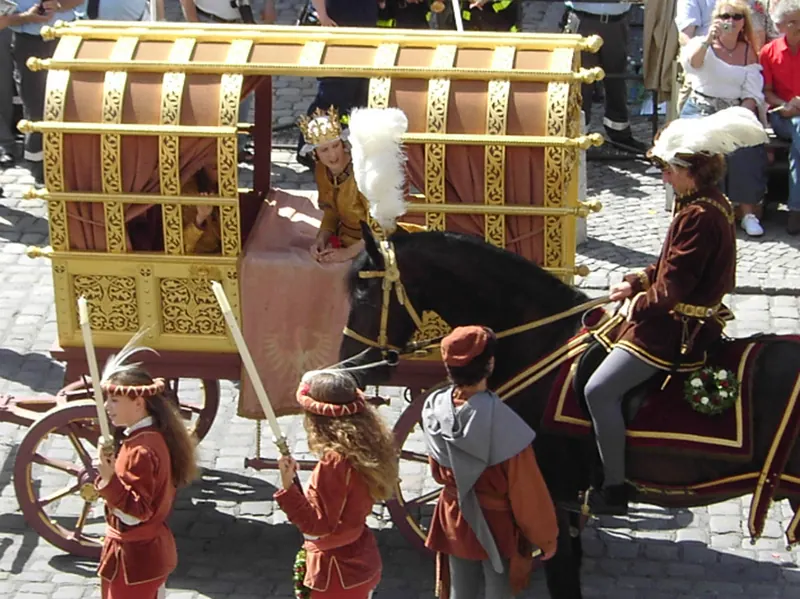
The Hochzeitszug is the centrepiece: mounted knights, musicians, wagons, the ducal households and the bridal couple, moving through the old town on each Sunday of the festival. From the street it is free and you will see it, in the sense that a procession passes you. From a grandstand seat on the route you see it arrive, which with a cavalcade is the difference between a parade and a story.
Stand on the street if you like a crowd, arrive early, and pick a spot with a wall behind you and no wagon-width gap in front; a procession on a street laid out for carts means the people on the kerb are closer to the horses than they expected. Book a stand seat if you are bringing children, grandparents, or a back. Sales open on 9 January 2027 at 09:00 and, by the organisers’ own warning, go fast.
The tournament and the camp
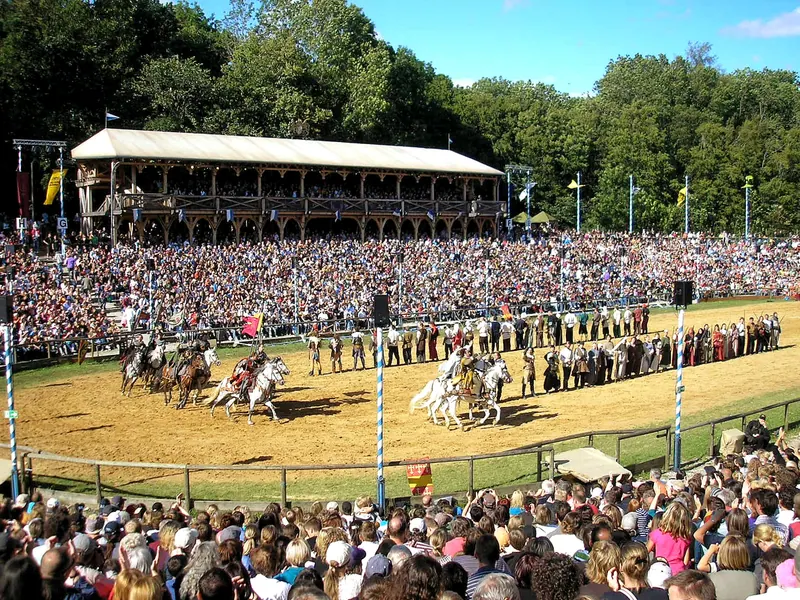
The Ritterspiele are a scripted tournament with mounted combat in the arena, ticketed, held on set days through the run. The Lagerleben, the camp life, is the evening event: the participants in their camp, cooking, drinking, playing 15th-century music, and the visitors walking through it with a ticket. If you have a reenactor’s habits, this is the part you came for, and it is the one where the residents-only rule pays off, because nobody in the camp looks like they have a job on Monday.
Ask anyone in a gambeson where the good beer is. They live here.
Evenings in the Altstadt: music, the Festspiel
The Festspiel is the historical play, staged in the town hall, which tells the wedding in the words the town has been refining since 1903. It is in German. Go anyway if you have a ticket; the costumes and the room carry it. The Mummenschanz is the masked evening, and the concerts of 15th-century music are the part we would book first after a stand seat, because they are in rooms that were standing in 1475 and sell to people who know that.
Around the ticketed events the Altstadt itself is the show: a long street of painted gables between St Martin’s and the Isar, full of people dressed for 1475 and people photographing them. It is free, it is loud, and by the evening it smells of roasting meat and horse.
Weekdays: quieter, still in costume
Between the weekends the participants are still in costume and the town still looks like it is expecting a duke. Weekday programme details vary and we haven’t walked one; check the timetable. A weekday is when you get into St Martin’s without a queue, up to Trausnitz without a crowd, and a table without asking twice.
Book the weekday bed, and use it to see the town the wedding happened in.
What is free and what needs tickets?
Free: watching the procession from the street, and the Altstadt in costume all festival long. Ticketed: grandstand seats on the procession route, the Ritterspiele, the Lagerleben evenings and the Festspiel. The organisers say the ticketed events sell out quickly; 2027 prices were not published as of August 2026, and sales open online through the official site on 9 January 2027 at 09:00.
That date is the one to write down. The procession seats and the camp evenings for the first and last Sundays are the ones we’d expect to go in the first hour, and there is no resale we’d trust. Decide in December what you want, be at a keyboard at 09:00 German time, and then book the bed, not before. A seat without a room is a long day; a room without a seat is still a free procession.
Getting there and sleeping
Landshut is about 70 km north-east of Munich and roughly 45 minutes from Munich Hauptbahnhof by regional train, which makes it the easiest big festival in Germany to reach by rail and the easiest to leave when the camp closes, provided you have checked the last train. It sits on the line towards Regensburg, so it also works from the north. Munich airport sits roughly midway between the two; look at a map before you book a hotel near the Marienplatz out of habit.
Beds: Landshut’s go first, and the procession Sundays go first of all. Munich has everything and a train. If you want the evenings, sleep in Landshut; if you want one Sunday and a look at the town, sleep in Munich and ride out. The Landshut page covers the town in the other three years.
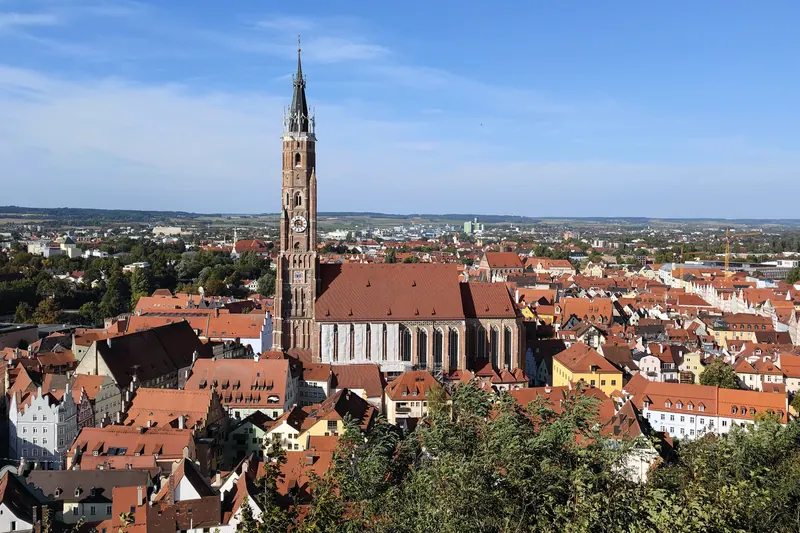
Between events, two things. Trausnitz Castle, founded in 1204 when Duke Ludwig I laid out the town, sits on the hill above the Altstadt, and the walk up is the shade the Altstadt lacks. St Martin’s, where the couple were married, has a brick tower of 130.6 m, said to be the tallest brick church tower in the world; stand under it on a procession Sunday and you understand why the organisers route the wedding past it.
Tips we’d give a friend
- Write 9 January 2027, 09:00, on something you will see. Book the seat first, then the room.
- Take the first or last Sunday if you can only do one; the procession is the same, the town’s mood is not.
- Street viewing is free and fine for adults who can stand for a couple of hours; a stand seat is worth it for children, because a wagon at kerb height is a wall.
- Book a Lagerleben evening and eat early; expect the Altstadt restaurants to be full on festival nights.
- Check the last train to Munich before the camp evening, not after.
- Read how to behave at a medieval fair before you walk into the camp; the people in it live here and will be in costume for three weeks.
- Pair it with the Kaltenberger Ritterturnier, 50 km west of Munich, expected 9–25 July 2027: a professional stunt joust in a 13,000-seat arena, from €34.90 a day in 2026, which is the other half of the Bavarian July. The rest of the country’s calendar is under Germany, the month’s options under July, and the long list in the best medieval festivals in Europe.
It is a wedding, so the usual rules apply: the ceremony is free, the good seats are for people who replied early, and the party is better than the service. Reply on 9 January. The next invitation is in 2031.