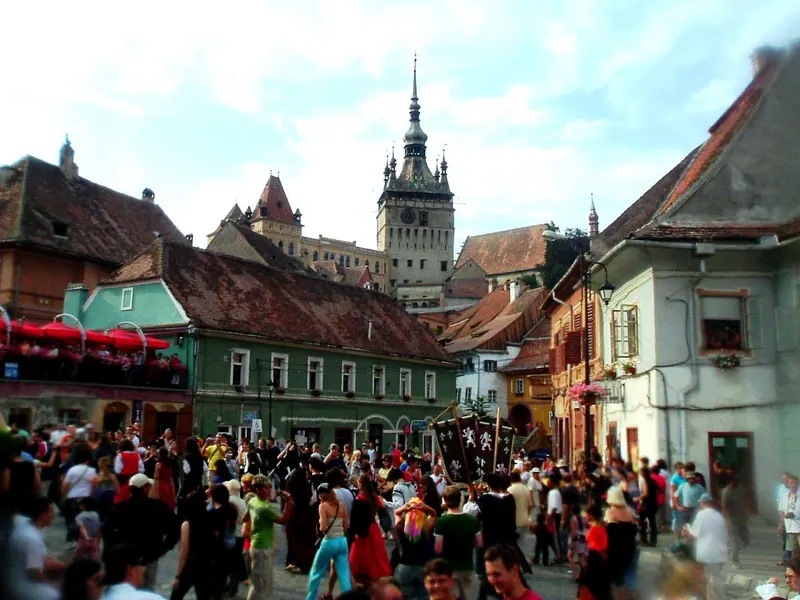
The festival grew out of a medieval street performance staged in 1991 by theatre students from Bucharest, and the first Sighișoara Medieval Festival opened on 29 May 1992, organised by the youth society Concret on an idea by Gabriel Apostol and Mihai Serghei Todor. It is now run by the Municipality of Sighișoara and has been held on the last weekend of July for most of its history, with two interruptions: 2016, because of local administrative disputes, and 2020, because of the pandemic. The 2026 edition, the 31st, took place 24–26 July under the high patronage of Margareta, Custodian of the Romanian Crown.
The whole hilltop citadel is the venue. Squares and lanes are given themed roles (Knights’ Market, Pilgrims’ Market, Mercenaries’ Square, Troubadours’ Square, Small Knights’ Square) and filled with parades of knights and ladies, military re-enactment groups, mounted displays, jesters, drummers and flag-throwers, craft workshops, exhibitions, talks and video-mapping on the old walls. A main stage on Citadel Square hosts evening concerts; in 2026 the programme opened on Friday at 19:00 with a parade through the historic centre, added combat demonstrations by Hungarian re-enactors and a gastronomy point on Piața Rățuștei, and closed on Sunday night with a Trooper concert and fireworks.
Entry is free. A children’s zone near the City Hall offers interactive workshops, historical games, puppet theatre, stilt-walkers and living statues. Tens of thousands of people visit over the weekend; local sources quote more than 30,000 in the strongest years.
Sighișoara is on the railway between Brașov (about two hours) and Cluj-Napoca, and about five hours from Bucharest. The citadel is closed to traffic during the festival and its few guesthouses sell out months ahead, so book early or stay in the lower town. The municipality publishes the daily programme on its website and Facebook page shortly before the event; the festival no longer has a dedicated website.