There is a kettle on the fire inside the rope and the man in the gambeson tending it would like you to ask what the gambeson is. He would not like you to say huzzah. That is most of the etiquette: be a curious guest, not a character. No festival on our list asks visitors to talk in period, and at the one place where the staff do stay in character all day, Middelaldercentret in Denmark, visitors are addressed as travellers and may answer however they like. By the end of this you’ll know how to behave in a camp, at a battle and in the street, what to call things, whether to dress up, and the one thing an organiser will remove you for.
Do you have to talk “medieval” at a medieval fair?
No, and nobody does. Between shows the people in the camps talk about the weather, the price of wool, whose tent leaked and where the good coffee is. Put on a voice and you will get a polite look and a shorter answer.
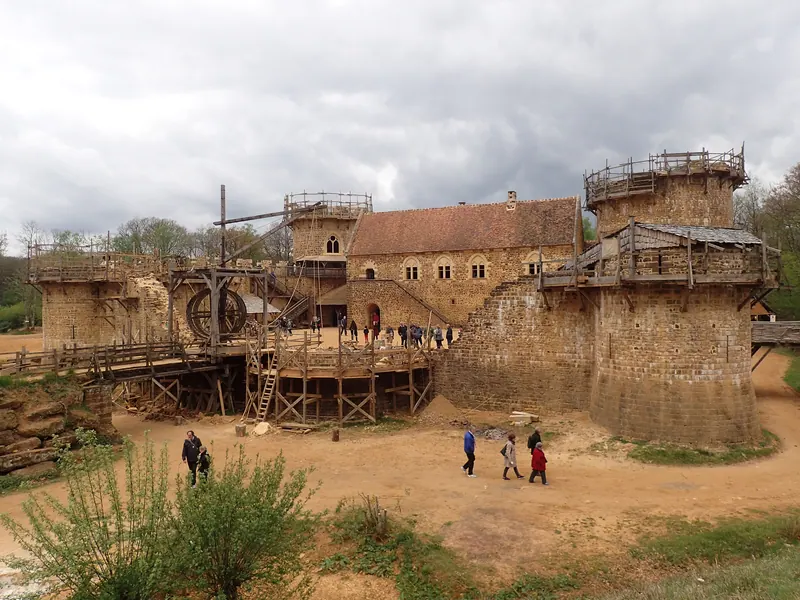
Two sites on the list keep staff in character, and neither asks anything of you. At Middelaldercentret the town of Sundkøbing lives in the year 1400 during opening hours, the staff do not step out of it, and you are addressed as a traveller from somewhere odd; play along, or ask in plain English where the toilets are, and either way you get an answer. At Guédelon the masons and carpenters are building a 13th-century castle with 13th-century tools and answer questions as they go, which is the model for the whole thing: people working, and you asking what they are doing.
Ask the question you actually have. “What is that for?” beats anything with a thee in it.
How do you behave in a living-history camp?
Ask before you touch
A sallet costs real money, a hand-stitched gambeson costs a winter of evenings, and the pot on the fire is somebody’s dinner. Every object inside the rope belongs to a person who will probably hand it to you if you ask, and who will mind if you don’t. Ask what it weighs. They know to the gram.
The rope is the rule
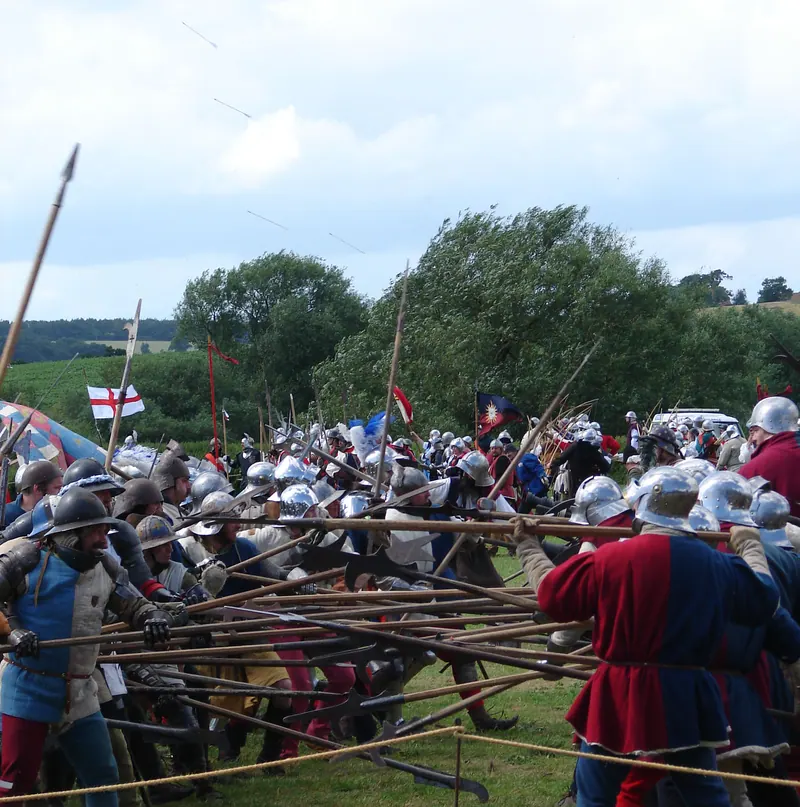
The rope along the front of a camp is a wall. It says which side the public is on, and it keeps children out of the fire and dogs out of the stew. Where there is no rope, the line of tents is the rope. Step over it only when invited, and keep the children on your side; most camps will wave a child in for a closer look at the helmet, but on their terms.
The fire is real, the pot is hot, the dog is someone’s
Camp fires are open and at ground level, the pot hanging over one has been there since breakfast, and the dog asleep beside it is not a prop. Keep your own dog on a short lead; Tewkesbury Medieval Festival asks specifically for no extending leads, because a lead across a path at knee height in a crowd is a trip wire.
Questions they love and questions they are tired of
“Are you hot in that?” Yes. “Is that real?” Yes, and it was expensive. Both questions get asked a hundred times a day and both have one-word answers. Ask instead what it is for, how long it took to make, where the pattern came from, and whether it works. Those get you twenty minutes and possibly a go with the thing.
How do you behave at the battle or the joust?
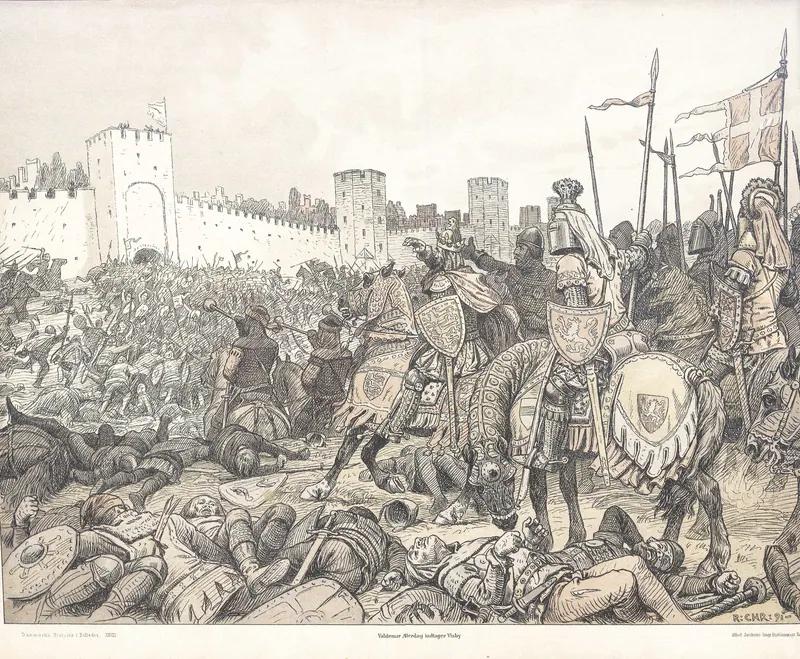
Arrive early, sit where you are put, and stay until the field is cleared. The rope at Grunwald before the 15:00 battle is the example: around 1,400 armoured fighters on the field, crowds the organisers put at about 100,000, and a noise you feel in your teeth. Be at the line an hour early with something to sit on, and expect the access roads to stop moving afterwards.
Don’t heckle. Don’t cheer a fall at the joust; the horse did not choose to be there and the rider is checking it before checking himself. Phones are fine, flash is not, because a flash at the moment a horse turns is a problem for the horse. Drones are a hard no at every festival we know of, and the exact rules on drones, flash and cameras are the festival’s own, so read the official site before you pack. Let children to the front if there is room; they are shorter than you and the sight lines are better at knee height than behind a tall man in a sallet.
When the field clears, the fighters walk off past the rope. That is the time to say it was good, not during.
What about photographs?
People in costume are not scenery. A nod or a question first, every time, and most will say yes and carry on with what they are doing, which is the photograph you want: someone arming, cooking, sewing or sharpening, rather than standing to attention for you. Children in costume, ask the parent. Reenactors will tell you that nobody has ever been offended by being asked; plenty have been offended by a lens appearing over the rope at breakfast.
The back rows of a camp are where people sleep and change. No cameras there, and no wandering either.
What should you call things?
Eight words you will hear inside the rope, two lines each.
- Reenactor: someone who portrays a period, usually in a group with rules about kit. Not an actor, not paid, and not in character unless the site says so.
- Living history: the camp, the cooking, the crafts; the part of a festival that shows how people lived rather than how they died. More of it under living history.
- Kit: everything a reenactor wears and carries. It is their savings, so treat it that way.
- Gambeson: the padded cloth coat worn under or instead of armour. Hot, heavy and the reason for the question you were going to ask.
- Period: correct for the time being shown. “Is that period?” is the question reenactors ask each other, usually about a buckle.
- Impression: the person being portrayed, a Bohemian crossbowman or a Gloucestershire billman, and the kit that goes with them.
- Authenticity: the standard a group holds itself to; some are strict to the stitch, some are not, and both know which they are.
- Farb: reenactor slang, as far as we can tell, for kit that would not pass in any century. Said about each other, never about you.
And the correction nobody asked for: “medieval” and “Renaissance” are different centuries and nobody needs you to say so on the day. The Viagem Medieval em Terra de Santa Maria is 12 days of mixed centuries and perfectly happy, and the battles are under reenactment and battles regardless of whose century they are.
Is it cringe to dress up?
No. At Visby Medieval Week (Medeltidsveckan) a large share of visitors are in costume, the town has hire and sewing workshops during the week, and you will feel underdressed without a cloak by the second day. At most other festivals the spectrum runs from a cloak over jeans to full harness, and nobody judges the cloak. Several gates pay you for it: Óbidos and Provins cut the ticket price for costume, Karlštejn lets a complete outfit in free, and Ávila’s locals dress for one of the town’s three cultures without anyone asking.
The people frowning at plastic armour are frowning at the plastic near the fire, not at you. What to buy, and what to leave in the traders’ field, is in what to wear to a medieval festival.
Drink, taverns, and the sword on your belt
The drinking is real and period; mead and ale were there in 1410 and they are at the bar now. The sword in the bar is neither. Most festivals have rules on carrying blades, some require edged weapons to be tied into their scabbards, and the rules differ by country and by site, so check the official site before you bring anything sharper than a spoon. If in doubt, leave it in the car.
The one thing organisers will remove you for is breaking their own rules on weapons, fire and dogs. Nothing else on this page gets you thrown out. It only gets you a shorter conversation.
Ten rules, which are really one
- Ask before you touch.
- The rope is a wall; stay on your side of it and keep the children there too.
- The fire is real and the pot is hot.
- Ask what it is for, not whether they are hot.
- Nod before you photograph; ask the parent before you photograph a child.
- Arrive early at the battle, sit where you are put, stay until the field clears.
- Don’t heckle, don’t cheer a fall, no flash, no drones.
- Talk in your own voice; play along with in-character staff or don’t.
- Dress up if you like; keep plastic away from the fire.
- Obey the festival’s rules on weapons, fire and dogs, because those are the ones that get you removed.
The one rule is the one the man with the kettle wanted: ask what the thing is. The other nine are that rule in different hats.
Which festival to try first is in the first-timer’s guide; the field itself is in our guides to Tewkesbury, Grunwald and Visby, and the other side of the rope on the Jornadas Medievales de Ávila page.
I lost at Tewkesbury again, on the Lancastrian side, which is period. A boy at the rope asked afterwards what the pollaxe was for. I told him. That is the entire transaction, and it was the best ten minutes of the weekend.