Most of the festivals on this site cost nothing to walk into, and the ones with a gate charged between €6 and about €35 a day in 2026, so the honest answer is yes: a day at a medieval festival is worth it, provided you pick the right first one. A day contains a market, a camp you can walk through, one set piece at a fixed time that everything else bends around, food eaten standing up, and a great deal of walking. I have taken two children to twenty-five of them and the children asked to go to at least half. By the end of this you’ll know what a day looks like hour by hour, what it costs, how it differs from an American renaissance faire, and which one to try first. The rule is short: free, in a real town, one day long.
Are medieval festivals worth it?
Yes, if you like history, outdoor food or a day with a timetable. For the price of parking you get a walled town or a battlefield used for what it was built for, a few hundred people who have spent their savings on wool and steel, and a roast pork queue. Skip the whole idea if you hate crowds and standing, because a festival is mostly both.
History readers get the dates: Tewkesbury re-fights 4 May 1471 on the ground where it happened, and Grunwald restages 15 July 1410 on the original field. Families get flat, free sites full of things to poke, and Ávila puts about 40 children’s activities in a single garden. Reenactors are the festival, not its audience, and a week with their own kind is the point. And the people who read the books get Visby: a complete 13th-century ring wall with a town inside it, which fills with people in wool for a week every August and looks, from the ferry, like the cover of something.
Go for the set piece. Stay for the camp, which is where the conversations are.
What actually happens at a medieval festival?
A day runs in the same order almost everywhere. The market and the camps open late morning, shows and tournaments run at fixed hours, one set piece happens in the afternoon and the whole site bends around it, then food, then an evening that is a concert or a procession depending on the country.
The fixed times are the whole skill of the day. At Ávila the Grand Parade of the Three Cultures leaves at 12:00 on the Saturday. Grunwald’s battle is at 15:00. Karlštejn runs its tournaments at 11:00 and 16:00 with the emperor’s procession arriving at 14:30 in between. Everything else on a programme can be missed and caught later; those cannot, and the viewing spots along the rope go an hour before.
Between the fixed points you walk. A living-history camp is a row of canvas tents with a rope along the front, a fire, a pot, and somebody mending something who will tell you what it is if you ask (the manners are in how to behave at a medieval fair). The market sells wool, leather, honey and wooden swords, in that descending order of worth. Food is eaten standing, off a paper plate, within smelling distance of a fire; which of it is period and which is a turkey leg is settled in the food guide.
Evenings are where the countries differ. Ávila closes each night with a parade at 22:00, Óbidos stays open until 02:00 on Fridays and Saturdays, and Tewkesbury’s field shuts at 18:00 and hands over to the town. Pick the evening that suits the youngest person in your party and work backwards.
What are the four kinds of medieval festival?
The free town festival
The town is the venue and the gate is the town gate. Jornadas Medievales de Ávila (the Mercado de las Tres Culturas), Tewkesbury Medieval Festival, Sighișoara Medieval Festival and Tallinn Old Town Days all cost nothing to enter; you pay for food, crafts and the odd workshop. Ávila had 310 stalls across about 20 sites in 2026. Sighișoara gives each square of its citadel a role, Knights’ Market here, Troubadours’ Square there. Tallinn is a city festival in a Hanseatic old town rather than a costumed one, with open doors to towers and courtyards that are shut the rest of the year, which suits people who want the buildings more than the banners. This is the kind to start with, because leaving costs nothing either.
The ticketed enclosure
A gate, a programme, a storyline and evening shows. Mercado Medieval de Óbidos charged €12 for adults and €8 for children in 2026 and fills the walled enclosure below the castle for about 11 days in July. The Viagem Medieval em Terra de Santa Maria runs 12 days near Porto for €6 to €8 a day. Les Médiévales de Provins is one June weekend at €12 a day inside the upper-town ramparts, and the Kaltenberger Ritterturnier is a scripted joust with stunt riders and pyrotechnics in a 13,000-capacity arena, from €34.90. These suit people who want a show with a start time and a proper set. The gate is also the downside: a daily ticket at the Viagem does not allow re-entry, and Óbidos shuts its gate when the enclosure is full, which happens on Saturday nights.
The battle reenactment
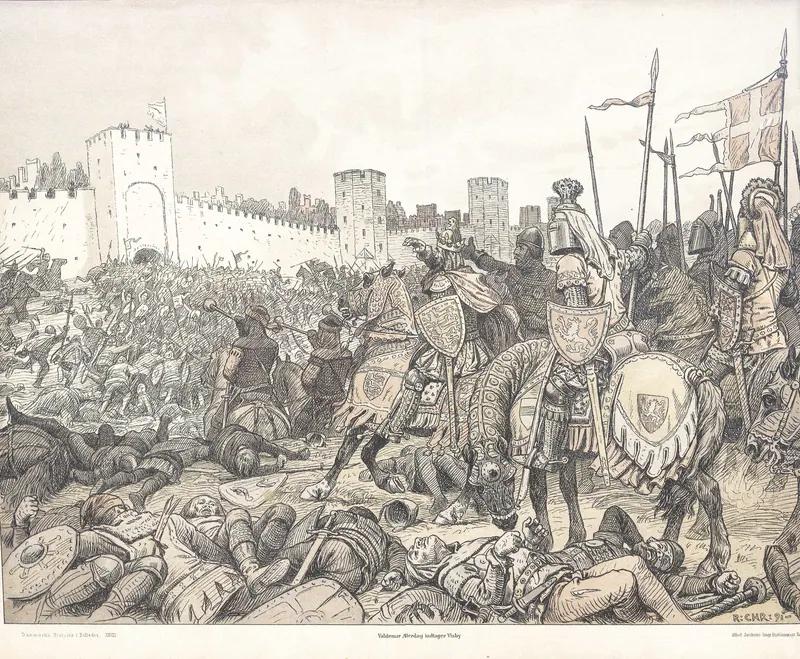
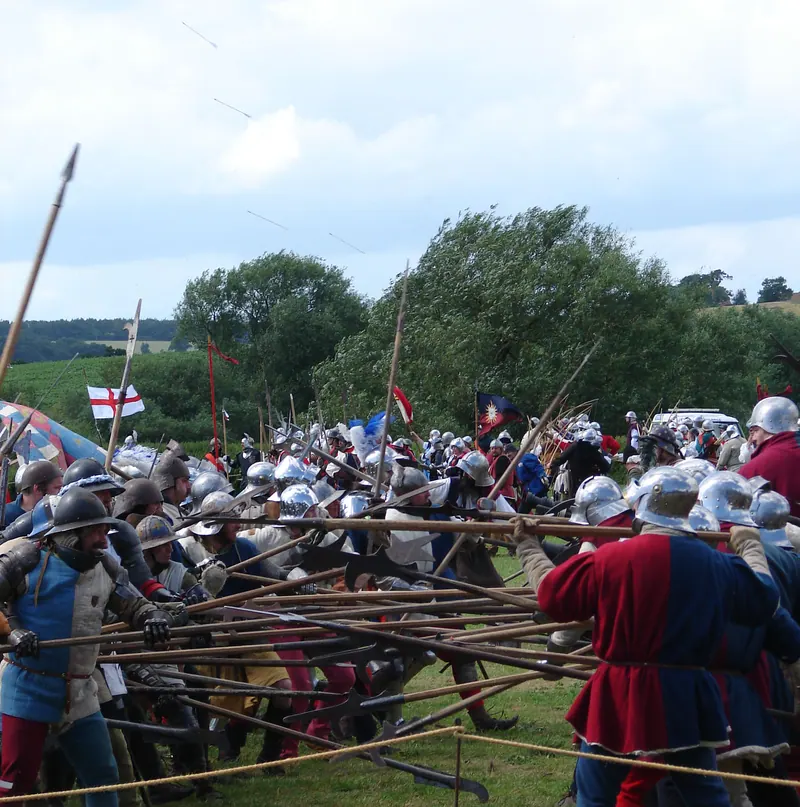
One fixed hour, a rope, a field. The Battle of Grunwald reenactment is free, with around 1,400 armoured fighters on the field at 15:00 on the Saturday nearest 15 July, crowds the organisers quote at about 100,000, and access roads that stop moving afterwards. The Battle of Hastings reenactment is English Heritage’s, £24 for adults booked in advance in 2026, fought once a day on the slope below Battle Abbey in October. Tewkesbury fights its battle twice, for nothing. These suit the history reader and anyone who enjoys a loud outcome. They do not suit anyone who needs a seat, shade or a short toilet queue, and the battle is about an hour of a seven-hour day. The rest of the kind are under reenactment and battles.
The living-history site
A season rather than a weekend, and the quietest option with small children. Guédelon is a castle being built in a Burgundy quarry with the tools of the 1230s, open April to November, €19 to €21 for adults in 2026, and the masons answer questions as they work. Middelaldercentret near Nykøbing Falster is a reconstructed Danish town of about 1400 whose staff stay in character all day and fire a trebuchet; adults paid 179 to 209 kr in 2026 and the ticket is valid for seven days, so a rained-off afternoon is not a lost one. No crowd line, no hour you can miss, a restaurant and a car park. More under living history.
How much does a medieval festival cost?
Entry: nothing, at most of the festivals on our list. Tewkesbury, Ávila, Grunwald, Sighișoara, Esslingen, Turku, Horsens, Šibenik and Bayeux are all free to walk into. Where there is a gate, 2026 prices ran from €6 at the Viagem (Sunday to Thursday; €8 on Friday and Saturday, or €12 for a bracelet covering all 12 days) through €12 at Óbidos and Provins, 350 Kč at Karlštejn on the Saturday, €19 to €21 at Guédelon, 179 to 209 kr at Middelaldercentret, £24 at Hastings in advance, and from €34.90 at Kaltenberg.
Parking is how the free festivals charge you. Tewkesbury’s official car parks are £10 a car, cash only; Grunwald charges for parking too, and the queue to leave is the long part of the day.
The budget goes on food. Every ticket above costs less than a family’s lunch; allow a few euros a stall per head and assume you will stop at four.
Nobody mentions the beds. Visby’s ferries and beds fill months ahead of its August week, and we’d book by February; Sighișoara’s citadel guesthouses sell out months ahead too. Costume, on the other hand, is a discount at several gates: Óbidos drops to €10, Provins to €9, and Karlštejn lets a complete outfit in free. What counts as complete is in what to wear to a medieval festival.
Is a medieval festival the same as a renaissance faire?
No. A European festival sits in a real town or on a real battlefield, usually on the date of something that happened there, and the people in the camps are reenactment groups who came for their own reasons rather than performers on a payroll. Fewer pirates, more pikemen. The Viagem and Óbidos, with their gates, storylines and costume hire by the entrance, are the closest to the faire model; Tewkesbury and Grunwald are the furthest from it.
The vocabulary is different as well. Nobody says huzzah, a camp means a living-history encampment, and kit is what someone has spent their savings on. The glossary, and the reasons not to ask whether it is hot in there, are in the etiquette guide.
Which medieval festival should you go to first?
A family with under-tens: Esslingen’s Christmas market on a weekday afternoon, when the smiths and glass-blowers are watchable and entry is free; Óbidos in the evening, when the heat drops; or Ávila’s children’s programme in the Jardines de San Vicente. Skip them if your under-tens hate noise and late nights: Ávila’s closing parade is at 22:00 and Óbidos runs past midnight.
A couple: Tallinn Old Town Days in early June, with balcony concerts and no battle, or Sighișoara, where the whole citadel is the venue and the Sunday ends with fireworks. Skip them if you want steel; these are the two with the least of it.
A history reader: Hastings, on the field, the weekend nearest 14 October, or Grunwald. Skip them if you need shade and a seat.
A fantasy reader: Visby Medieval Week (Medeltidsveckan), a whole ring-walled town in wool for eight days in early August. Skip it if you have not booked a ferry and a bed by February, because you will not find either in June. Visby without the festival is the quiet version and still has the wall.
The sceptic: Tewkesbury. Free, the second full weekend of July, and two hours is enough to walk the camps and the traders’ field; if you are bored you leave having paid £10 to park. The battle is at 16:00 on the Saturday if you stay. The full case is in our Tewkesbury guide, and the town on its own is on Tewkesbury. Ávila on the first weekend of September is the same bet with better weather and a wall, and the Ávila page covers the town once the stalls have gone.
If none of those fits, the whole calendar is at all festivals, July has the most of them, and the long read is the best medieval festivals in Europe.
Mistakes first-timers make
- Arriving at noon for a 15:00 battle and finding the rope three deep. Be at the line an hour early with something to sit on; at Grunwald, earlier.
- New shoes. The ground is a meadow, a castle hill or cobbles, sometimes all three in a day; wear the pair that has already been rained on.
- No cash. Tewkesbury’s parking is cash only and card readers on a field are a rumour; bring notes.
- No seat. A folding stool is the difference between watching the battle and watching a tall man’s hat. I watched most of one joust over the brim of a stranger’s and can describe the brim.
- Booking Visby in June. February, for the ferry and the bed, or go another year.
- Planning the whole day around the joust. It is a short slot in a long day; plan around the camp and the food and let the joust happen.
- Trying Óbidos and the Viagem on the same day. One is an hour north of Lisbon and the other half an hour south of Porto; pick one per day, and note that a Viagem day ticket does not let you back in.
Leave while the youngest person in the party is still pleased to be there. That is the only review of a festival that counts, and you write it in the car.