Medieval Booker

Living History & Museums ◆ France

Guédelon Castle (living medieval construction site)

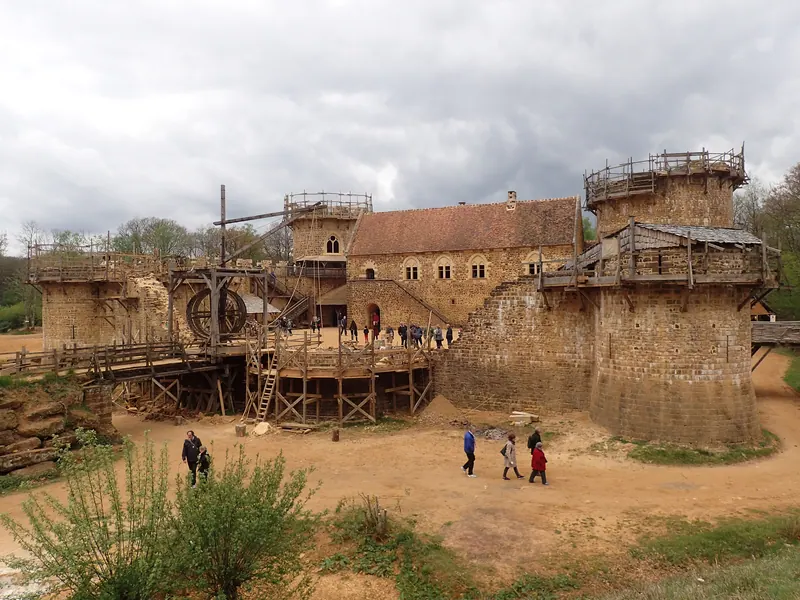
Guédelon is a 13th-century castle being built from scratch in a Burgundy forest quarry using only the tools, materials and techniques of the 1230s, open to visitors from spring to autumn since the first stone was laid in 1997. Around forty masons, carpenters, blacksmiths, tilers, rope-makers and carters work in front of the public, and the site draws roughly 300,000 visitors a season.

When is Guédelon Castle (living medieval construction site) 2027?

Next edition
Expected 2027 Guédelon Castle (living medieval construction site) 2027 See all editions
Where
Treigny, France
Also called
Guédelon · Chantier médiéval de Guédelon · Guedelon Castle
How often
Open for the season
Entry
2026: adults €19–21 and children 5–17 €13–15 depending on season; students €16; under-5s free
Family-friendly
Yes — bring the kids
Founded
1997
Attendance
~300,000 visitors

Checked · we re-check every festival twice a year.

Past and upcoming editions

Editions of Guédelon Castle (living medieval construction site)
EditionDatesStatusCalendar
2027 season – Expected 2027 Google Calendar · .ics

Expected means the organiser hasn't announced yet; we show the usual window.

Past editions (1)
  • 2026 season — 2 April – 1 November 2026

What happens at Guédelon Castle (living medieval construction site)?

Guédelon began in 1997 when Michel Guyot, owner of the nearby Château de Saint-Fargeau, and a group of partners decided to build a castle the way it would have been done under Philip Augustus, in a disused sandstone quarry in the Guédelon forest near Treigny in the Puisaye, about two hours south of Paris. The premise is that a minor lord starts work in 1228 and the builders advance their calendar by a year each season. Nearly three decades on, the towers, curtain walls, great hall and chapel tower stand, and the 2026 programme centres on the gatehouse between two towers, its portcullis and the east curtain wall. The carpentry techniques rehearsed here were used in rebuilding the roof of Notre-Dame de Paris after the 2019 fire.

Visitors walk freely around the site and its workshops: quarrymen splitting stone, masons dressing and setting it, lime-burners and mortar-makers, carpenters squaring oak with axes, a blacksmith forging tools, tile and pottery kilns, rope-makers, dyers and basket-makers, with horse-drawn carts and a treadwheel crane moving materials. The workers answer questions as they go, and guided tours and workshops can be booked. From 2026 visitors can for the first time walk the full circuit of the enclosure. Allow three to four hours; weekdays outside the French school holidays are quietest.

The 2026 season runs from 2 April to 1 November. In summer the site opens daily from 9:30 to 18:30; in spring and from September it opens 10:00–17:30 or 18:00 and closes on certain Tuesdays and Wednesdays, so check the opening calendar on guedelon.fr before travelling. Adult tickets cost €19 to €21 and children aged 5–17 €13 to €15 depending on the season; students pay €16 and under-fives enter free. There are two restaurants, picnic areas, a free car park with electric-vehicle charging, and dogs on a lead are welcome; the site is partly accessible to wheelchair users.

Guédelon lies on the D955 between Saint-Sauveur-en-Puisaye and Saint-Amand-en-Puisaye, and a car is the practical way to reach it: there is no regular bus, and the nearest railway stations (Cosne-sur-Loire and Auxerre) are each roughly a 45-minute drive away. The site is closed from early November until the following spring.
Frequently asked questions

When is Guédelon open in 2027?

The 2027 dates are not published yet. The site opens from late March or early April to the start of November; in 2026 it ran from 2 April to 1 November, daily 9:30–18:30 in summer, with shorter hours and some Tuesday and Wednesday closures in spring and autumn. Check the calendar on guedelon.fr before you go.

How much does Guédelon cost?

In 2026 adults pay €19–21 and children aged 5–17 €13–15 depending on the season; students pay €16 and children under five go free.

What is Guédelon?

A castle in the style of the 1230s being built in a Burgundy quarry since 1997 with only medieval tools, materials and techniques. Visitors watch and talk to the masons, carpenters, blacksmiths and other workers on site.

When will Guédelon castle be finished?

There is no fixed completion date. After nearly thirty years the towers, curtain walls and great hall are up; 2026 work focuses on the gatehouse, its portcullis and the east curtain wall.

How do I get to Guédelon?

By car on the D955 between Saint-Sauveur-en-Puisaye and Saint-Amand-en-Puisaye in the Yonne, about two hours south of Paris. There is no regular bus; the nearest stations, Cosne-sur-Loire and Auxerre, are around 45 minutes away by car.

Is Guédelon good for children?

Yes. Children can watch every trade at close range, join workshops, and picnic on site; dogs on a lead are allowed and there is a free car park.

More medieval festivals in France

Same country, upcoming first.

All festivals in France
  • Featured
    Medieval Markets & Fairs Medieval Christmas

    Ribeauvillé Medieval Christmas Market

    Ribeauvillé, France

    On the first two weekends of December the whole Grand'Rue of Ribeauvillé, a walled wine town under three ruined castles of the lords of Ribeaupierre, becomes a medieval Christmas market: costumed beggars, peasants, dancers and jugglers work the street, the Three Kings arrive with camels, wild boar turns on spits and cervoise is poured from barrels. The 2026 market is on 5–6 and 12–13 December, Saturdays 10:00–19:00 and Sundays 10:00–18:00, and entry is free.

    – 2026
    Family
  • Medieval Markets & Fairs Jousting & Tournaments +2

    Festival Médiéval de Sedan

    Sedan, France

    The Festival Médiéval de Sedan is a two-day medieval festival held on a weekend in May since 1996 in and around the Château fort de Sedan in the French Ardennes, billed as the largest fortified castle in Europe. It brings living-history camps, combat and tournament shows in the castle moats, a market of more than 100 stalls and a Saturday-evening procession.

    Expected 2027
    Family
  • Medieval Markets & Fairs Jousting & Tournaments +2

    Fête Médiévale de Guérande

    Guérande, France

    The Fête Médiévale de Guérande is a two-day medieval festival run by the town of Guérande in and around its walled old town on the Loire-Atlantique coast, usually on the first weekend of June. It brings a costumed parade of more than 2,000 people, equestrian tournaments, taverns, living-history camps and street performers; the 2027 edition is set for 29 and 30 May.

    – 2027
    Family

Other living-history sites and museums

All living-history sites and museums
  • Jousting & Tournaments Living History & Museums

    Middelaldercentret (The Medieval Centre), Nykøbing Falster

    Nykøbing Falster, Denmark

    Middelaldercentret is an experimental living-history museum on the Guldborgsund opposite Nykøbing Falster, where a reconstructed Danish market town of around the year 1400, Sundkøbing, is populated by costumed staff who stay in character all day. Its season runs from early May to late September with daily trebuchet firing, jousting and craft demonstrations, plus an autumn-holiday week in October and a Christmas market.

    – 2026
    Family
  • Medieval Markets & Fairs Living History & Museums +1

    Midwinter Fair Archeon

    Alphen aan den Rijn, Netherlands

    The Midwinter Fair fills Archeon, the open-air archaeological museum park in Alphen aan den Rijn, with a two-day winter fantasy market, folk and pagan bands and fire-lit winter rituals on a December weekend. The backbone is the park's reconstructed medieval town and Roman quarter and the craft stalls; the fantasy is in the costumes, the folklore acts and the Yule theme of celebrating the return of the light.

    – 2026
    Family
  • Featured
    Reenactment & Battles Living History & Museums +1

    JORVIK Viking Festival

    York, England

    The JORVIK Viking Festival takes over York for a week every February half-term with a Viking encampment and traders' market in the city centre, a march of hundreds of warriors, talks, crafts, a best-beard contest and a ticketed finale battle with pyrotechnics. Founded in 1985 by the team behind the JORVIK Viking Centre, it is the largest Viking festival in Europe and draws around 40,000 people.

    – 2027
    Family

Read more about Treigny

Stories and guides from medieval Treigny.

Medieval Treigny — the city guide