A festival field in September is a different animal from the same field in July: cooler, cheaper, half as crowded, and the people in wool are finally comfortable. Between 3 September and 1 November 2026 there are five festivals and three living-history sites worth the trip across seven countries, every date announced by its organiser as of 24 August 2026, and three of the five festivals are free. By the end you’ll know which weekend to take, which one to skip if you are pushing a buggy, and where you can get warm after four.
I pick by my usual three tests, the food, the loos, and whether anyone cried before lunch, plus the autumn one: is there anywhere to thaw.
Checked 24 August 2026; all 2026 dates announced by the organisers
Jornadas Medievales de Ávila, Ávila, Spain (3–6 September 2026)
Jornadas Medievales de Ávila is the big free one: 310 stalls and about 150 activities across some 20 sites inside and below a wall with 88 towers, nine mounted tournaments at the Atrio de San Isidro, falconry, and a Grand Parade of the Three Cultures at 12:00 on Saturday. There is no entry ticket. You pay for food, crafts and the odd workshop. The council counted 130,000 visitors in 2025, which is the catch, and the reason the free shuttle buses from the outlying car parks exist.
Ávila sits at 1,130 m, 90 minutes from Madrid Chamartín by train, and the evenings up there in September are properly cold. Pack the jumper you were going to leave in the car. Families get about 40 activities in the Jardines de San Vicente and a children’s race on Sunday at 11:00 for ages 4–12, which is the quietest hour of the weekend to be inside the wall with a small person.
Medieval Fair in Šibenik, Šibenik, Croatia (4–6 September 2026)
The Medieval Fair in Šibenik (Sajam u srednjovjekovnom Šibeniku) runs on the green strip of the riva directly below the Cathedral of St James, 9:00–22:00 on Friday and Saturday and until 14:00 on Sunday, and the whole programme is free. Costumed craftspeople sell from the stalls, reenactment groups fight in the lanes, there is cannon fire, and the set piece of recent editions is an evening re-enactment on the waterfront of the 1378 naval battle, when Venice and Genoa brought their war to this channel.
The size is the thing to know. The fair paused for five years and came back in 2025 with around 30 exhibitors against the 130 or so of its best years, so this is an intimate weekend by the sea, not a mass festival, and the 2026 programme hadn’t been published when we checked. Treat it as the excuse for Šibenik: the climb to St Michael’s Fortress above the town, the boat out to St Nicholas at the mouth of the channel, and a swim before the cannon start.
Reichsstadt-Festtage and the Meistertrunk play, Rothenburg ob der Tauber, Germany (4–6 September 2026)
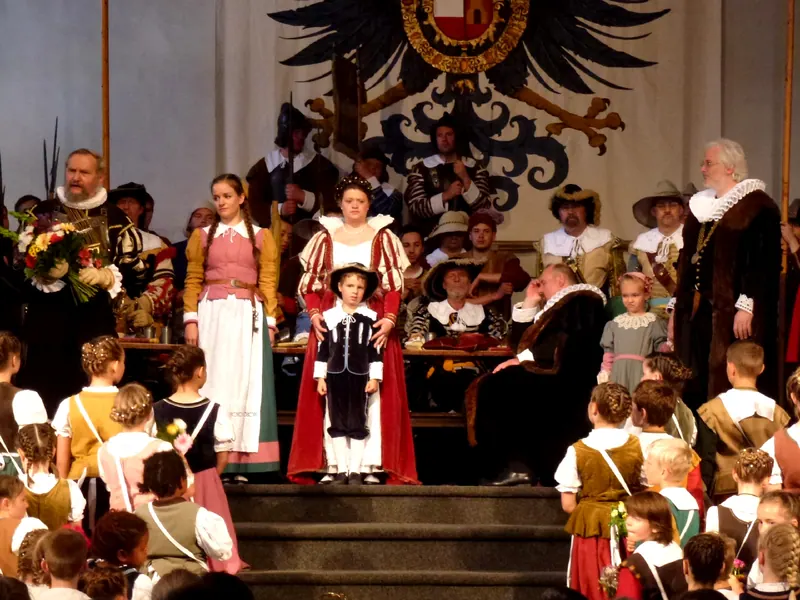
Rothenburg ob der Tauber’s Imperial City Festival Days, 4–6 September 2026, bring the Meistertrunk play out of its Whitsun home: performances in the town hall on Saturday 5 September at 15:30 and 18:00, ticketed through meistertrunk.de, and a free “long night of the Meistertrunk” at the town hall on Friday 4 September at 18:00. The play repeats on 3 October at the same times.
One thing to know before you buy: the story is 1631, not 1331. During the Thirty Years’ War, the legend goes, General Tilly agreed to spare the Protestant town if a councillor could drain a tankard of more than three litres of wine in one go, and former mayor Nusch obliged. It is early modern, the play dates from 1881, and the town itself is the medieval part: a near-complete ring of walls you can walk, and a free imperial city since 1274. Stay inside the walls if you can, because the coaches empty the town by evening, and read the Rothenburg guide for which bits are 1400 and which are 1945.
Karlštejnské vinobraní, Karlštejn near Prague, Czechia (26–27 September 2026)
Karlštejnské vinobraní is the emperor climbing a hill. At 14:30 on both days Charles IV, his empress and a court of more than 150 costumed courtiers, knights and musicians process from the wine research station up through the village to the castle he built in 1348 to keep the imperial crown jewels in. Tournaments run at 11:00 and 16:00, Saturday ends with a torchlit procession, and burčák, the cloudy half-fermented new wine, is everywhere and stronger than it tastes.
Saturday costs 350 Kč and Sunday 250 Kč in 2026; under-15s are free, and so is anyone in complete medieval costume, which makes the kirtle in the wardrobe the best-value ticket on this page. The weekend sits just before St Wenceslas Day on 28 September, a public holiday, so the trains from Prague are full. Take the S7 from the main station, 45 minutes, then walk 20 to 25 minutes uphill from the bridge over the Berounka. Don’t drive: the roads are closed and the parking is worse than the hill. The Prague guide covers the rest of the emperor’s city, and the Czechia list has what else is on that month.
Battle of Hastings Re-enactment, Battle, England (10–11 October 2026)
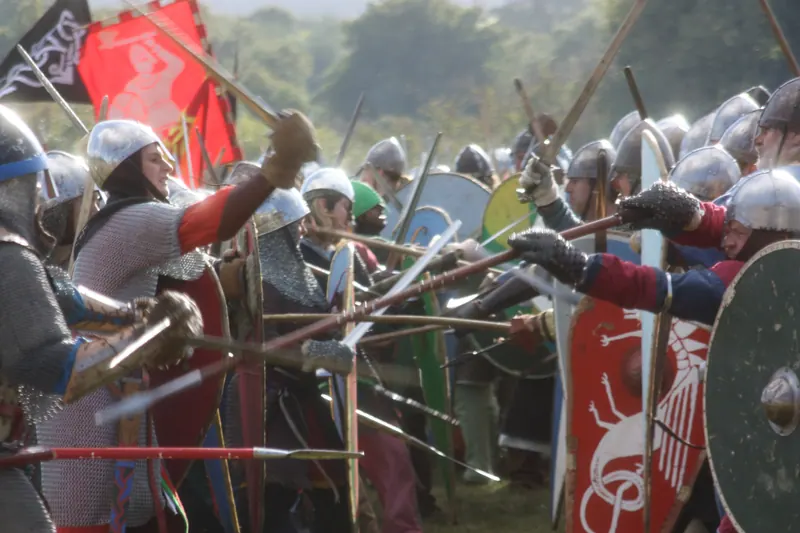
The Battle of Hastings Re-enactment on 10–11 October 2026 marks 960 years since 14 October 1066, and it happens on the slope below Battle Abbey where Harold’s shield wall stood and broke. English Heritage runs it from 10:00 to 17:00 both days: Saxon and Norman camps you can walk through, falconry, a market, a sword school for children, and one full battle a day with cavalry and archers. Advance prices for 2026 are £24 for adults, £12 for children aged 5–17 and from £36 for a one-adult family; on the day costs more, and members pay less.
The ground is grass, and English Heritage’s own note says it can be muddy in October. Wear boots. Book ahead, because the weekend sells well, and take the train: Battle station is on the Charing Cross to Hastings line and a short walk from the abbey gatehouse. The ticket also covers the abbey ruins and the battlefield walk, so arrive at ten and treat the battle as the afternoon. The England list has the rest of the country’s autumn.
Still open before winter: three living-history sites
None of these is a festival. They are places where the year 1400 or the year 1230 is a working day, and each has a date after which the door shuts.
Middelaldercentret, Nykøbing Falster, Denmark
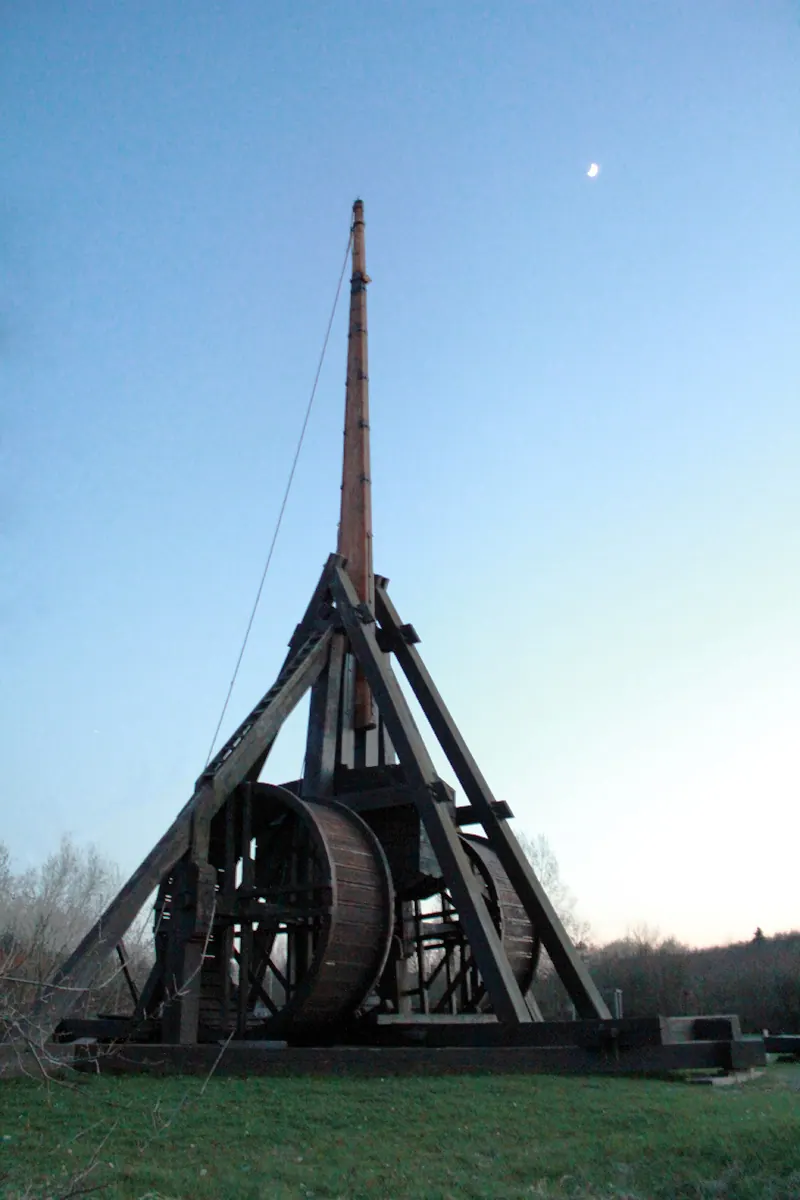
Middelaldercentret is a reconstructed Danish market town of around 1400 on the Guldborgsund, staffed by people who stay in character all day and fire a trebuchet on schedule. Its main 2026 season ends on 20 September, then it reopens for the Danish autumn holiday from 12 to 16 October, 10:00–16:00, with Wednesday 14 October open until 20:30, when it is dark enough for the fires to do their work. High-season prices apply that week: 209 kr for adults, 119 kr for children aged 4–11, 599 kr for two adults and three children, and the ticket is valid for seven days.
It is about 1.5 to two hours from Copenhagen by train and 4 km from Nykøbing Falster station by bus or bike. There is a Christmas market on 28–29 November. Of everything on this page it is the one with a restaurant, a roof and a trebuchet, which is the half-term trifecta.
Guédelon Castle, Treigny, France
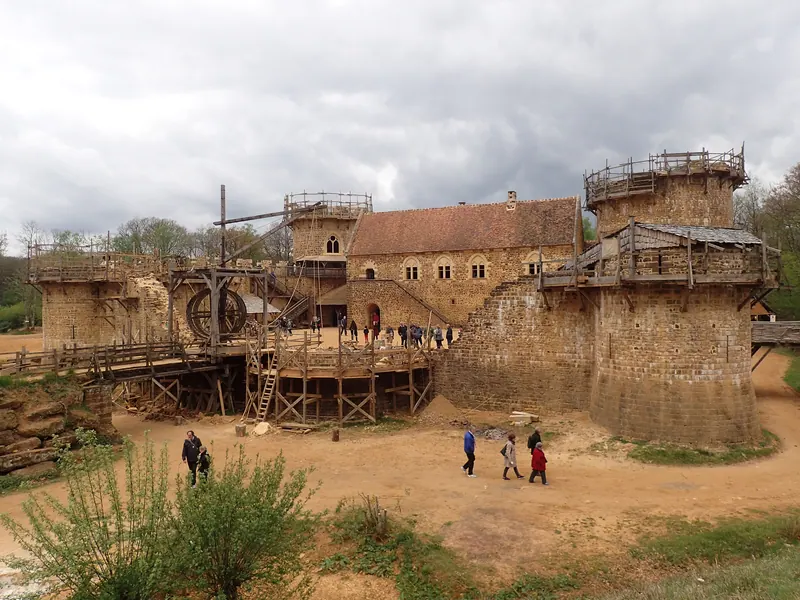
Guédelon Castle is a 13th-century castle being built from nothing in a Burgundy quarry, since 1997, with the tools and methods of the 1230s, and it closes on 1 November 2026. From September it opens 10:00 to 17:30 or 18:00 and is shut on certain Tuesdays and Wednesdays, so check the calendar on guedelon.fr before you drive, and you will drive: there is no bus, and the nearest stations are about 45 minutes away by car. Adults pay €19–21, children aged 5–17 €13–15, under-fives nothing. In 2026 visitors can walk the full circuit of the enclosure for the first time. Allow three to four hours, bring the dog if you have one (on a lead), and ask the masons anything; answering is part of the job.
Cēsis Castle, Cēsis, Latvia
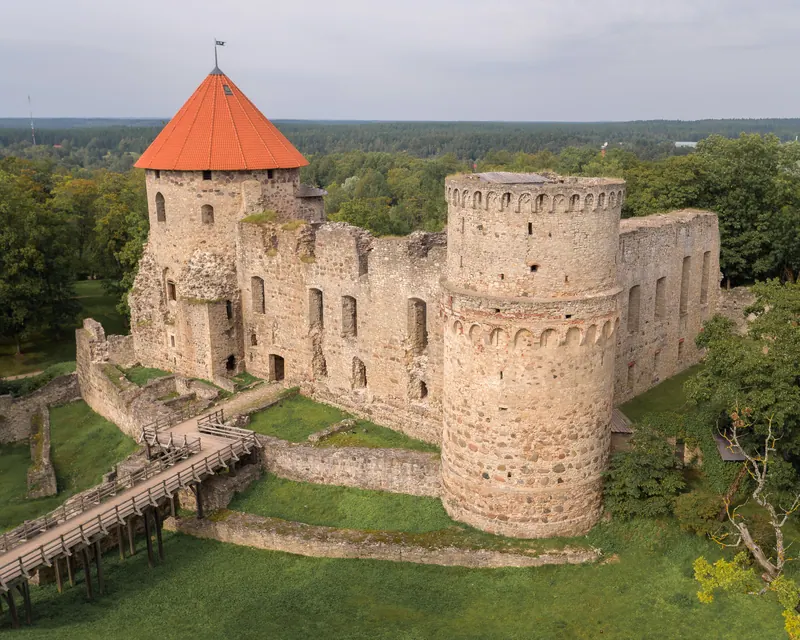
Cēsis Castle, the Livonian Order’s great fortress and Latvia’s best-preserved castle ruin, runs a costumed programme with period-dressed castle folk, games and craft demonstrations in the bailey from May, usually to the end of September; we haven’t verified the autumn hours, so check cesupils.lv. There is no dated medieval festival at Cēsis this autumn that we can find. The old Baltic Medieval Festival has given way to smaller craft days, and the 2026 ones were in July. Go for the castle, which is about 1 hour 45 minutes from Riga by train, and treat anyone in a hood as a bonus.
How to choose
First-timer: Ávila. Free, big, and a real walled city rather than a field with a wall painted on a banner. Skip the Saturday if crowds of six figures undo you; go Thursday evening or Sunday morning.
Family at half-term: Middelaldercentret’s October week, with the fires lit on the Wednesday evening, or Battle for the sword school and the camps. Skip Battle if wet grass on a slope ends the day for your youngest.
A couple who want a coast: Šibenik. Skip it if you need scale; thirty stalls and a naval battle is the whole weekend, and the rest is the Adriatic.
The Prague add-on: Karlštejn, on the Sunday for the cheaper ticket and the lighter crowd. Skip it if you can’t do the hill.
Reenactor: Battle, for the real ground and the 960th. The October and September month pages have the smaller events we didn’t list, and what to wear covers the boots.
What you just missed, and what comes next
Horsens Medieval Festival in Denmark (28–29 August 2026) and England’s Medieval Festival (29–31 August 2026) fall the week before this list starts; the August page has both for next year’s planning. After Battle the outdoor season is over, and the calendar turns to Esslingen’s medieval market and Christmas market from 24 November, the rest of the winter markets across November and December, and then Up Helly Aa in Lerwick on 26 January 2027, where a thousand people with torches decide winter has gone on long enough. The best festivals of 2026–2027 picks fifteen for the whole year.
Ávila at eight in the evening on the first Thursday of September, the closing parade still two hours off and a jumper on for the first time since May: that is the argument for autumn.