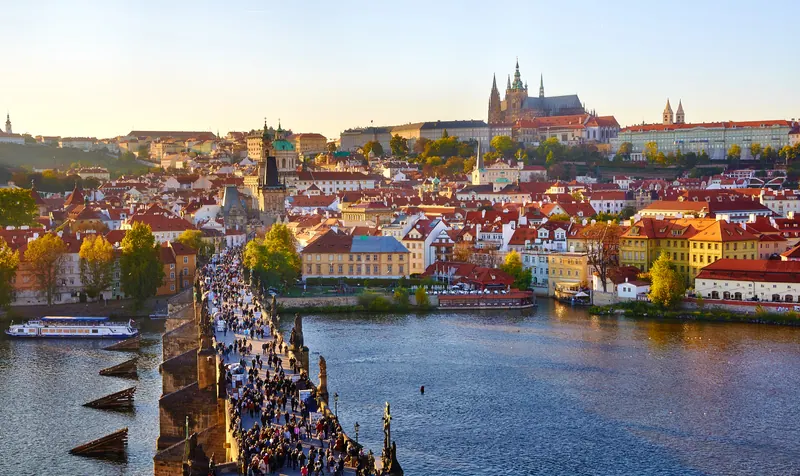
Prague, in Czechia, looks the way it does because one man spent thirty years building it, and the man was Charles IV. The Charles Bridge was begun on his orders in 1357; the New Town was laid out in 1348 on a plan larger than the three existing towns put together; the clock on the Old Town Hall has been running since 1410, thirty-two years after he died and entirely in his spirit. What you see from the bridge at seven in the morning is 14th-century in the bones and Baroque in the skin. Telling the two apart is the whole trick. This walk does that, says where to stand and at what hour, and ends with the two dates that matter: the last weekend of September at Karlštejn, and St Wenceslas Day on 28 September.
What is actually medieval in Prague?
The street plans of the Old Town, chartered in the 1230s, and the New Town of 1348; the Charles Bridge and its Old Town tower; the Old Town Hall of 1338 with its 1410 clock; the Old-New Synagogue of about 1270; the east end of St Vitus; the Vladislav Hall; the Powder Tower of 1475; the Hunger Wall on Petřín. The facades mostly are not. The plan underneath them is, and once you know that you read the city differently: the Baroque is paint, the Gothic is the wall it was painted on.
Old Town and the 1410 clock
Stand in Old Town Square at 08:50 with your back to the Týn church and look at the Old Town Hall. The building is 1338; the astronomical clock on its south face was installed in 1410 by Mikuláš of Kadaň and Jan Šindel, and the city’s claim that it is the oldest still operating has not been seriously challenged. On the hour the apostles pass the two little windows, a skeleton pulls a bell rope, and a crowd films a mechanism that predates the printing press. It takes under a minute. Dispersing takes twenty.
Everything around you is older than it looks. The Old Town got its walls and privileges in the 1230s, and the lanes running off the square towards the river follow that plan, with Gothic arcades and vaulted ground floors surviving under plaster fronts repainted in the 18th and 19th centuries. Duck into any arcade on the south side and look up at the vault before you look at the shop.
Be there for the 09:00 strike, then leave the square by Karlova before the tour groups arrive from the other direction.
Charles Bridge and the towers
There was a stone bridge here from about 1170, the Judith Bridge, and a flood took most of it in 1342. Charles laid the foundation stone of the replacement in 1357; tradition has it that he chose 9 July at 05:31 so the moment read 1-3-5-7-9-7-5-3-1, which is a legend, and a good one, and the kind of thing a man who founded a university might actually have done. Work finished in the early 15th century. The saints along the parapet are later, Baroque additions; the bridge under them and the Old Town bridge tower at its eastern end are the real thing.
By ten in the morning the bridge is a slow-moving queue with caricaturists in it, and from then until dark you will see the tower, the castle and the back of someone’s rucksack. Cross at seven, when the river mist is still on the water and the stone is the colour of wet sand, or after 22:00, when the lamps are lit and the crowd has gone to dinner.
Climb the Old Town bridge tower if it is open: the view back along the bridge is the one every illustrator of a walled river city has been copying since.
The Castle hill: what is 14th-century, what is 1929
Prague Castle was founded by the Přemyslid prince Bořivoj around 880 and has been the seat of Bohemian rulers ever since; by area it is one of the largest castle complexes in the world. A bishopric arrived in 973. Everything you walk through today is layers, and the cathedral in the middle is where the layers show most.
St Vitus was begun in 1344 by Matthias of Arras and continued by Peter Parler, and then it stopped for five centuries. The choir, the east end with the high vaults and the chapel of St Wenceslas, is 14th-century. The nave, the west front and the two tall towers facing the third courtyard were built in the 19th and 20th centuries, and the whole thing was only declared finished in 1929. Walk round the south side and the join is there to see if you look for it: the stone changes character about halfway along.
Next door, in the Old Royal Palace, the Vladislav Hall of 1493–1502 by Benedikt Ried was the largest secular vaulted hall in late-medieval Europe, built wide enough for jousting indoors, with the Riders’ Staircase designed so the knights could come in on horseback. The crown jewels of Bohemia, the crown of 1347 among them, are kept in St Vitus behind seven locks and shown only on rare occasions. Check the castle’s site before you build a trip around seeing them.
Go up in the late afternoon and come down through the Lesser Town, founded in 1257, when the light is on the river and the coach parties are going the other way.
Old-New Synagogue
In the Jewish Town, a few streets north of the square, the Old-New Synagogue was built about 1270 and is the oldest synagogue still in use in Europe. It is small, low, and sits below the current street level, which is how you can tell a building has been there longer than the road. The Golem story attached to Rabbi Loew belongs to the 16th century, three hundred years after the building; the souvenir stalls have not let that stop them. It is a working synagogue, so opening days vary with the calendar and the Sabbath; check before you go.
Vyšehrad and the Hunger Wall
Prague grew up between two hill-forts, the Castle and Vyšehrad, and Vyšehrad is the one the tour buses skip. Most of what stands on the rock today is later fortress work, but the rock, the view down the Vltava and the quiet are exactly as they were, and it is a twenty-minute walk from the New Town. The Hunger Wall climbs Petřín hill on the opposite bank; Charles built it in 1360–62, and the name comes from the tale that he commissioned it to give the poor paid work in a famine. That is a story, and we have labelled it one, but the wall is real and you can walk beside it through the orchards.
Take Vyšehrad at sunset and Petřín in the morning. Both are free and neither has a queue.
Who was Charles IV and why does the whole city look like him?
Charles of Luxembourg became King of Bohemia in 1346 and Holy Roman Emperor in 1355, and he ran Prague as the capital of the Empire, which meant it had to look like one. He started almost everything at once. The archbishopric, then St Vitus in 1344; the university in 1348, the first in central Europe; the New Town the same year, with market places that survive as Wenceslas Square and Charles Square; Karlštejn Castle, also 1348, to keep the imperial regalia; the bridge in 1357; the Hunger Wall in 1360. He had the crown of Bohemia made in 1347 and dedicated it to St Wenceslas, the duke murdered by his brother in 935, whose feast on 28 September is now a national holiday.
The Powder Tower of 1475 came a century later and marks the start of the Royal Route, the coronation procession through the Old Town, over the bridge and up to the castle. Walk it in that direction and you are walking the kings’ way in; walk it in reverse and you are walking the tourists’ way out, which is why it is quieter uphill.
What Charles did not leave behind was peace. Jan Hus preached reform in Czech at the Bethlehem Chapel from 1402; he was burned at Constance on 6 July 1415, and on 30 July 1419 a crowd threw the councillors out of the windows of the New Town Hall, the First Defenestration, which started the Hussite wars. On 14 July 1420 Jan Žižka’s Praguers beat a crusading army on Vítkov hill, east of the centre. The hill has a very large bronze horse on it now and a view over the whole of Charles’s city, and almost nobody goes.
Which medieval events happen in Prague?
Not many inside the city, and the ones that claim the word mostly do not earn it. The real calendar around Prague has two fixed points, one in late June and one in late September, and both are a train ride out.
The September one is Karlštejnské vinobraní, the wine-harvest festival at Karlštejn Castle, held every year on the last weekend of September. The 2026 edition is confirmed for 26–27 September; the 2027 edition is expected 25–26 September and not yet announced. Charles IV and Elizabeth of Pomerania arrive at 14:30 on both days with a procession of more than 150 courtiers, knights and musicians that climbs from the wine research station through the village to the castle courtyard. There are mounted tournaments at 11:00 and 16:00, a torchlit procession on the Saturday evening, and burčák everywhere. In 2026 tickets cost 350 Kč on the Saturday and 250 Kč on the Sunday; under-15s and anyone in complete period costume get in free, which is the most Bohemian pricing policy on this site. The weekend sits just before St Wenceslas Day on 28 September, so a long weekend does both.
The June one is the Royal Silvering of Kutná Hora (Královské stříbření Kutné Hory), an hour east by train in Kutná Hora. It restages a visit by King Wenceslas IV and his court to the silver town around 1400, with a procession at 10:00 on the Saturday from the Italian Court to St Barbara’s and a programme in the park below the mint until 23:00. The 2026 edition was 20–21 June; the 2027 edition is expected 19–20 June, dates not announced, and the organisers say the second half of June is the rule. Saturday cost 300 Kč in 2026, Sunday 150 Kč, and you can hire a Gothic costume on site for 100–150 Kč.
The markets on Old Town Square at Easter and Christmas are markets. They are pleasant, they are lit well, and nothing about them is older than the stall timber. The Czechia list has the country’s other dates, and the September and October guide puts Karlštejn beside its European rivals.
Book Karlštejn for the Saturday: the torchlit procession is the reason to stay past dark, and the Sunday ticket is cheaper because it ends at 17:00.
When should you go for the medieval side?
Late September, and the reason is light. The sun comes in low along the river from about 17:00, the trees on the embankment are turning, the bridge stone goes gold for an hour, and the last weekend of the month is Karlštejn, with the 28 September holiday on its heels. Expect the city to be full that weekend; it is a public holiday in a capital with a castle.
June is the alternative if Kutná Hora is the point: long evenings, the festival’s Saturday running until 23:00, and Prague itself in its summer crowd, which is the downside. December is beautiful because the bridge is lit and empty at 07:00 in the cold, and the markets are not medieval; go for the one and not the other.
If you can only manage one day on the bridge, make it a weekday in late September, early.
What should you eat?
Trdelník first, because you will be offered one within a hundred metres of the bridge. The sugared chimney cake on a spit is not a Prague dish and not medieval, whatever the sign says. Eat one if you like warm sugar, and do not let anyone tell you that you have eaten history.
Burčák is the real seasonal thing: partly fermented new wine, cloudy, sweet, fizzing slightly, sold by the cup in September and at Karlštejn by the litre. It tastes like grape juice that has started to have opinions, and it keeps fermenting after you drink it, so two cups is plenty before a 25-minute walk up to a castle. In a pub, order the pork knuckle or svíčková, beef in cream sauce with bread dumplings, which is not 14th-century either but is what Prague actually cooks. The longer argument about what was really on a period table is in medieval festival food.
Drink the burčák at the bottom of the hill, not the top.
Getting there and around, and the castles worth the hour
Prague’s centre is walkable and the trams are the fastest way across it; you will not need anything else until you leave. Sleep in the Old Town if you want to be on the bridge at seven and do not mind paying for the privilege, in the Lesser Town below the castle if you want quiet lanes at night, or across the river in Vinohrady if you want a flat at a local price and a tram ride in.
Karlštejn is the first castle and the easy one. Take the S7 suburban train from Prague main station towards Beroun; it is 45 minutes to Karlštejn, then a walk across the Berounka bridge and 20–25 minutes up through the village. Charles built the castle between 1348 and 1365 to keep the imperial regalia, and it still looks like a place designed to keep something: a tall keep on a spur, walls stepping down the rock. Tours of the interiors are booked separately from any festival ticket, and on festival days the roads are closed and parking is close to impossible, so the train is the only sensible plan.
Křivoklát, further west along the same river valley, is the other royal castle within reach: less visited, and a longer trip with a change of train. We have not checked the current timetable, so look it up before you commit a day to it.
Kutná Hora is the second day trip and the better one if you like a town around your castle. Direct trains from the main station take about an hour to Kutná Hora hlavní nádraží, and a shuttle train or bus continues to Kutná Hora město by the centre. St Barbara’s was begun in 1388 by Peter Parler’s workshop as a church meant to rival St Vitus; the mines ran out before it did, and the west end was finished in 1905, which makes it Prague’s cathedral in miniature, right down to the centuries-late ending. Sedlec, a short way east, has the ossuary: the bones of perhaps 40,000 people arranged into chandeliers and coats of arms in 1870. It is a cheerful place to end a day that began with a 14th-century clock.
Give Prague two days and the castles one each. If you can take only one of the three trains, take the S7 on the last Saturday of September, stand in the village at 14:25, and watch an emperor who has been dead since 1378 walk up to his own front door.