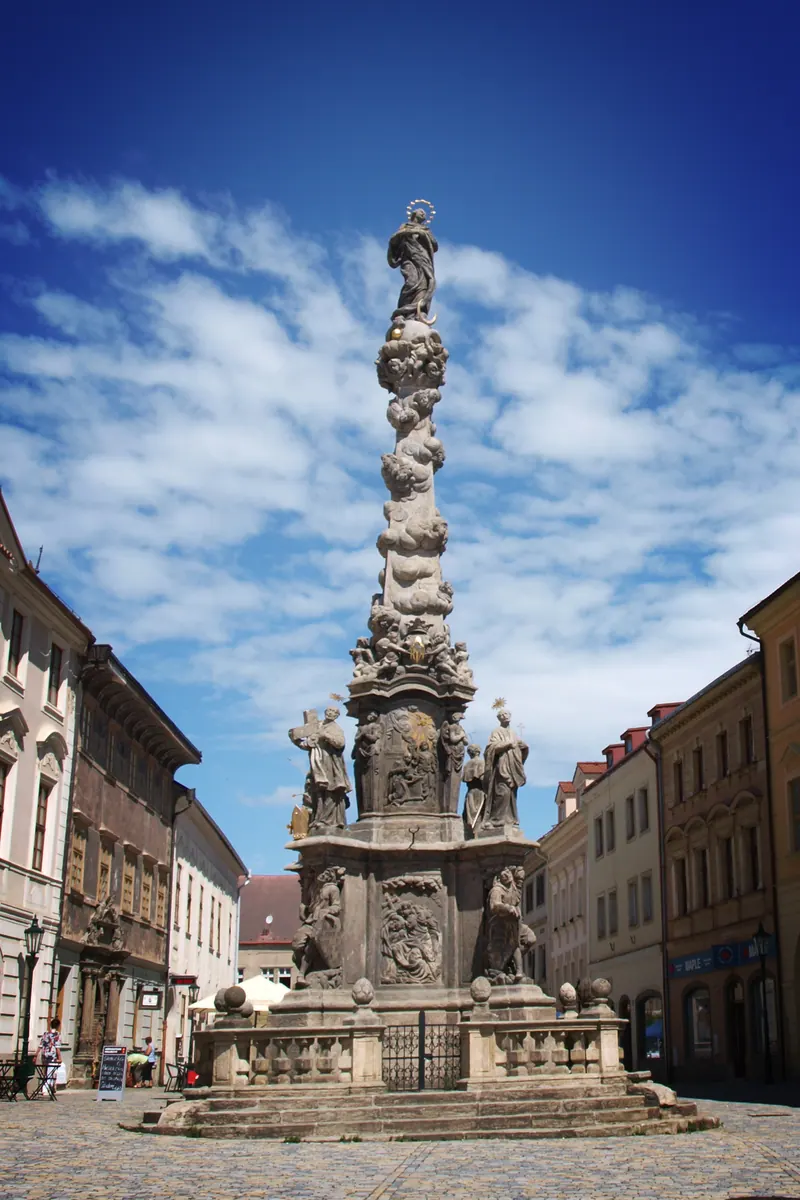
The silver that paid for Kingdom Come: Deliverance’s Bohemia came out of the ground under Kutná Hora, and most of it is still there in the form of a town. Kuttenberg is Kutná Hora, in Czechia, about 70 km east of Prague; Rattay is Rataje nad Sázavou, Talmberg is Talmberk, Sasau is Sázava, and Trosky, the two-towered castle the sequel opens beneath, is Trosky. The mint where the Prague groschen was struck from 1300, a gallery of the Osel mine 22 m down, and the cathedral the miners built for their own saint all stand and take visitors. By the end you’ll know what is real in each place, what the game moved, and when to come so that the court of 1400 is in residence, which is one weekend in June.
Is Kingdom Come: Deliverance set in real places?
Yes, and unusually faithfully. Warhorse Studios built the first game on a stretch of the Sázava valley south-east of Prague in the year 1403, and the second, released on 4 February 2025, on the Bohemian Paradise around Trosky and on Kutná Hora itself, keeping the real names in their German forms. The mapping below is the one we could check; the game shortens every road between them.
Kingdom Come: Deliverance, game to map (checked 12 September 2026; every row is flagged for our researcher, so treat it as a guide, not a deed)
What happened in Bohemia in 1403?
One paragraph, one date. Wenceslas IV, King of Bohemia, was seized in March 1402 by his half-brother Sigismund, King of Hungary, who then governed Bohemia in his name and brought his own troops into it; the chroniclers put Wenceslas’s escape from custody in Vienna in November 1403. Its sack of Skalitz is the game’s dramatisation of that year, with Sigismund’s Cuman mercenaries as the raiders. Villages burn in the game that are on no list a historian keeps, which is the novelist’s privilege, and the game is honest about using it.
The silver is the part nobody has to dramatise. Ore was found in the hills east of Prague in the late 13th century, and the rush that followed turned scattered settlements into a royal town that for a time supplied a large share of Europe’s silver. In 1300 Wenceslas II issued the Ius regale montanorum, one of the earliest mining codes in Europe, and concentrated the kingdom’s minting at the Italian Court, named for the Florentine specialists who introduced the Prague groschen struck there.
By 1400 Kutná Hora was the second city of Bohemia and a favoured residence of Wenceslas IV, who rebuilt the court as a palace; it was here, in January 1409, that he signed the decree that handed Prague’s university to the Bohemian nation and Jan Hus’s party. The town in the sequel is rich because the town was rich.
What is real in Kuttenberg?
Almost everything with a stone in it. Prices below are as of August 2026, and the operators change them in January.
The Italian Court
The Italian Court (Vlašský dvůr) was the central royal mint from 1300 under Wenceslas II, gained its palace, audience hall and chapel under Wenceslas IV around 1400, and struck coins until 1727. Its Royal Mint route is CZK 120, the Royal Palace CZK 150 with a Czech guide or CZK 190 with an English one, and for CZK 50 you hammer out your own groschen on a die and take it home with a certificate. Open daily, with a lunch break from 11:45 to 12:15 that the 14th century would have understood.
The silver mine
The Czech Museum of Silver occupies Hrádek, a mansion a mine owner rebuilt in the 1490s on the ore beneath it, and its Route II puts you in a perkytle, the white hooded canvas smock the miners wore, and a helmet lamp, and walks you about 250 m through a real gallery of the Osel mine, 22 m down. CZK 200, guided only, booked ahead; closed on Mondays and for all of February; nobody under six goes down, and the museum lists claustrophobia among the reasons to stay up. Osel means donkey, and the story goes that the animal found the first ore. The game’s tunnels are wider.
St Barbara’s
The Cathedral of St Barbara was begun in 1388 by Peter Parler’s workshop and paid for by the mining companies rather than a bishop, which is why the chapels off the ambulatory have frescoes of miners at the winch and minters at the bench; ask for the Hašplíř chapel. Work stopped in 1558 when the silver ran short, and the west end was only closed off in 1905. CZK 180 an adult, open daily, 09:00 to 18:00 from April to October. Stand at the east end and look back down the nave at Benedikt Ried’s vault, and you will understand what a mining town thought money was for.
Sedlec: the ossuary and the cathedral
The Sedlec Ossuary holds the bones of an estimated 40,000 people, stacked into pyramids, a chandelier and a coat of arms by the woodcarver František Rint around 1870, in the lower floor of a cemetery chapel of the early 14th century. Entry is by timed slot, the “Areál Sedlec” ticket (CZK 220) also covers the Cathedral of the Assumption next door, and photography inside the ossuary is not allowed, which is the honest downside for a certain kind of visitor.
The cathedral is the older story: the church of the first Cistercian house in Bohemia, built between 1290 and 1320, burnt out by the Hussites in 1421 and left a ruin for nearly three centuries until Santini-Aichel rebuilt it from 1703 without straightening a single Gothic line. Half an hour for the bones. Longer for the church.
The Silver Kuttenberg walk
The town’s own guide service runs the Silver Kuttenberg walk under the KCDlive banner: two hours on foot setting the streets of the sequel against what actually stood here in 1403, with the plot kept back, by the operator’s description, with entry to the mint and a struck groschen included. CZK 650 an adult, CZK 455 for students and seniors, CZK 1,755 for a family of four; departures are published about a month ahead and reservations are required at least three days in advance, with a minimum of two people. The operator lists Warhorse Studios among its partners. Do it after you have walked the streets once on your own, so the guide is correcting your memory rather than making it.
Two more the game got right without a ticket: the Church of St James, begun in the 1330s and finished in 1420 with one 80 m tower where the design called for two, free with a guide leaflet but on short seasonal hours; and the Stone Fountain of 1493–95, a twelve-sided tank built because the town’s own mines had wrecked its groundwater and drinking water had to be piped in from a spring 2.5 km away. Never ornamental, it supplied the town until 1890.
What is real in Rattay, Talmberg, Sasau and Skalitz?
Rataje nad Sázavou, the game’s Rattay, is a small town on a bend of the Sázava with the castle of Pirkštejn on the rock above the river and a chateau on the square, and the layout is the game’s layout: a town on a hill with the water below. The castle is not: the game gives Rattay a fortress with wards and a tournament ground, where the real Pirkštejn is a compact late-medieval seat and the chateau a country house. Go for the river, the bridge and the shape of the streets, and set your expectations at “a place you will recognise” rather than “a place you have been”.
Talmberk, the game’s Talmberg, is a ruin on a spur above a hamlet a few kilometres from Rataje, and the Divish who keeps you waiting at his gate has a real original: Diviš of Talmberk held the castle from 1390 to 1415, by the account the game’s own wiki gives. What stands is a fragment of tower and wall. We have not verified access on the ground, so plan it as a view from the road on the way to Sázava.
Sázava, the game’s Sasau, is the one village on the list with a building worth the drive on its own. The Benedictine monastery was founded around 1032 for the hermit Procopius, later Saint Procopius, by the Přemyslid dukes, and its Gothic church was never finished, which the game also gets right; the monastery takes visitors, and its own history page has the story of the Slavonic liturgy that was kept here when Latin ruled everywhere else.
Stříbrná Skalice, the game’s Skalitz, is a village a short way south whose name keeps the silver that was once dug near it, and it is a drive-through with a stop for the church rather than a destination.
The distances are the thing to understand. Rataje, Talmberk and Sázava sit within roughly a quarter of an hour’s drive of one another, and the game makes them a morning’s ride apart; Trosky is in a different landscape altogether, about two hours’ drive north in the Bohemian Paradise, where Čeněk of Vartenberk founded the castle between 1380 and 1390 on two basalt plugs and named the towers Baba and Panna, the Crone and the Maiden. The sequel opens beneath them, and for once the skyline is the skyline. Kutná Hora’s guide service also runs KCDlive experiences at Malešov, Suchdol, Rataje nad Sázavou, Sázava and Trosky, which is the way to do the villages without a car and a map you argue with.
What about the siege of Kutná Hora?
It belongs to a different war. The fighting around the town in December 1421 was the Hussite wars, when Sigismund, by then the crowned and disputed king, marched on Kutná Hora and Jan Žižka’s army fought him out of it; the Cistercian church at Sedlec burned that year, and the town’s own history records mine shafts used as mass graves in the years the town changed hands. Eighteen years and a religious revolution separate it from the game’s 1403, and it deserves its own paragraph, which is this one.
Where to see it: the festival and the emperor’s castle
The Royal Silvering of Kutná Hora (Královské stříbření Kutné Hory), held since 1992, puts the court of 1400 back in the town for a weekend in the second half of June: Wenceslas IV and his household process on the Saturday at 10:00 from the Italian Court to St Barbara’s, and the programme runs in Breüerovy sady below the mint until 23:00 that night, with tournaments, crafts, music and the kind of feast a mining town could afford. Its 2027 edition is expected on 19–20 June, with 26–27 June also possible; the dates were not announced when we checked.
In 2026 the Saturday cost 300 Kč for an adult and the Sunday 150 Kč, children under six went free, and Gothic costume could be hired on site for 100–150 Kč, which is the cheapest way into the year 1400 on this page. Everything else in the country’s calendar is under Czechia, and the month is under June.
The emperor is an hour the other way. At the Karlštejnské vinobraní (Karlštejn Wine Harvest Festival), on the last weekend of September, Charles IV’s court climbs to the castle he built at 14:30, with tournaments at 11:00 and 16:00 and the year’s new wine, burčák, cloudy and half-fermented, sold below the walls; 26–27 September 2026 is confirmed and 2027 is expected on 25–26 September. Charles was Wenceslas’s father, and the castle was built to hold the crown jewels his son would lose the right to. Prague is the base for both, about an hour from each by train, and the Prague guide has what Charles left in the city.
How to do it in a day from Prague
Take the train from Prague to Kutná Hora hlavní nádraží, about an hour, and start at Sedlec, ten minutes’ walk from the platform, with a timed ossuary slot booked before you left. Then the shuttle or the local train up to the town for the mine, which you booked too, and the Italian Court, where you strike the groschen. Do the guided walk on a second visit, once you know the streets, or on a first one if you would rather be told.
The villages need a car and most of a second day, and Trosky needs a third, unless you fold it into a trip north. Skip the ossuary if you came to photograph it, because you cannot, and skip the mine if you came with a five-year-old, because they will not let either of you down.
By the end of the day there is a coin in your pocket that you hammered yourself, on the site where the real ones were struck for four centuries, and it is worth exactly what the game says a groschen is worth: nothing, and everything.