Medieval Booker

Central Bohemia ◆ Czechia

Medieval Kutná Hora

Former royal silver-mining town 70 km east of Prague, the second city of medieval Bohemia and home of the Prague groschen. St Barbara's Cathedral, the Italian Court mint and the Sedlec ossuary make up its UNESCO-listed heritage.

1 festival 9 places no articles yet next event 19 June 2027

Why is Kutná Hora a medieval destination?

Kutná Hora owes everything to silver. Ore was found in the hills east of Prague in the late thirteenth century, and a rush of miners turned scattered settlements into a royal town so productive that for a time it supplied a large share of Europe’s silver. In 1300 King Wenceslas II issued the Ius regale montanorum, one of the earliest mining codes in Europe, and concentrated the kingdom’s minting at the Italian Court (Vlašský dvůr), named after the Florentine specialists who introduced the Prague groschen struck there.

In the fourteenth and fifteenth centuries Kutná Hora was the second city of Bohemia after Prague and a favoured residence of Wenceslas IV, who rebuilt the Italian Court as a palace. It was here in 1409 that he issued the Decree of Kutná Hora, which handed control of Prague’s university to the Bohemian ‘nation’ and Jan Hus’s party. The miners and German patricians sided against the Hussites, and the town changed hands repeatedly during the Hussite wars, with mine shafts used as mass graves.

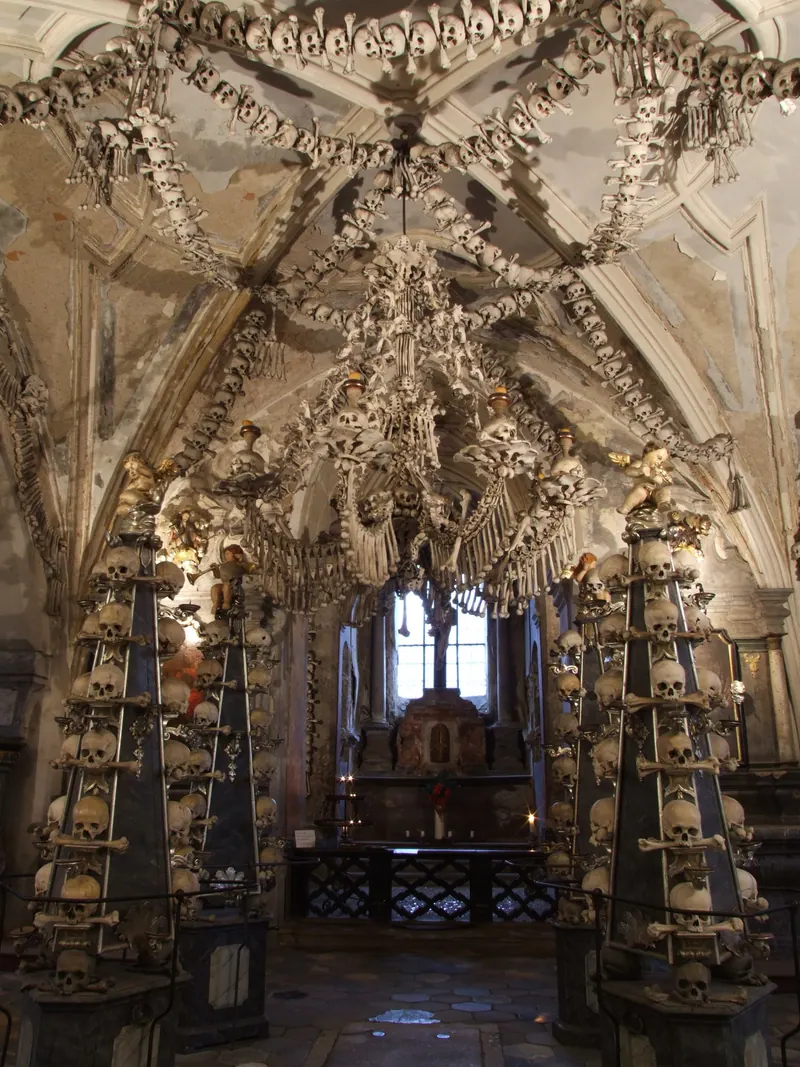
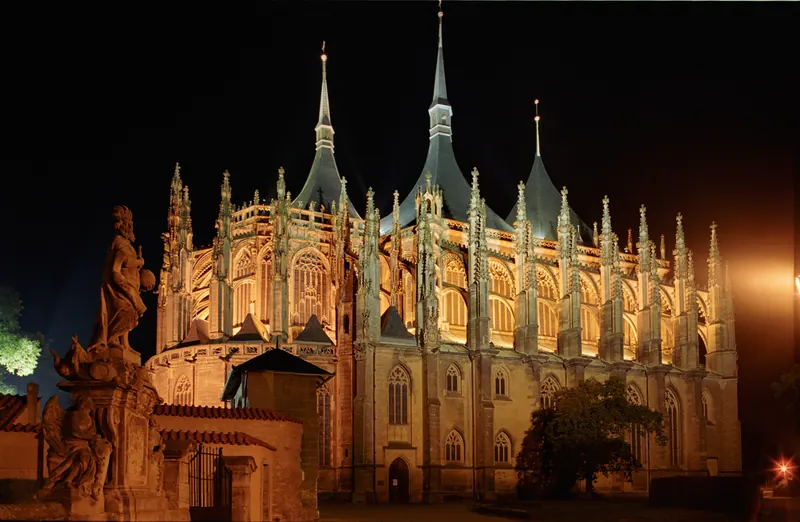
The buildings reflect the money. The Cathedral of St Barbara, patron of miners, was begun in 1388 by Peter Parler’s workshop as a church meant to rival St Vitus in Prague; work stopped when the mines faltered and the west end was only completed in 1905. The Stone House, the Stone Fountain of 1495 and the burghers’ houses on the squares date from the same late-Gothic boom, and the Jesuit College on the terrace above the valley was added in the 1660s. At Sedlec, a short way east, the Cistercian abbey founded in 1142 has a cathedral reworked by Santini-Aichel around 1700 and the ossuary whose bones, from perhaps 40,000 people, were arranged into chandeliers and coats of arms in 1870.

The mines were exhausted by the early eighteenth century, the mint closed in 1727 and the town dwindled, which is why so much Gothic fabric survived. The historic centre with St Barbara and the Sedlec cathedral was inscribed by UNESCO in 1995. Kutná Hora is about an hour by train from Prague; the Czech Museum of Silver runs tours into a medieval mine gallery, and the Royal Silvering festival in June fills the park below the Italian Court.
Medieval festivals in Kutná Hora

Jousting & Tournaments Living History & Museums +1

Královské stříbření Kutné Hory (Royal Silvering of Kutná Hora)

Kutná Hora, Czechia

The Royal Silvering of Kutná Hora recreates a visit by King Wenceslas IV and his court to the silver-mining town around the year 1400, with a costumed procession from the Italian Court to St Barbara's Cathedral, mounted tournaments, period music, crafts and a torchlit evening programme in the park below the royal mint. Held on a weekend in late June since 1992, it reached its 32nd edition on 20–21 June 2026.

Expected 2027
Family

Months with a festival are linked. Expected dates say so. June

What else to see in medieval Kutná Hora

Short list on purpose. Everything here is somewhere we'd actually send you, checked and still standing.

Museums & collections

Museum Start here

Czech Museum of Silver and the medieval mine

Hrádek rebuilt in the 1490s by Jan Smíšek of Vrchoviště; the mine gallery worked 14th to early 16th century

The town's silver museum occupies Hrádek, a late-Gothic mansion built by a mine owner on the ore beneath it, and its second route puts you in a miner's white canvas smock and a helmet lamp and walks you 250 m through a real gallery of the Osel mine. Book Route II ahead, and note that nobody under six is allowed underground.

Good with children Works in the rain
Walking directions
Museum

Stone House and its lapidarium

Pre-Hussite cellars; upper storeys and gable c. 1489, facade sculpture after 1491; re-Gothicised 1900–02

A pre-Hussite burgher's house that gained two more storeys and a carved gable around 1489, now a branch of the silver museum. Buy the lapidarium ticket rather than the house one: the Gothic stone salvaged from Kutná Hora's churches is in the two-storey cellars, down a staircase off the front hall.

Works in the rain Free or cheap
Walking directions

Churches & ossuaries

Church

Cathedral of St Barbara

Begun 1388 by Peter Parler's workshop; choir vault by Matěj Rejsek from 1489, nave by Benedikt Ried after 1512; work stopped 1558, west front completed 1905

Begun in 1388 by Peter Parler's workshop, carried on by Matěj Rejsek and Benedikt Ried, abandoned in 1558 when the silver ran short and only closed off at the west end in 1905 — a cathedral built by miners for their own patron saint, not by a bishop. Go straight to the chapels off the ambulatory and ask for the Hašplíř and minters' chapels: their frescoes show men in white hooded smocks working a winch and Prague groschen being hammered out by hand.

Works in the rain Quiet corner
Walking directions
Church

Sedlec Ossuary

Cemetery chapel of the first half of the 14th century; bone arrangement by František Rint, around 1870

A two-storey Gothic cemetery chapel of the early 14th century whose lower floor holds the bones of an estimated 40,000 dead, stacked into four pyramids, a chandelier and a coat of arms by the woodcarver František Rint around 1870. Book a timed slot before you travel and leave the camera in the bag: photography inside is banned outright.

Works in the rain
Walking directions
Church

Cathedral of the Assumption at Sedlec

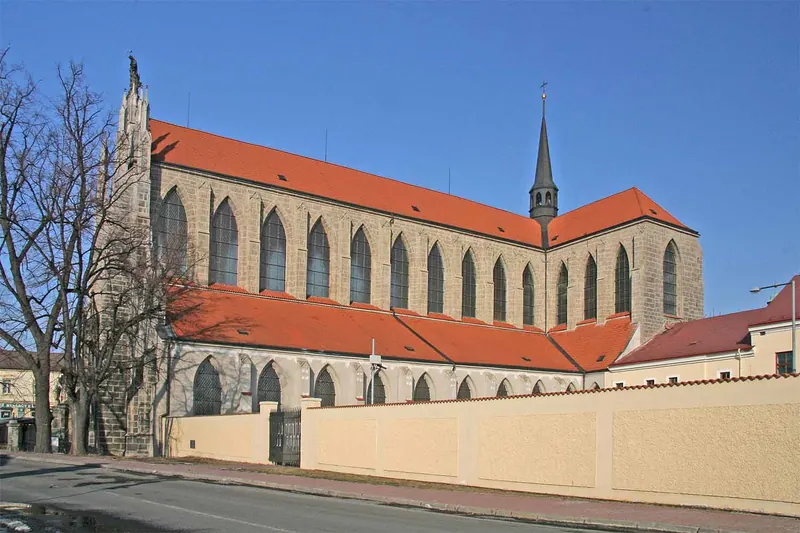
Cistercian abbey founded 1142; church built 1290–1320; burnt by the Hussites 1421; rebuilt by Santini-Aichel 1703–08

The abbey church of the first Cistercian house in Bohemia, built between 1290 and 1320 on the plan of a French cathedral, burnt out by the Hussites in 1421 and left a ruin for nearly three hundred years until Santini rebuilt it from 1703 without straightening a single Gothic line. Your ossuary ticket already covers it and it is a few minutes' walk away — most visitors never use the second half.

Quiet corner Works in the rain
Walking directions
Church

Church of St James

Begun in the 1330s, completed 1420; restored 2019–22

The oldest stone church in the town, begun in the 1330s and finished in 1420, with one 80 m tower where the design called for two. It is free to go in with a text or audio guide — but the hours are short and seasonal, so check the day before rather than turning up.

Free or cheap Quiet corner
Walking directions

Landmarks & bridges

Landmark

Stone Fountain

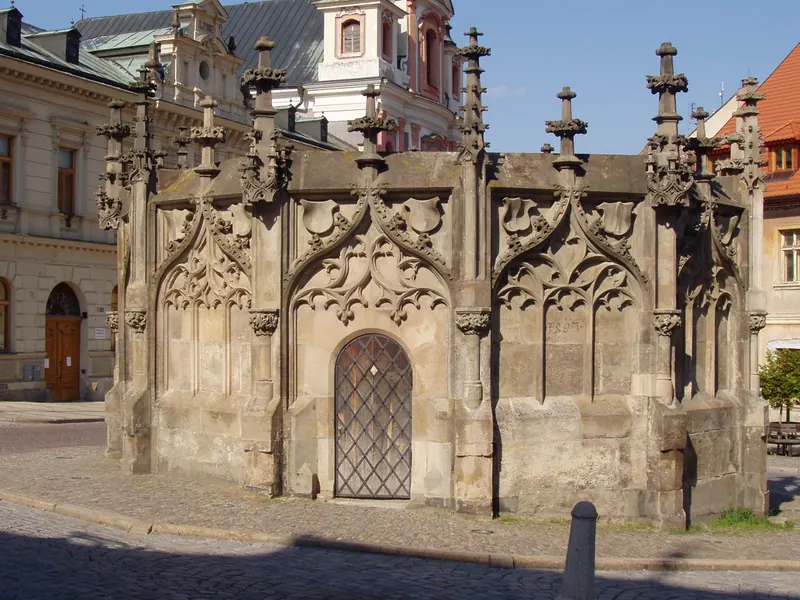
Built 1493–95, attributed to Matěj Rejsek and now to the mason Brikcí Gauske; largely re-cut by Ludvík Lábler 1887–90

A twelve-sided late-Gothic water tank of 1493–95, built because the town's own mines had ruined its groundwater and drinking water had to be piped in from a spring 2.5 km away. It is not an ornamental fountain and never was — look for the blind tracery, and note that it supplied the town until 1890.

Free or cheap Quiet corner
Walking directions

Castles & fortresses

Castle

Italian Court (Vlašský dvůr)

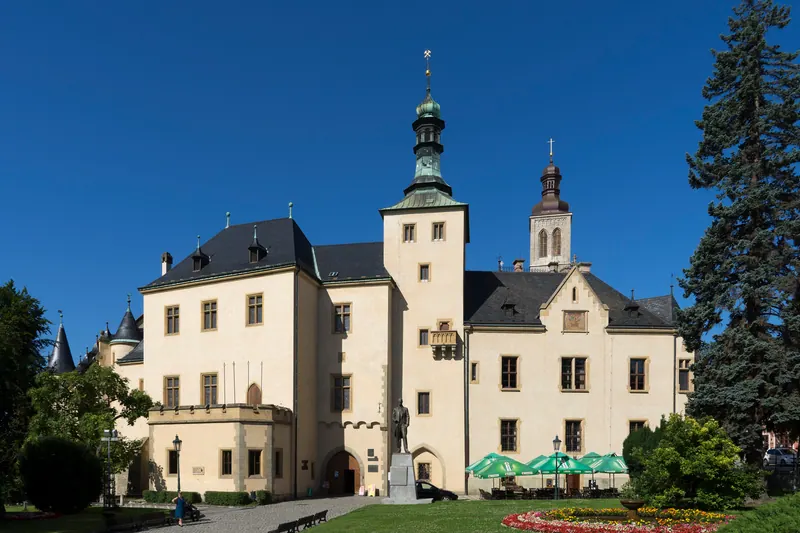
Central royal mint from 1300 under Wenceslas II; palace and chapel added by Wenceslas IV around 1400; mint closed 1727

The royal mint of Bohemia from 1300, where the Prague groschen was struck for four centuries, rebuilt by Wenceslas IV as a palace with an audience hall and a chapel. For CZK 50 you can hammer out your own groschen on a die and take it home with a certificate.

Good with children Works in the rain
Walking directions

Tours & workshops

Experience

Silver Kuttenberg — the Kingdom Come: Deliverance walk

Set in 1403; the buildings on the route are 14th- and 15th-century

Two hours on foot round the real Kutná Hora with the town's own guide service, setting the streets you walked through in Kingdom Come: Deliverance II against what was actually here in 1403, and ending with a groschen you strike yourself at the mint. Book at least three days ahead — departures are published about a month at a time.

Good with children
Walking directions
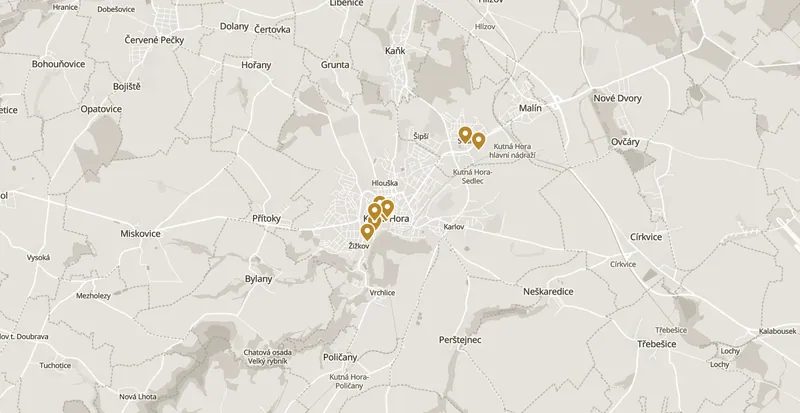
Map of the places worth your time in Kutná Hora
Everything above, on one map. Tap a link to open it in Google Maps on your phone. © MapTiler © OpenStreetMap contributors

More medieval festivals in Czechia

All festivals in Czechia
Featured
Living History & Museums Music, Feasts & Theatre +1

Karlštejnské vinobraní (Karlštejn Wine Harvest Festival with Emperor Charles IV)

Prague, Czechia

Karlštejn's wine-harvest festival brings Emperor Charles IV, Empress Elizabeth of Pomerania and a court of more than 150 costumed courtiers back to the castle he built 30 km south-west of Prague to guard the imperial crown jewels. Held on the last weekend of September, it combines ceremonial processions up to the castle, mounted knights' tournaments, period music, crafts and tastings of young wine and burčák; the 28th edition is confirmed for 26–27 September 2026.

2026
Family

Other medieval cities in Czechia: Prague