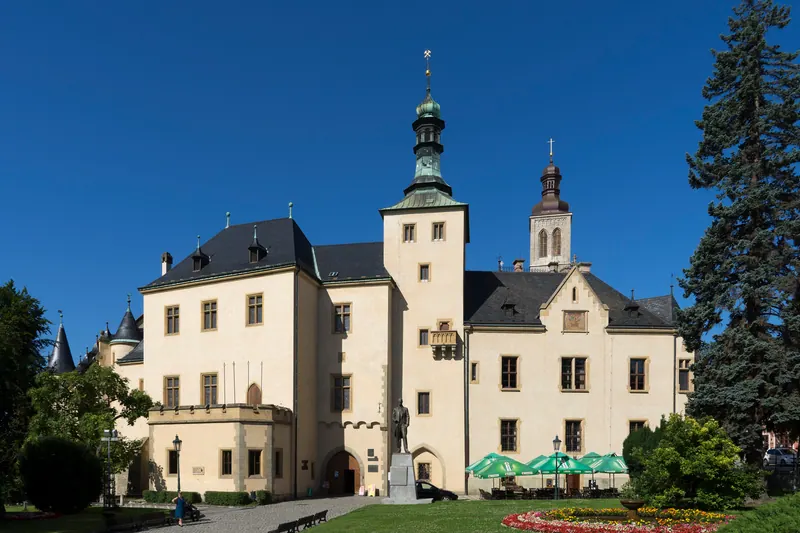
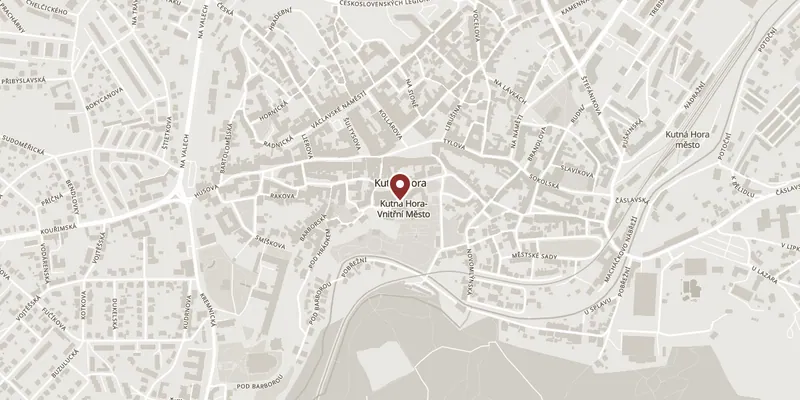
In 1300 Wenceslas II reformed the coinage of the kingdom, issued the Ius regale montanorum — one of the earliest mining codes in Europe — and moved all minting to one place: a fortified house above the Vrchlice valley, at the ore. Specialists from Florence were brought in to run it, which is where the name comes from. From here the Prague groschen went out across central Europe, and it kept coming until the mint finally closed in 1727.
His grandson Wenceslas IV turned the working mint into a royal residence, adding a palace wing with an audience hall and the Chapel of St Wenceslas and St Ladislaus around 1400. On 18 January 1409 he signed the Decree of Kutná Hora here, handing the Bohemian “nation” three votes to one at the university in Prague; the German masters walked out and founded Leipzig. The building was mauled by a neo-Gothic restoration in 1893–98, so read the fabric with care — the chapel’s oriel and the arcades are the parts to look at.
The visit is sold as four separate routes and you should choose rather than buy them all by reflex. The Mystery of the Lost Silver (CZK 50) is the cellars, done as an interactive treasure hunt with a crawl-through mine passage and a comic-strip guide — pitched at children and good at it. The Royal Mint (CZK 120) is the coin collection and the striking technology: the dies, the blanks, the sequence from ore to groschen. The Royal Palace (CZK 190 with an English guide) is the guided route through the audience hall, the chapel and the “film chambers”. All three together are CZK 260 with an English guide.
The thing to actually do is the “Strike your own groat” experience, CZK 50, which buys a guided demonstration, a hand-struck coin and a certificate. It is the only place in the country where you can put a hammer to a groschen die on the site the real ones were made.
Note the daily lunch break, 11:45–12:15.