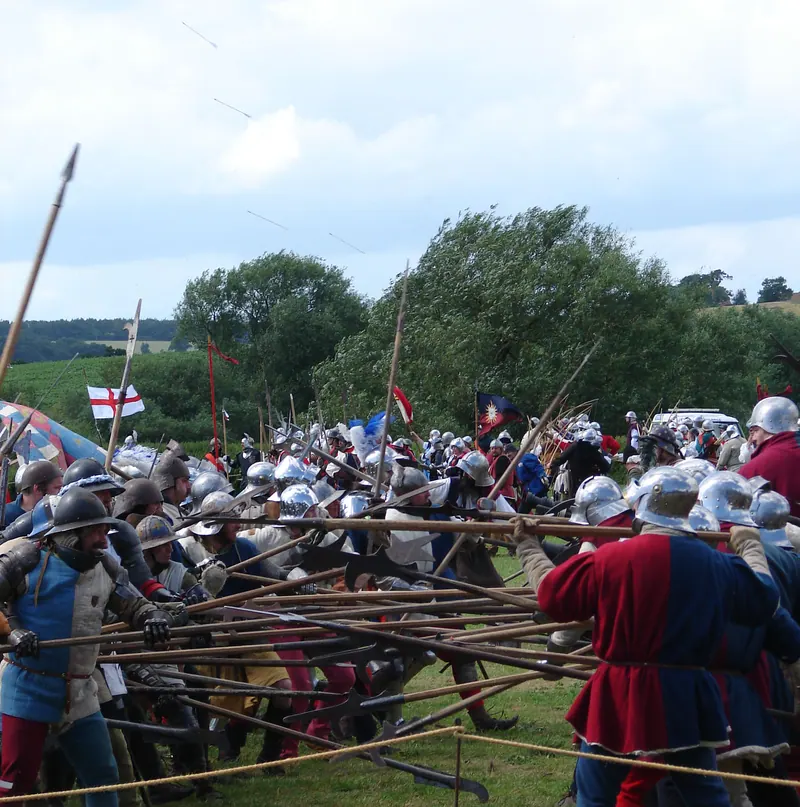
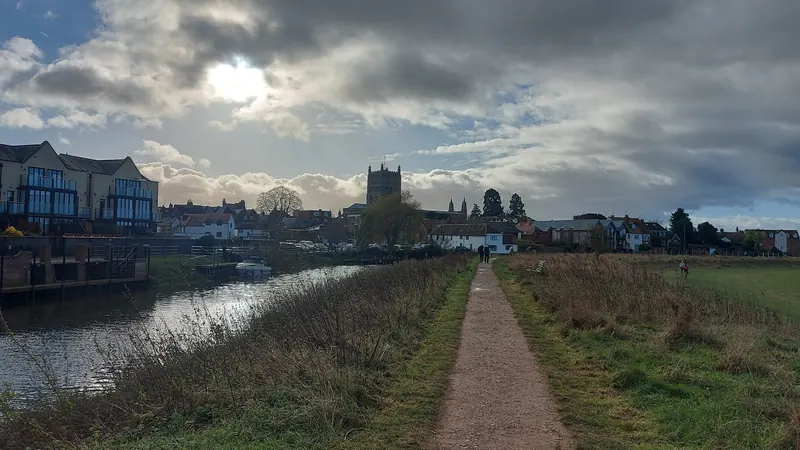
Two thousand people in harness, a cannon, a traders’ field the size of a village and a Norman abbey at the end of the lane. Nobody asks you for a ticket. Tewkesbury Medieval Festival, in Tewkesbury, England, is worth going to, because it is free and because the battle it re-fights happened on this ground on 4 May 1471. It runs on the second full weekend of July, and the organisers have already published 10–11 July 2027. Entry costs nothing, the official parking is £10 a car in cash, and the site is a river meadow, which matters in a wet year. By the end you’ll know which day to pick, where to stand for the battle, and where to put the car.
What is Tewkesbury Medieval Festival?
A free two-day reenactment of the Battle of Tewkesbury, held each July since 1984 on fields beside the Bloody Meadow, part of the original battlefield, next to Tewkesbury Leisure Centre. The organisers, the volunteer Companions of the Black Bear, call it the largest free medieval gathering of its kind in Europe; around 2,000 reenactors come, and the usual estimate is 25,000 visitors.
The battle it commemorates was fought on 4 May 1471, near the end of the Wars of the Roses. Edward IV’s Yorkists caught Queen Margaret’s Lancastrian army here before it could cross the Severn, broke it, and killed Edward of Westminster, the Lancastrian Prince of Wales. Those who survived ran for the abbey and claimed sanctuary, which bought them two days. The abbey is still there, a short walk from the stalls, and the “beheading of the traitors” staged at it on the Saturday evening is the festival’s one concession to how the weekend actually ended.
Len and Peggy Clatworthy and a few others started the festival in 1984, and it is still run by volunteers, which is why it is free and why the car park is cash only. For the weekend itself you need three facts: the battle is fought both days, the market is the reenactors’ own, and the abbey was there when it happened.
Go on the Saturday if you can. The later battle and the evening at the abbey make it the fuller day, and the Sunday is the one to fall back on if it rains.
What actually happens?
Camps and market from 11:00 (the 2026 hours: Saturday to 18:00, Sunday to 17:00), the battle mid-afternoon for about an hour, and on the Sunday a morning parade through town. The rest of the site: a traders’ field of up to 120 stalls, living-history camps for both armies, a storyteller’s garden, music, street performers, and the battlefield with a crowd line along it.
The battle
Saturday at 16:00 and Sunday at 15:00 in recent years, roughly an hour each, with cannon. Those times come from the organisers’ FAQ and can shift, so check the programme on the day. Both armies form up. The guns go off, the arrows go over, and then the lines meet and it is bills and pollaxes in a press for the best part of half an hour, which is the point of the whole weekend and the reason to be at the line forty-five minutes early.
Bring your own chair or a shooting stick; the organisers say so, and the ground is a meadow and behaves like one after rain. Stand upwind of the guns if you can tell which way the wind is going, because black-powder smoke sits on a still day and you will spend the first volley looking at a cloud. With small children, stand further back than you think you need to; the cannon is louder than it looks.
I’ve fought on this field and lost, which is accurate to the period: the Lancastrians lose every year, and the people playing them know it by the Friday night.
The market and the living-history camps
The traders’ field is the best market we know in England for kit, because the stalls sell to the reenactors first and to you second. You can buy a gambeson, turnshoes, a bolt of wool or a pollaxe from the person who made it. The tourist end is small. Wooden swords, plastic helmets, easy to walk past.
The camps are the two armies’ camps, Edward’s and Margaret’s, and you can walk through them: people cooking over fires, arming each other, mending kit, arguing about 1471. A rope at the edge of a camp is a wall and the fire is hot; the rest of the manners are in how to behave at a medieval fair. Food is hog roast and burger van, plus a sausage we have eaten every year and never quite trusted. The bar queue peaks in the half-hour after the battle, so drink before it or long after.
The abbey and Bloody Meadow walk between events
Tewkesbury Abbey is a short walk from the site and was standing in 1471, which is why the losing side ran to it. Go between the camps and the battle. The field is at its hottest then and the abbey is cool, and you can go back on the Saturday evening for the “beheading of the traitors”, which is staged there once the field has closed. Bloody Meadow, where tradition puts the end of the Lancastrian rout, is the part of the battlefield beside the site, and the organisers run guided battlefield walks over the weekend; the Sunday-morning one fits before the parade, which in 2026 left the town centre at 11:15.
Who will love it, and who won’t?
Families, because it is free, flat, loud and full of things to poke; reenactors, because it is the big one and the market is theirs; anyone with a Wars of the Roses habit. It will not suit you if you want shade, a seat or a short queue for a toilet, or if a cannon at a hundred metres is a problem.
The crowd is the first downside. Twenty-five thousand people over a weekend on a free site means the crowd line for the battle fills early, the bar queue is long, and the toilets are portaloos, disabled ones included, with a queue that is also in costume.
The weather is the second. It is July on a meadow with no shade, so a dry year means sun cream and a hat, and a wet year means the ground goes soft under 25,000 pairs of feet and stays soft. Bring the boots either way.
Cash is the third. The organisers say card service on site is intermittent and tell you to come with cash; the nearest cash points are a short walk away in the town centre. Parking is cash too.
Reenactors: if you are coming with a group, the camps are where you sleep, and the rules come with your group’s booking. Turning up alone in a gambeson and hoping for a tent is not a plan.
Children: the parade, the storyteller’s garden and the camps are theirs; the battle is loud, with cannon, and the odd small one hates it. Dogs are welcome on short leads, and the organisers ask specifically for no extending leads, because a lead across a footpath at knee height is a hazard in a crowd.
Getting there, parking and sleeping
Tewkesbury sits between junction 9 of the M5 and the M50 in Gloucestershire. The official car parks are signposted and next to the site (sat-nav GL20 5SX, the leisure centre), £10 per car per day, cash only, blue-badge spaces at the same price. They are locked at 18:30 and there is a fee to get a car out after that, so if you are staying for the abbey piece on the Saturday, move the car into town first.
By train it is Ashchurch for Tewkesbury, a small station about 3 km from the site with bus and taxi links into town, or a walk of forty minutes or so if the bus isn’t there. Cheltenham and Gloucester are the bigger stations and the places with beds.
Tewkesbury itself has few beds and they go early. Cheltenham is roughly 15 km away, Gloucester about the same, and both are a short drive or a local train to Ashchurch. The festival does not run a public campsite that we could find; the camps on site belong to the reenactment groups, and the campsites and caravan sites around the town fill for the weekend. Book in spring. The Tewkesbury page has the town outside festival weekend, when the abbey is the whole reason to come.
Tips we’d give a friend
- Bring cash, in notes and coins. Parking is cash, the organisers say card service on site is intermittent, and the cash points are in town.
- A chair or a shooting stick: the organisers recommend it, and an hour of standing behind a tall man in a sallet is not the same as watching a battle.
- Be at the crowd line forty-five minutes before the battle, upwind of the guns.
- Do the Saturday for the later battle and the abbey evening; keep the Sunday as the fall-back. If you can only do one and the forecast is bad, the Sunday battle is an hour earlier.
- Move the car before 18:30 if you are staying in town for the evening.
- Dogs on short leads, no extending leads, and bring a bowl; there is no shade for them either.
- Wear what you’d wear to stand in a field for six hours, and read what to wear to a medieval festival before you buy anything in the traders’ field.
What other festivals are like it?
Two in the south-east scratch the same itch and charge for it; the rest of the country’s calendar is under England, and the month’s other options under July. England’s Medieval Festival runs on the August bank holiday weekend, expected 28–30 August 2027, at Pippingford Park near Nutley in the Ashdown Forest; it left Herstmonceux Castle in 2023, is ticketed, builds its weekend around jousting rather than a pitched battle, and includes camping with weekend tickets.
The Loxwood Joust in West Sussex runs over three weekends in August, with 2026 day tickets at £27 for adults and £8 for children and 2027 dates not yet announced, and is staged as a themed “Kingdom of Loxwood” with characters in role all day rather than a reenactment.
Neither has a real battlefield under it.
Go on the Saturday, get to the line early, stand upwind, and when the guns stop and the bills come down, listen to the noise two thousand people make when they stop being polite. Ten pounds and a tank of petrol. We can’t think of anything else in England this size that costs so little.