Medieval Booker

Museum ◆ Kutná Hora

Stone House and its lapidarium

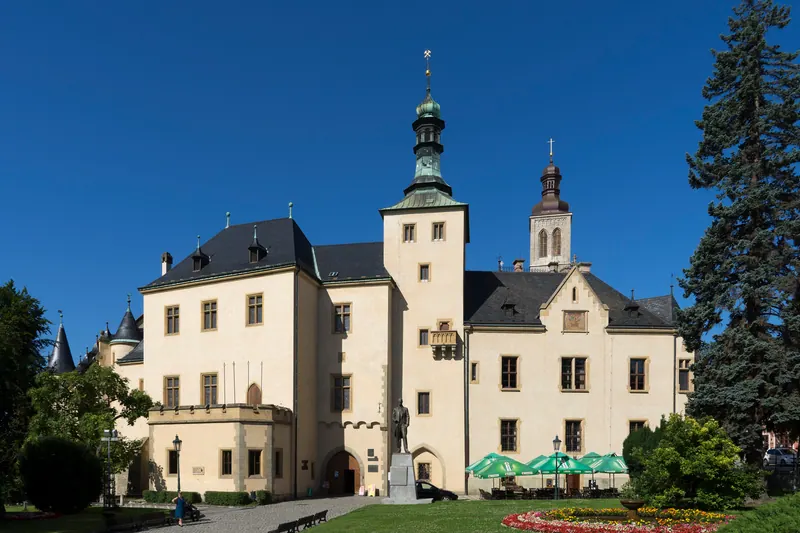
A pre-Hussite burgher's house that gained two more storeys and a carved gable around 1489, now a branch of the silver museum. Buy the lapidarium ticket rather than the house one: the Gothic stone salvaged from Kutná Hora's churches is in the two-storey cellars, down a staircase off the front hall.

Where and when

Where
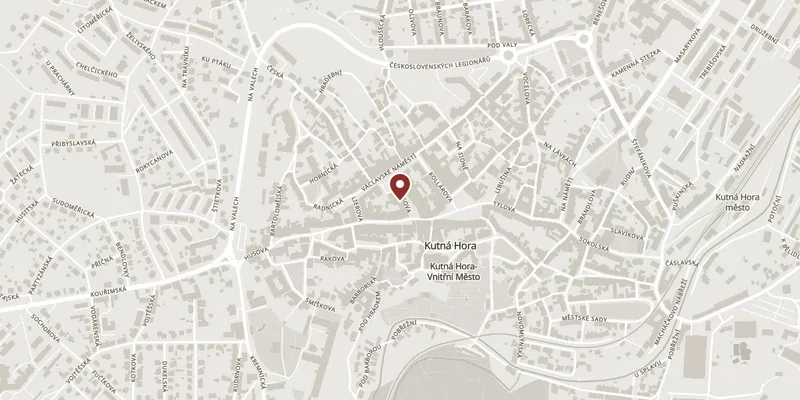
Václavské náměstí 183, 284 01 Kutná Hora, Kutná Hora, Czechia Open in Google Maps Walking directions
Era
Pre-Hussite cellars; upper storeys and gable c. 1489, facade sculpture after 1491; re-Gothicised 1900–02
Opening
Tuesday–Sunday with a break 12:00–12:30; closed Mondays. Closed January–March and December. April and October 09:00–17:00; May, June and September 09:00–18:00; July and August 10:00–18:00; November 10:00–16:00 (as of August 2026)
Price
"Royal Mining Town" exhibition CZK 80 adult / 60 child, student, senior / 250 family. Lapidarium CZK 70 / 50 / 200. Both together CZK 110 / 70 / 320 (as of August 2026)
Best time
Any open weekday. Forty minutes covers both circuits comfortably.
Good for
Works in the rainFree or cheap
Official site
www.cms-kh.cz
Map showing where Stone House and its lapidarium is
Open in Google Maps Walking directions © MapTiler © OpenStreetMap contributors

Checked

What is Stone House and its lapidarium?

The cellars and part of the ground floor here are pre-Hussite. Around 1489, when the house belonged to the burgher Prokop Kroupa, two storeys and a tall triangular gable were added, and after 1491 the front was given a single worked-out sculptural programme, generally credited to the mason Brikcí Gauske — the same man now thought to have built the Stone Fountain a few streets away. A prismatic stone oriel projects at first-floor level above the central pier of the double gateway, and the gable is stiff with finials, crockets and Gothic window tracery. It is routinely called the finest late-Gothic town house in Bohemia.

Be clear about what you are photographing. Ludvík Lábler re-Gothicised the facade in 1900–02 and sculpture was added then, including the Madonna in the gable by Professor Kastner. The house was stripped and rebuilt again in 1997–99. The medieval substance is the cellar and the underlying structure; the front is a late-Gothic design that has been read and re-cut twice.

Inside there are two separate tickets and they are not equal. “Royal Mining Town” (CZK 80) is burgher life in the upper town in the 17th to 19th centuries across three floors — a good regional display, not the reason you came to Kutná Hora. The lapidarium (CZK 70) is: stone sculpture and architectural fragments recovered from the town’s major Gothic buildings, set out in the house’s two-storey cellars and reached by the staircase in the front hall. That is where the carving from St Barbara’s and its neighbours ended up, at arm’s length and lit, and it is the best half-hour of Gothic stonework in the town after the cathedral itself. Both circuits together cost CZK 110.

It sits on Václavské náměstí, five minutes’ walk from the Italian Court. Check the calendar before you go: it is shut from January to March and again in December, closed Mondays, and there is a half-hour break at noon.
What visitors say

4.5 from 259 ratings

  • Alyssa Raven

    4 out of 5 2 months ago

    The Stone House (Kamenný dům) is one of the finest examples of late Gothic architecture in Kutná Hora. Built in the late 15th century for a wealthy mining family, it reflects the prosperity the town gained through its rich silver mines. Its beautifully decorated stone façade features religious symbols, coats of arms, and scenes connected to medieval mining. Today, the building is part of the Czech Museum of Silver and offers exhibitions about everyday life in medieval Kutná Hora, local traditions, and the town’s important mining history. The museum provides valuable insight into the region’s past, and the admission prices are very reasonable, making it an attractive and worthwhile stop for visitors interested in history and culture.

    Read this review on Google
  • Lukáš

    4 out of 5 3 months ago

    The museum was empty so we had a nice experience overall

    Read this review on Google
  • Matteo Marangon

    5 out of 5 8 months ago

    We went here with basic expectations for the KCD escape game, just to have some fun between friends, but it was actually really enjoyable and rewarding! The lady that instructed us was really nice, we appreciated her instructions.

    Read this review on Google

Ratings and reviews from Google. See all on Google Maps

Frequently asked questions

What is in the Stone House in Kutná Hora?

Two separate circuits: an exhibition on burgher life in the mining town from the 17th to the 19th century, and a lapidarium of Gothic stone sculpture and architectural fragments from the town's major medieval buildings, displayed in the two-storey cellars.

How much does the Stone House cost?

CZK 80 for the main exhibition, CZK 70 for the lapidarium, or CZK 110 for both, with reductions for children, students and seniors, as of August 2026.

How old is the Stone House?

The cellars and part of the ground floor are pre-Hussite. The upper storeys and the carved gable were added around 1489 and the facade sculpture after 1491. The front was heavily re-Gothicised by Ludvík Lábler in 1900–02.

Is the Stone House open in winter?

No. It closes from January to March and again in December, and it is closed on Mondays all year, with a half-hour break at noon.

Where is the lapidarium entrance?

Down the staircase off the front hall of the Stone House, into the two-storey cellars. It is ticketed separately from the main exhibition.

Festivals in Kutná Hora

Medieval festivals in Kutná Hora
Jousting & Tournaments Living History & Museums +1

Královské stříbření Kutné Hory (Royal Silvering of Kutná Hora)

Kutná Hora, Czechia

The Royal Silvering of Kutná Hora recreates a visit by King Wenceslas IV and his court to the silver-mining town around the year 1400, with a costumed procession from the Italian Court to St Barbara's Cathedral, mounted tournaments, period music, crafts and a torchlit evening programme in the park below the royal mint. Held on a weekend in late June since 1992, it reached its 32nd edition on 20–21 June 2026.

Expected 2027
Family

More places in Kutná Hora

Places in Kutná Hora
Museum Start here

Czech Museum of Silver and the medieval mine

Hrádek rebuilt in the 1490s by Jan Smíšek of Vrchoviště; the mine gallery worked 14th to early 16th century

The town's silver museum occupies Hrádek, a late-Gothic mansion built by a mine owner on the ore beneath it, and its second route puts you in a miner's white canvas smock and a helmet lamp and walks you 250 m through a real gallery of the Osel mine. Book Route II ahead, and note that nobody under six is allowed underground.

Good with children Works in the rain
Walking directions
Church

Cathedral of St Barbara

Begun 1388 by Peter Parler's workshop; choir vault by Matěj Rejsek from 1489, nave by Benedikt Ried after 1512; work stopped 1558, west front completed 1905

Begun in 1388 by Peter Parler's workshop, carried on by Matěj Rejsek and Benedikt Ried, abandoned in 1558 when the silver ran short and only closed off at the west end in 1905 — a cathedral built by miners for their own patron saint, not by a bishop. Go straight to the chapels off the ambulatory and ask for the Hašplíř and minters' chapels: their frescoes show men in white hooded smocks working a winch and Prague groschen being hammered out by hand.

Works in the rain Quiet corner
Walking directions
Castle

Italian Court (Vlašský dvůr)

Central royal mint from 1300 under Wenceslas II; palace and chapel added by Wenceslas IV around 1400; mint closed 1727

The royal mint of Bohemia from 1300, where the Prague groschen was struck for four centuries, rebuilt by Wenceslas IV as a palace with an audience hall and a chapel. For CZK 50 you can hammer out your own groschen on a die and take it home with a certificate.

Good with children Works in the rain
Walking directions