Medieval Booker

Occitanie (Aude) ◆ France

Medieval Carcassonne

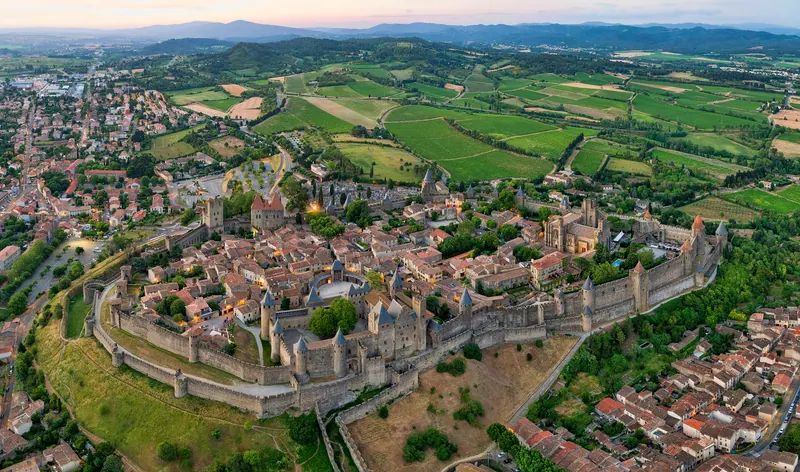
Town in the Aude in south-west France whose hilltop Cité is Europe's largest surviving double-walled fortified town: about 3 km of ramparts, 52 towers, a castle and a basilica, restored by Viollet-le-Duc and UNESCO-listed since 1997.

1 festival 7 places 1 article next event 12 July 2026

Why is Carcassonne a medieval destination?

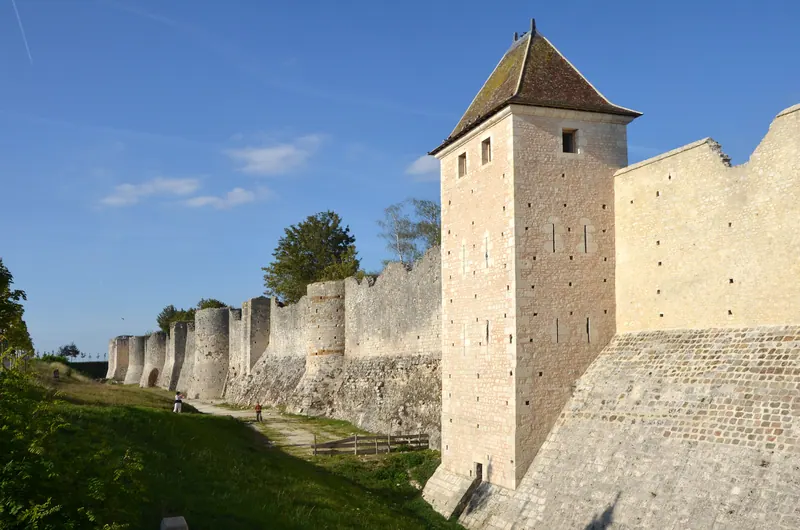
The Cité de Carcassonne is the largest fortified town in Europe to survive with a complete double wall: about 3 km of ramparts and 52 towers on a spur above the river Aude, on the old road between the Mediterranean and Toulouse. Parts of the inner wall are Gallo-Roman (late third to fourth century, recognisable by their brick courses and rounded towers); the rest was raised by the Trencavel viscounts in the twelfth century and then rebuilt by the French crown in the thirteenth.

In 1209 the Albigensian Crusade arrived. The Cité, sheltering Cathar sympathisers under the young viscount Raymond-Roger Trencavel, surrendered after a two-week siege when its water ran short; Trencavel died in his own dungeon and Simon de Montfort took his lands. A failed attempt by Trencavel’s son to retake the city in 1240 led Louis IX to expel the inhabitants, found the grid-planned Bastide Saint-Louis on the far bank of the Aude in 1247 and, with his son Philip III, build the outer wall and rebuild the inner one. The result was the concentric fortress that the Black Prince’s army could not touch when it burned the lower town in 1355.

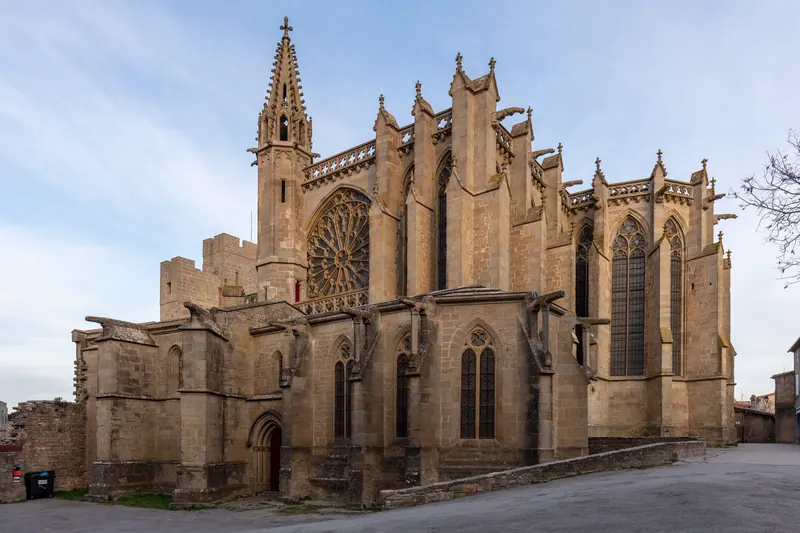
Inside the walls stand the Château Comtal (begun around 1130, with its own moat and barbican), the basilica of Saint-Nazaire with its Romanesque nave and Gothic choir, and a small town that housed several thousand people in the Middle Ages. After the Treaty of the Pyrenees in 1659 moved the frontier south the Cité lost its purpose and decayed into a poor quarter quarried for stone; it was saved from demolition in the 1840s and restored from 1853 by Eugène Viollet-le-Duc, whose pointed slate roofs on the towers remain controversial but define the silhouette.

The fortified city was inscribed on the UNESCO World Heritage List in 1997 and draws several million visitors a year. The ramparts and castle are run by the Centre des monuments nationaux and are ticketed, while the streets and the lices between the two walls are free. Local lore names the town after Dame Carcas, who supposedly tricked Charlemagne’s besiegers by throwing a well-fed pig over the wall; the 14 July fireworks, first staged in 1898, and the summer tournament in the lices are the modern set pieces.
Medieval festivals in Carcassonne

Featured
Jousting & Tournaments Castle Events

Tournoi de Chevalerie de Carcassonne (Knights' Tournament and Falconry Show)

Carcassonne, France

Every summer the lices between the double walls of the Cité de Carcassonne host a daily knights' tournament, a 45-minute show of mounted combat in armour, billed in 2026 as 'Tournois de chevalerie et spectacle de fauconnerie' after a falconry display was added. The 2026 season runs from 12 July to 27 August with three performances a day, every day except Saturday.

On now until
Family

Months with a festival are linked. Expected dates say so. July

What else to see in medieval Carcassonne

Short list on purpose. Everything here is somewhere we'd actually send you, checked and still standing.

Castles & fortresses

Castle Start here

Château Comtal and the rampart walk

Trencavel palatium c. 1130 on a Gallo-Roman wall; royal fortress after 1226; restored by Viollet-le-Duc from 1853

The Trencavel viscounts' palace of about 1130, rebuilt by the French crown after 1226 into a castle inside the castle, and the only ticketed part of the Cité. The ticket buys the castle, its moat and barbican, the wall walk on the inner rampart and the lapidary museum — and it is the only way to stand on the Gallo-Roman wall instead of under it.

Good with children Best in the evening
Walking directions
Castle

The four castles of Lastours

Cathar-era castrum of Cabaret, besieged 1209, surrendered 1211, destroyed 1240; four royal Capetian forts rebuilt on the crest in the later 13th century; UNESCO-inscribed 26 July 2026

Four small fortresses on one rock spine 18 km north of Carcassonne — Cabaret, Tour Régine, Surdespine and Quertinheux — on the site where Pierre-Roger de Cabaret held out against Simon de Montfort in 1209 and only came to terms in 1211. It is the closest, best day trip from the city, it is now UNESCO-listed, and the honest headline is that the towers you climb to are not the Cathar castles: they are the ones the king built afterwards so there would never be another Cabaret.

Good with children
Walking directions

Landmarks & bridges

Landmark

The lices and the double walls

Inner wall Gallo-Roman (late 3rd–4th c.) and 12th-century; outer wall and lices built for Louis IX and Philip III after 1240

The strip of grass between Carcassonne's two rings of wall is free, open at all hours and usually near-empty, and it is where the fortress finally makes sense — outer wall on one side, Gallo-Roman and 12th-century inner wall on the other, both close enough to touch. Go in at the Porte Narbonnaise, drop straight down into the lices, and walk to the Tour de l'Évêque, the one tower built across the strip to cut it in two.

Free or cheap Quiet corner Best in the evening
Walking directions
Landmark

The Bastide Saint-Louis

Founded by Louis IX in 1247–48 on an orthogonal plan; walled 1355–59 after the Black Prince; ramparts replaced by boulevards in the 18th century

Carcassonne has two medieval towns, and this is the one nobody photographs: a grid laid out by Louis IX in the 1240s for the people he had just evicted from below the Cité, still legible street for street. Come on a market morning, walk the ring of boulevards that stands exactly where the wall stood, and look for the covered passages that lead into the gardens hidden inside each block.

Free or cheap Good with children
Walking directions

Churches & ossuaries

Church

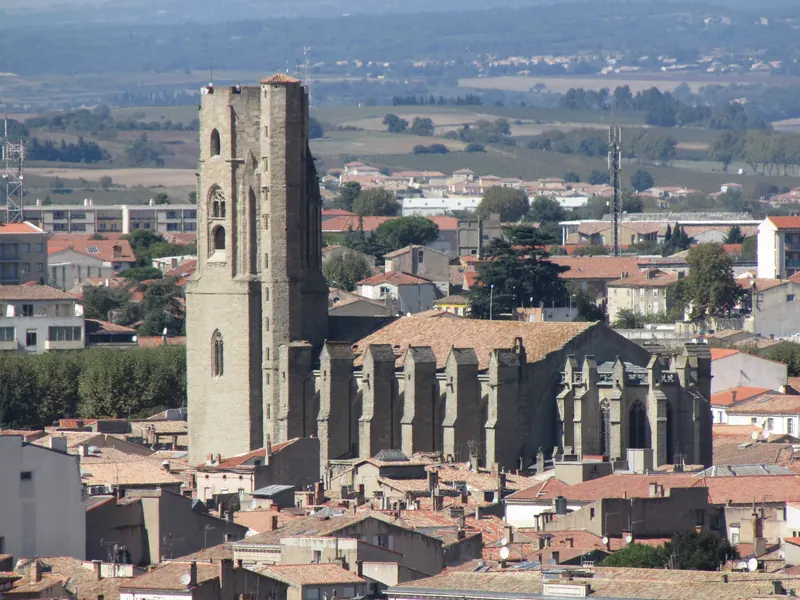
Basilica of Saints Nazarius and Celsus

Romanesque nave from 1096; Gothic transept and choir 1269–1330; cathedral until 1801, minor basilica since 1898

The Cité's cathedral until 1801: a Romanesque nave whose building stones Urban II blessed on 11 June 1096, welded to a Rayonnant Gothic transept and choir put up between 1269 and 1330. Entry is free, and the 13th- and 14th-century glass — which the Aude tourist board calls the finest in the Midi — is the reason to go in.

Free or cheap Quiet corner Works in the rain
Walking directions
Church

Église Saint-Vincent and its bell tower

Parish founded 1247 with the Bastide; rebuilt from 1308 under Philip the Fair; classified historic monument 1907

The parish church of the new town, begun in the 13th century and rebuilt from 1308 with money from Philip the Fair: a single southern-Gothic nave about 20 m wide, once the widest in Bas-Languedoc, and no aisles at all to interrupt it. For €2.50 you can climb 232 steps up the 54 m tower — past medieval masons' marks, to the platform astronomers used in the 1790s to help measure the metre — and look down on the Cité from above.

Free or cheap Quiet corner
Walking directions

Views & walks

View

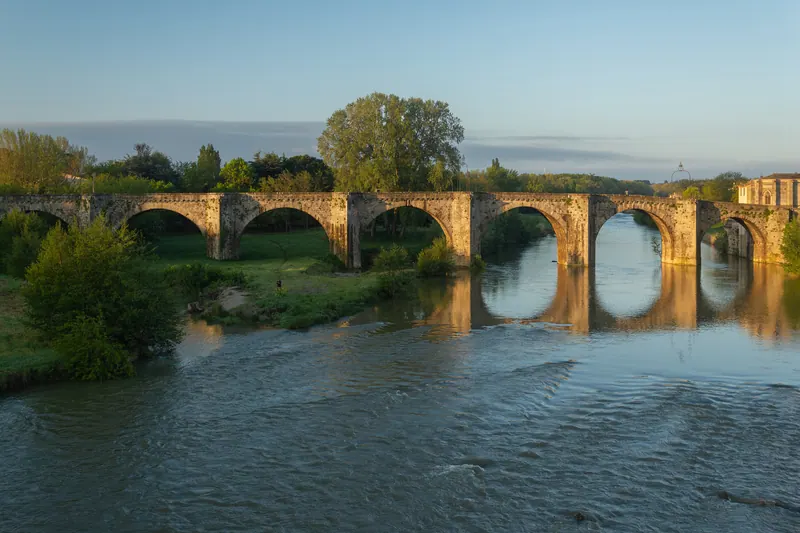
Pont Vieux

Stone bridge under construction 1315, completed c. 1320; classified monument historique 1926; heavily restored 1820

Twelve arches thrown across the Aude around 1320, and for five centuries the only way from the new town to the Cité. Cars were moved off it long ago, so it is now the one place in Carcassonne where you can stand still, in the middle of a river, and see the entire fortress at once — free, at any hour, and best in the twenty minutes after sunset.

Free or cheap Best in the evening Good with children
Walking directions
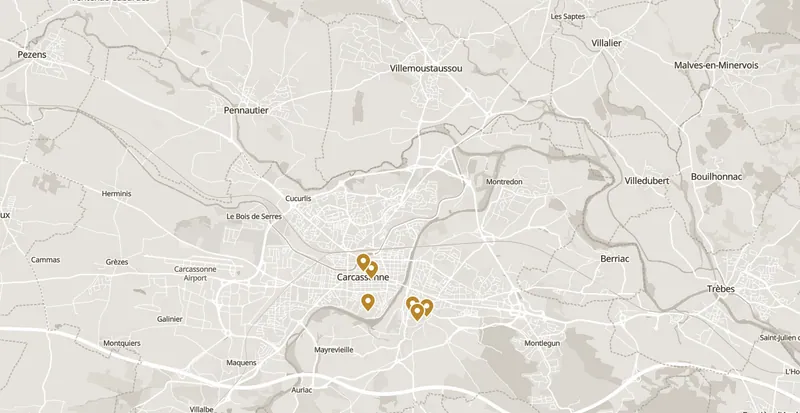
Map of the places worth your time in Carcassonne
Everything above, on one map. Tap a link to open it in Google Maps on your phone. © MapTiler © OpenStreetMap contributors

Stories from medieval Carcassonne

All articles

More medieval festivals in France

All festivals in France
Featured
Living History & Museums Castle Events

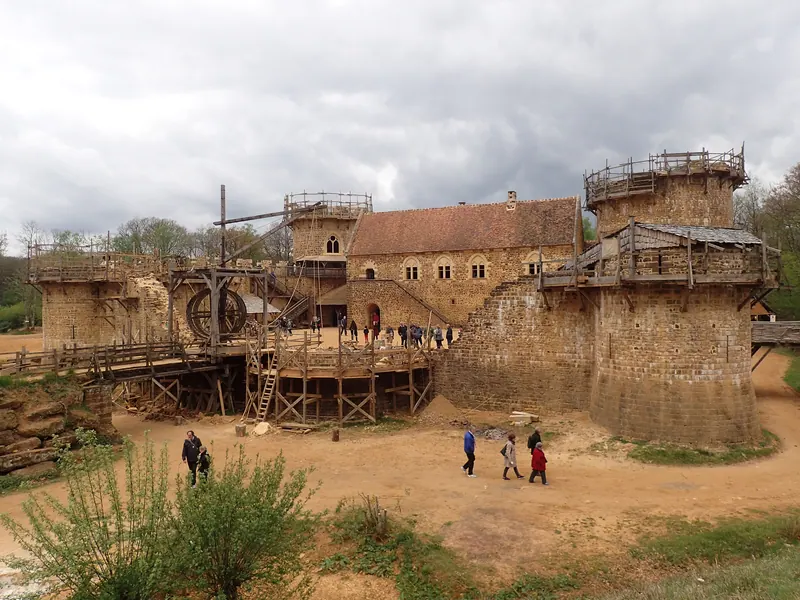
Guédelon Castle (living medieval construction site)

Treigny, France

Guédelon is a 13th-century castle being built from scratch in a Burgundy forest quarry using only the tools, materials and techniques of the 1230s, open to visitors from spring to autumn since the first stone was laid in 1997. Around forty masons, carpenters, blacksmiths, tilers, rope-makers and carters work in front of the public, and the site draws roughly 300,000 visitors a season.

On now until
Family
Reenactment & Battles Medieval Markets & Fairs +1

Festival Médiéval de la Rose d'Or

Avignon, France

Every autumn some 60 to 70 historical associations camp on the Île de la Barthelasse, the island in the Rhône facing the Palais des Papes, for a re-enactors' festival with a market, archery, tournaments and a closing battle. Running since 2007 and organised by volunteers without public subsidy, it is one of the largest medieval gatherings in southern France; the 2026 edition, billed as the twentieth, falls on 10–11 October.

2026
Family
Featured
Medieval Markets & Fairs Music, Feasts & Theatre +1

Les Médiévales de Provins

Provins, France

Les Médiévales de Provins turn the UNESCO-listed upper town into a two-day medieval fair each June, with a market of around 320 stalls, tournaments, a Saturday-night ball and concert and a Sunday parade of about 700 costumed participants. Held since 1984, it attracted 120,000 visitors in 2025, the largest attendance of any medieval festival in France.

Expected 2027
Family

Other medieval cities in France: Avignon · Bayeux · Dinan · Provins