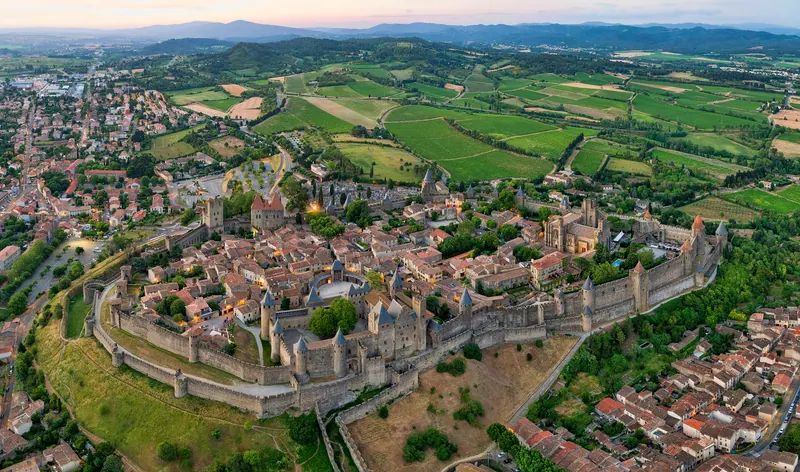
In 1849 the French state ordered the Cité de Carcassonne demolished, and the reason everyone now photographs it is that a local archivist and Prosper Mérimée talked them out of it. The fortress on the hill above the Aude, in Carcassonne, France, is about 3 km of double wall with 52 towers and four gates: the inner ring has Gallo-Roman brick courses from the 3rd and 4th centuries, the outer ring is 13th-century, and the Château Comtal inside dates from about 1130. The pointed slate roofs on the towers are not medieval. Eugène Viollet-le-Duc put them there from 1853. By the end of this you’ll know which stones are which, what happened here in August 1209, when the knights’ tournament runs in the lices, and what hour of the day to arrive so that you see a fortress rather than a queue.
Is Carcassonne a real medieval city?
Yes. The walls, the towers, the gates and the castle are original fabric that never fell down; they decayed into a slum and were quarried for stone after the Treaty of the Pyrenees in 1659 made the frontier move south, but they stood. What Viollet-le-Duc added from 1853 is the top: roofs, battlements and some wall-walks. Think of a 13th-century fortress wearing an 1850s hat. Its body is real. The hat is arguable, and the argument started in his lifetime.
The two walls and 52 towers
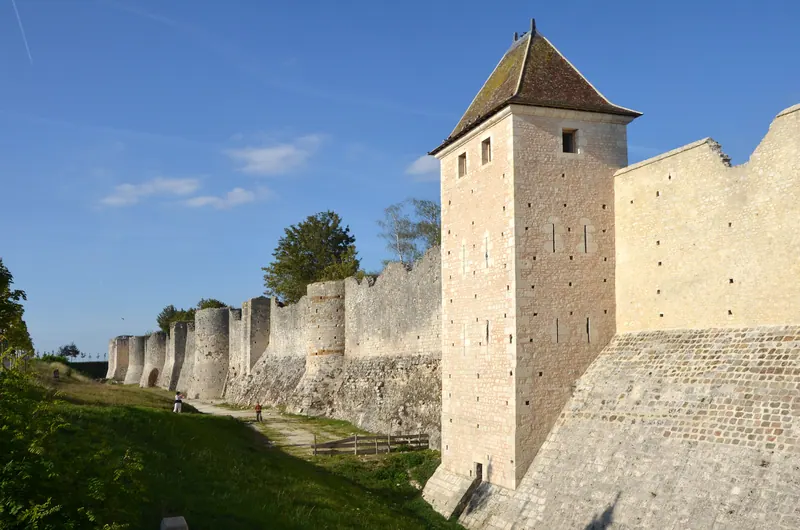
The inner wall is the old one. Walk the lices, the grassy strip between the two rings, from the Porte Narbonnaise anticlockwise and look at the inner face: the rounded towers with horizontal bands of thin red brick are Gallo-Roman, from when the hill was fortified in the 3rd and 4th centuries; the Visigoths held the place from the 5th century and the Franks took it in 759, and nobody in between saw any reason to pull down a wall that worked. The outer ring was built by Louis IX and his son Philip III after 1247, which turned a walled town into a double enceinte, and when the Black Prince burned the lower town in 1355 he looked at the Cité and kept walking.
The lices themselves were full of houses until Viollet-le-Duc cleared them. What reads now as a designed killing ground between two walls was, for several centuries, a street.
Count towers if you like; 52 is the figure the sources agree on. Better: pick one and look at where the brick stops and the cut stone starts, because that line is the difference between a Roman and a Capetian mason.
What Viollet-le-Duc changed
The demolition decree of 1849 was overturned after a campaign by Jean-Pierre Cros-Mayrevieille, the town archivist, and Prosper Mérimée, the novelist who also happened to be the state’s inspector of historic monuments. Viollet-le-Duc restored the Cité from 1853 until his death in 1879, and the pointed slate roofs he put on the towers were criticised at once as northern and un-Occitan: slate is what you roof a tower with in Burgundy, not in the Languedoc, where the sun would have argued for flat tiles. The critics were right about the history. They have not, in 170 years, managed to make anyone dislike the result.
The silhouette you know from the postcards is his. What holds it up is not. If that bothers you, stand on the outer wall at the Porte d’Aude side and look at the inner towers with their brick bands, and you will be looking at something a Roman would recognise.
Château Comtal and the Basilica of Saints Nazarius and Celsus
The Trencavel viscounts ruled from the late 11th century and built the Château Comtal, the castle within the walls, around 1130; it is the ticketed part, and the ticket includes the rampart walk, which is the only way onto the top of the inner wall. Do it early. The basilica of Saint-Nazaire, at the far end of the Cité from the main gate, is two churches in one: an 11th- and 12th-century Romanesque nave, dark and barrel-vaulted, joined to a Gothic transept and choir of about 1269–1330 with glass that the nave makes you grateful for. Inside is the siege stone, a carved relief thought to show a 13th-century siege, possibly this one.
Buy the castle ticket online before you come, and go through the Porte d’Aude rather than the Porte Narbonnaise if you want to arrive without the crowd.
What happened here in 1209?
In August 1209 the Albigensian Crusade, sent by the Pope against the Cathar heresy of the Languedoc, besieged the Cité, which had taken in Cathar believers. It surrendered after about two weeks when the water ran short. The viscount, Raymond-Roger Trencavel, was 24; he died in his own castle prison that November, and Simon de Montfort took his title. Carcassonne became a seat of the Inquisition from the 1230s, and the prison known as the Wall held Cathar suspects, which is why one tower inside the Cité is still called the Tour de l’Inquisition. That is the whole story in one paragraph, and the souvenir shops will sell you the longer version on a tea towel.
The Dame Carcas at the Porte Narbonnaise belongs to a different and older tale: during a siege by Charlemagne she fed the last pig with the last wheat and threw it over the wall, the besiegers assumed plenty inside and withdrew, and the bells she rang gave the town its name, “Carcas sonne”. It is a legend, the bust by the gate is modern, and the pig is the most sensible character in the history of the place.
Why is there a second town across the river?
Because Louis IX threw the first one out. After Trencavel’s son failed to retake the city in 1240, the king expelled the inhabitants and in 1247 founded the Bastide Saint-Louis on the flat ground across the Aude, a grid-planned new town of the kind the 13th century built all over the south-west. The Cité stayed a garrison and the Bastide became the town, which it still is: the station, the market, the restaurants and most of the beds are there, and the Canal du Midi, a World Heritage site in its own right since 1996, passes the bottom of it. The Cité itself was inscribed in 1997. Two World Heritage sites, one river, one bridge between them.
The Pont Vieux is that bridge, and the walk across it from the Bastide at dusk, with the towers lit above the river, is the best free thing in town because it is the view the restoration was built to make.
When is the jousting, and what else happens in summer?
The Tournoi de Chevalerie de Carcassonne runs in the lices from mid-July to the last week of August, every day except Saturday, with three 45-minute shows at 14:00, 15:30 and 17:00. The 2026 season is confirmed for 12 July to 27 August; the 2027 season is expected 11 July to 26 August, dates not yet announced, usually published by the tourist office in late spring. Mounted knights in armour fight with lance, sword and mace as a contest between rival houses, and since 2026 a falconry display flies birds of prey over the arena. In 2026 adults paid €13, children aged 5–10 €9, and under-fives went free; the tribune is shaded and unnumbered, so arrive 20 minutes early for the middle seats. It has been staged every summer for about 25 years and is the one fixed medieval-style show Carcassonne puts on.
The 14 July Embrasement de la Cité has been staged since 1898: on Bastille Day night, red fire along the whole length of the walls makes the fortress appear to burn, and then the fireworks go up. You watch from the lower town, the river bank or the Pont Vieux, and the good spots go hours ahead. The Festival de Carcassonne, in the Château Comtal and the Grand Théâtre through July, is concerts. It is a fine thing and it is not medieval, whatever the venue.
If you want a whole town in costume rather than a show in a field, Les Médiévales de Provins, a weekend in mid-June near Paris, is the French one to compare it with; our best medieval festivals in Europe list puts the two side by side, and the France page has the rest.
Book the 17:00 show: the heat has gone off the lices and the light on the inner wall is the colour the brick was meant to be.
When should you go?
May, June, September or early October, and the reason is the middle of the day. Visitor numbers to the Cité are usually put at two to three million a year, the great majority of them in July and August between 10:00 and 18:00, squeezed into lanes that were laid out for a garrison. In high summer the main street from the Porte Narbonnaise to the castle is a corridor of plastic swords and nougat, and it is hot; the hill has no shade, the stone holds the heat, and 35 °C on the rampart walk is not unusual.
Summer still wins if the tournament or the 14 July fire is the point. Then the rule is hours, not months: be inside the walls by 09:00, leave for the Bastide at midday, come back for the 17:00 show and stay until the day visitors go down the hill at around 19:00. The hour after that, with the lanes empty and the towers going orange, is the Cité as Mérimée wanted it.
Shoulder months give you the same hour with a jumper on and no show. Pick your trade.
What to eat
Cassoulet, and a caveat. The white beans, confit duck or goose, pork and sausage baked slow in an earthenware pot is the dish of this corner of France, and Carcassonne is one of the three towns that claim it; Castelnaudary, 40 minutes up the canal, says it invented it, and since nobody can prove otherwise it wins on persistence. Eat it at lunch, not dinner, and not inside the Cité, where it is cooked for people who will never come back. A proper one arrives with a crust on top and makes the afternoon’s rampart walk a slow one.
Nougat and the sweet things in the lanes are for carrying home. The wine is Languedoc, cheap and mostly red, and the local rule that a carafe beats a bottle applies. For what any of this has to do with what a 13th-century garrison ate, the medieval festival food piece has the argument; the short answer is beans, yes, duck confit, no.
Eat in the Bastide, around the covered market, and leave the Cité to the ice cream.
Getting there and around
Carcassonne station is in the Bastide, on the Toulouse–Narbonne line; Toulouse is roughly an hour by train and the timetable is worth checking, because the fast services are the ones that make a day trip work. From the station the Cité is a 25–30 minute walk uphill, or a short ride on the summer shuttle bus from the lower town. Car parks sit below the walls, fill by mid-morning in summer, and empty at the same hour everyone else wants to leave. The Canal du Midi runs past the station; a walk along it is the flat, shaded alternative to the hill in the hot hours.
Sleep in the Bastide if you want restaurants, a market and a fair price, and walk up in the evening. Sleep inside the Cité if you want the walls after dark and can pay for a scarce room you reach on foot with your luggage. I would take the Bastide and the evening walk over the bridge, because the view of the fortress is better than the view from it.
If you have one day, arrive at nine through the Porte d’Aude, walk the lices, take the castle and rampart ticket, eat cassoulet in the Bastide, and come back for the 17:00 joust and the empty hour after. The hat is Victorian. Everything under it is not, and at seven in the evening with the light on the brick, nobody is arguing.