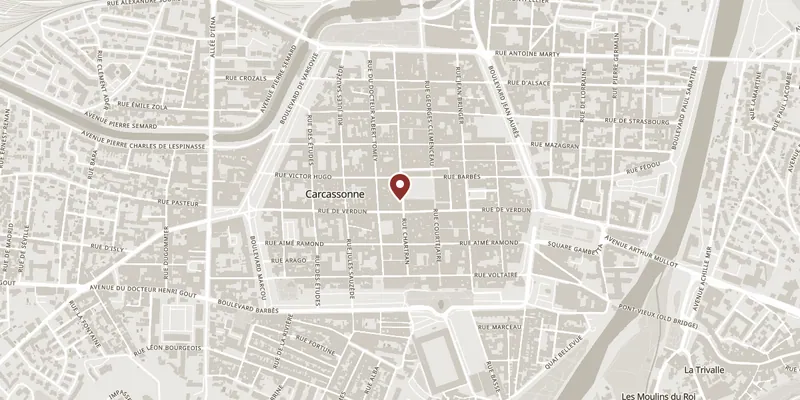
This town is a punishment with a street plan. Raymond Trencavel II’s attempt to retake Carcassonne failed in 1240; the suburbs clinging to the slope below the Cité were destroyed, and Louis IX granted their inhabitants the right to resettle across the Aude. The first site chosen, on the right bank, proved unsuitable and they were moved to the other side. The Ministry of Culture dates the new town to 1248, the Aude tourist board to 1247 — the point is the same: the king built a second Carcassonne, on open ground, to a drawn plan, an orthogonal grid roughly 1,000 m on a side inside walls, with one square as the commercial heart and the churches as the spiritual one. It went on to become one of the great cloth-making towns of Languedoc.
The grid is the monument. The district is still divided into carrons — blocks bounded by four streets, each of 40 to 65 ares, with a garden in the middle of the block, reached from the street by covered passages and served by wells. Walk the side streets off Place Carnot and look for the dark arched openings mid-terrace: that is the way in to the green interior of a 13th-century block, and it is the one piece of medieval town planning here you can still put your hand on. Most of the buildings above ground level are 17th-, 18th- and 19th-century houses standing on those medieval plots.
The ring road is a wall. The boulevards were laid out in the 18th century on the filled ditches of the fortified lower town. That wall was not part of the original design: after the Black Prince burned the town in 1355, the inhabitants built a rampart of about 2,800 m with round towers, raised between 1355 and 1359 under the Count of Armagnac, with corner towers named Calvaire, Saint-Martial and Montmorency; five bastions were added during the Wars of Religion. It came down at the end of the 18th century. Of the four gates, the town’s own heritage page says the southern Porte des Jacobins survives and is protected as a historic monument — it is the one bit of the enceinte you can still stand in front of. (A local heritage association also reports a stretch of the lower rampart uncovered in 1992 during work at the Jacobins car park; we could not confirm that against an official source, so treat it as a maybe rather than a destination.)
Place Carnot is the original market square, now with a Neptune fountain and café terraces. The open-air market is listed as Tuesday, Thursday and Saturday mornings, roughly 07:00 to 13:00, and the covered Halles Prosper Montagné, a block away, trades on weekday and Saturday mornings — butchers, charcutiers, fishmongers, growers. Sources disagree on whether the Halles open on Mondays, and we found no municipal page stating the hours, so treat the days as reliable and the edges as not.
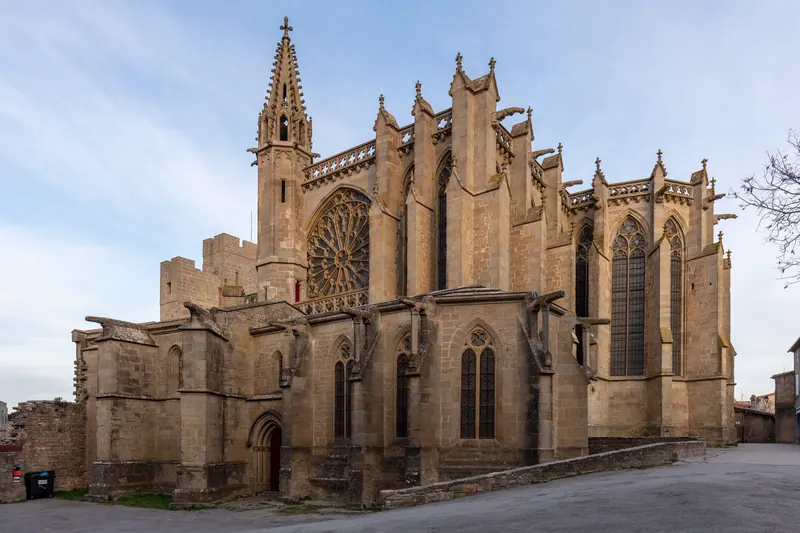
Be clear about what this is. It is not a second Cité and it will not feel like one; it is a working French market town whose bones happen to be a royal foundation of the 1240s. The one genuinely medieval building standing in it is the church of Saint-Vincent, which has its own entry.