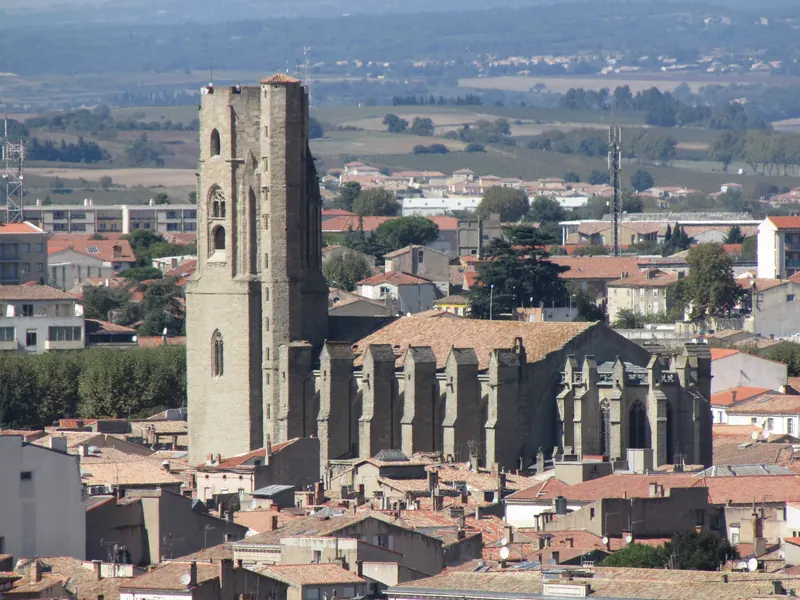
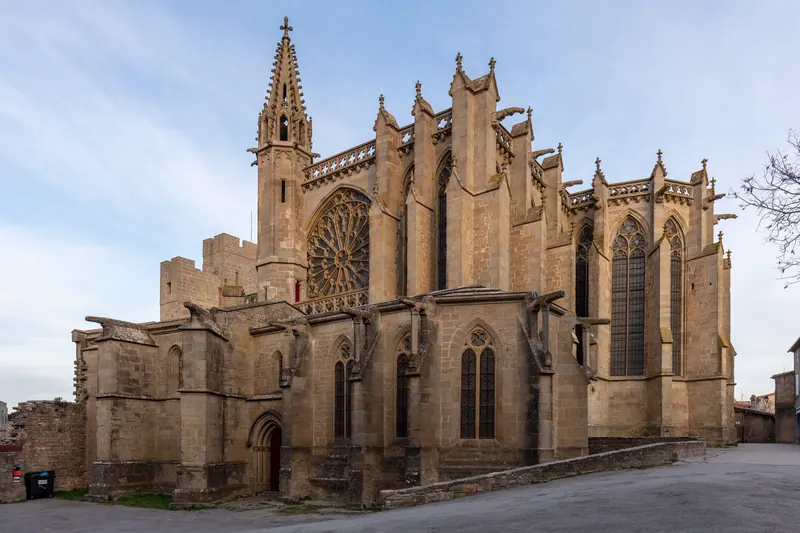
The Bastide got its parish in 1247, when Louis IX laid the town out; the church you walk into is the rebuilding begun in 1308 and funded by Philip the Fair, and it is a textbook of gothique méridional — southern Gothic, which solved the problem of space by refusing to divide it. There are no aisles. One nave of six bays, chapels set between the buttresses, and the Aude tourist board gives the width as 20.25 m with vaults 23.5 m up (the town’s own page says 21 m and 27 m; take your pick, they are both enormous). It was the widest Gothic nave in Bas-Languedoc, and for centuries the widest in France. Whatever you expect a Gothic interior to look like, this is the opposite: no forest of piers, no processional aisles, just one great room built to hold a whole town in a single sightline. It was classified a historic monument in 1907, and there is 15th-century glass in the windows and roses.
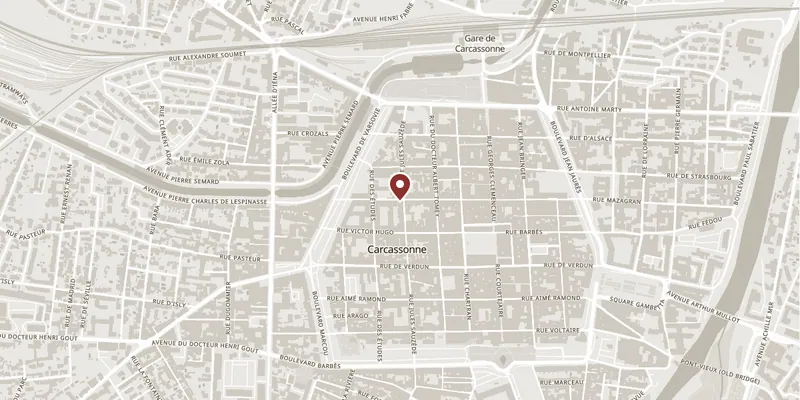
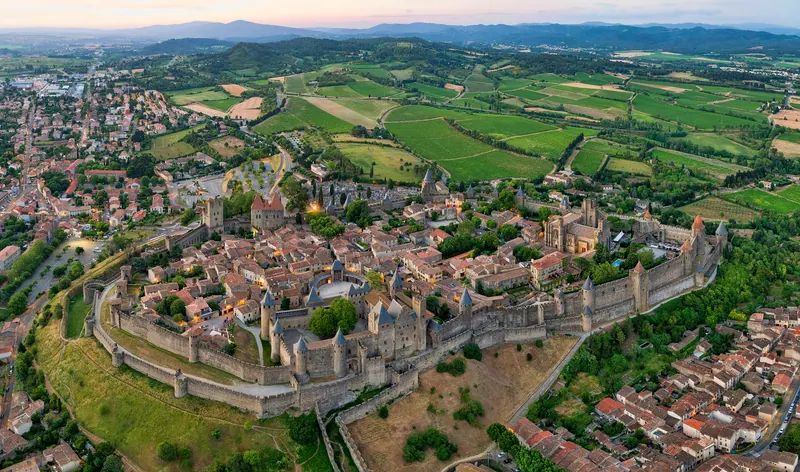
Then climb. The tower is 54 m, octagonal on a square base, 232 steps — carcassonne.org points out the stonemasons’ marks left in the walls of the stair, which are the closest you get in this town to touching the hands that built it. At the top: the Bastide grid laid out below you like the plan it is, the Cité on its ridge across the river, the Canal du Midi, and the Pyrenees on a clear day. This is the other view of Carcassonne, the one taken from inside the medieval town rather than from a bridge, and almost nobody does it.
The platform has a second life. Carcassonne was one of the five principal astronomical stations — with Dunkirk, the Paris Panthéon, Évaux and Montjuïc in Barcelona — of the Delambre and Méchain meridian survey of 1792–99, the measurement of the Paris meridian from which the metre was defined. The two men met here in November 1798 to join their halves of the arc. You are climbing a medieval bell tower that helped define the metric system.
The tower also carries a carillon, one of the most complete in the region: the Aude tourist board counts 47 bells, the town says 54. If you are here on a Saturday morning in July or August the tower is closed for the Vents d’Anges concerts — which is a fair trade, because you get to hear it instead.
Restoration has been running in phases since 2018, with a campaign on the north facade, stonework, glass and roof running from October 2022; expect the possibility of scaffolding on one elevation.