The Trencavel family took the viscounty of Carcassonne in 1067 and built the palatium here around 1130, straight on top of the Gallo-Roman rampart; the monument’s own account calls it “a veritable urban palace”. In 1209, with the Albigensian Crusade on the road, crenellations were added to the roofs to turn them into firing positions and the Tour Pinte was raised. After 1226 the building stopped being a residence and became the seat of the royal seneschal: the deep moat that cuts it off from the town, the two barbicans — one facing the streets, one running down towards the Aude — and the 14th-century administrative rooms are French royal work, not Trencavel.
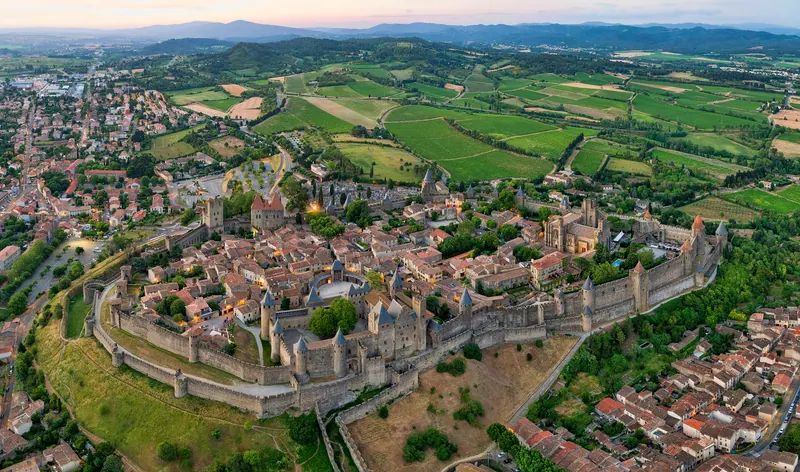
Be clear about what you are looking at, because the Cité’s silhouette is a 19th-century argument. The lower courses of the inner wall on the north and east are genuinely Gallo-Roman, late third to fourth century: small blocks banded with courses of red brick, semicircular towers, windows too small to fight from comfortably. Above and beside them sits 12th-century Trencavel masonry and 13th-century royal rebuilding in larger, squarer stone. The pointed slate roofs on the towers — the shape on every poster of Carcassonne — are Eugène Viollet-le-Duc’s, from a restoration he began in 1853 and continued until his death in 1879, finished by his successors into the 20th century. Southern towers of this date were roofed flat with tiles; he chose northern slate, and critics said so at the time. Knowing which lines are 13th-century and which are 1860s does not spoil the place. It tells you where to look.
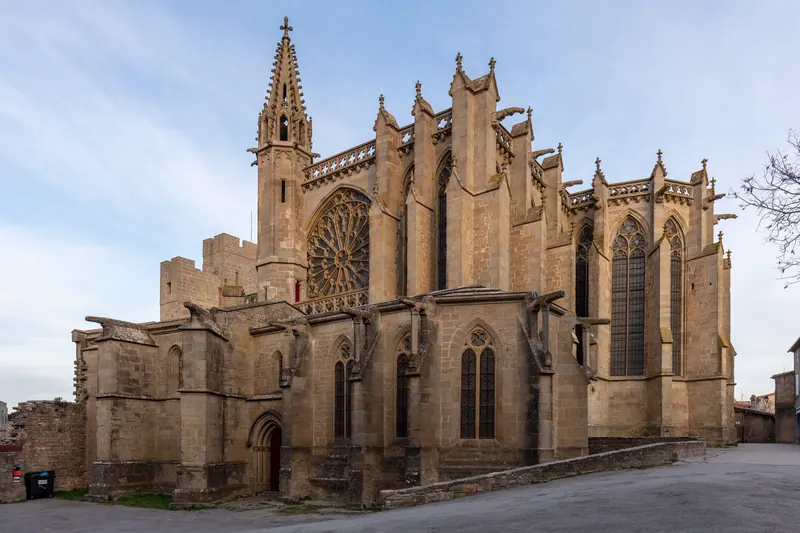
Inside the ticket: the castle courtyards and halls, the moat and barbican, the chemin de ronde along the inner wall, and the musée lapidaire, reached from the wall walk through the Tour de la Poudre — sarcophagi, funerary slabs, Gothic statuary and architectural stone lifted out of the Cité and the basilica, running from antiquity to the 17th century. The audioguide is €5 in six languages, but sales stop at 16:00, so buy it on the way in.
On 26 July 2026 the castle and ramparts were inscribed on the UNESCO list a second time, as one of the eight Forteresses royales capétiennes du Languedoc alongside Lastours, Peyrepertuse, Quéribus, Termes, Aguilar, Puilaurens and Montségur.