Medieval Booker

Landmark ◆ Carcassonne

The lices and the double walls

The strip of grass between Carcassonne's two rings of wall is free, open at all hours and usually near-empty, and it is where the fortress finally makes sense — outer wall on one side, Gallo-Roman and 12th-century inner wall on the other, both close enough to touch. Go in at the Porte Narbonnaise, drop straight down into the lices, and walk to the Tour de l'Évêque, the one tower built across the strip to cut it in two.

Where and when

Where
Lices de la Cité, 11000 Carcassonne (enter at the Porte Narbonnaise or the Porte d'Aude), Carcassonne, France Open in Google Maps Walking directions
Era
Inner wall Gallo-Roman (late 3rd–4th c.) and 12th-century; outer wall and lices built for Louis IX and Philip III after 1240
Opening
The Cité's gates, streets and lices are free and open at all hours; there is no gate to shut and people live inside. In July and August a fenced arena in the lices is used for the daily knights' tournament, a separate ticket with its own entrance — expect a detour on that stretch (as of August 2026)
Price
Free, always. Only the Château Comtal and the inner rampart walk are ticketed (as of August 2026)
Best time
The hour before sunset, or first light. The lices run north and south, so one side or the other is lit at either end of the day and the Gallo-Roman brick courses go orange.
Good for
Free or cheapQuiet cornerBest in the evening
Official site
www.audetourisme.com
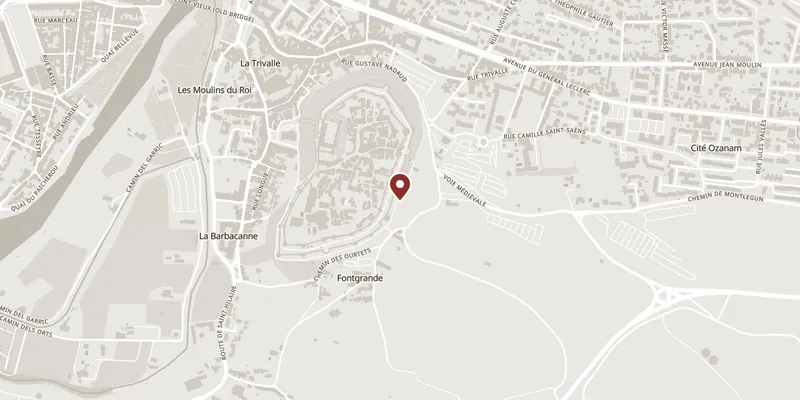
Map showing where The lices and the double walls is
Open in Google Maps Walking directions © MapTiler © OpenStreetMap contributors

Checked

What is The lices and the double walls?

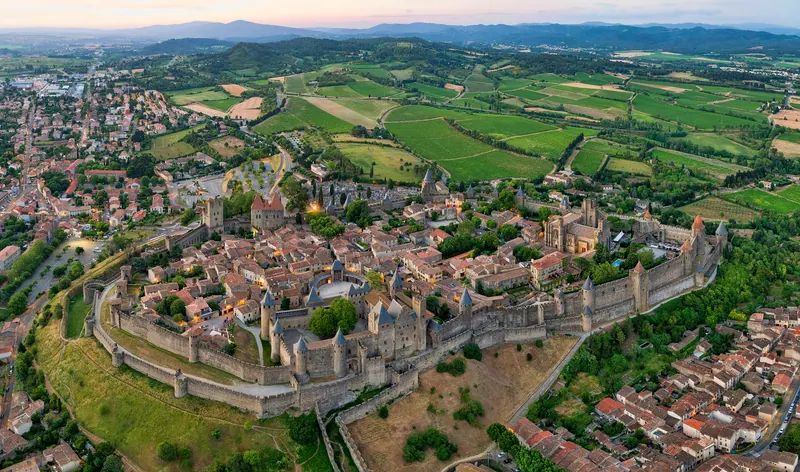
The second wall is a punishment. After Raymond Trencavel’s son failed to retake the city in 1240, Louis IX expelled the inhabitants, founded the grid-planned Bastide Saint-Louis across the river in 1247 and, with his son Philip III, threw a whole new enceinte outside the old one. The gap between the two is the lices, and it is a killing ground: an attacker who got over the outer wall found himself in a walled corridor overlooked from both sides with nowhere to form up. About 3 km of double wall and 52 towers survive. By the 19th century the lices were packed with houses; Viollet-le-Duc cleared them, which is the only reason you can walk here at all.

What to look at, from below. On the inner wall, the north and east stretches are Gallo-Roman at the base — late third to fourth century, small blocks banded with courses of red brick, semicircular towers, no machicolation. Beside and above that is bigger, squarer 12th- and 13th-century stone. On the outer wall the towers are lower, plainer and open at the back, because they were never meant to be lived in. Every pointed slate roof you can see is Viollet-le-Duc’s, from 1853 on. The flat tiled roofs he replaced are what a 13th-century garrison would have known.

The specific thing to find is the Tour de l’Évêque, on the west side above the Porte d’Aude. Built under Philip III (1270–85) in large bossed sandstone blocks, it is the only tower that spans the lices from wall to wall, sealing the passage between the upper and lower lices and covering the Aude gate and the castle behind it. Square, machicolated at the corners, it makes the logic of the whole system readable in a single object. At the south-west angle, the Tour du Grand Burlas holds the corner of the outer wall.

Go in through the Porte Narbonnaise on the east — twin towers on spurred bases, a drawbridge approach, and the stone bust called Dame Carcas at the outer gate — then take the ramp down beside it rather than following everyone up the main street.
Frequently asked questions

What are the lices at Carcassonne?

The open strip between the two rings of wall, built after 1240 for Louis IX and Philip III. It was a deliberate trap: anyone who took the outer wall was left in a walled corridor covered from both sides.

Is it free to walk the walls of Carcassonne?

The lices between the two walls, the gates and the streets are free and open at all hours. Walking on top of the inner rampart requires the Château Comtal ticket.

How long are the walls of Carcassonne?

About 3 km of double enceinte with 52 towers and four gates — Narbonnaise, Aude, Saint-Nazaire and the Rodez or Bourg gate.

What should I look for in the lices?

The Tour de l'Évêque on the west side, built under Philip III between 1270 and 1285 — the only tower that bridges both walls and blocks the lices, guarding the Porte d'Aude and the castle. Also the red brick courses low in the inner wall, which are Gallo-Roman.

Who is Dame Carcas?

The figure of local legend who is said to have tricked Charlemagne's besiegers by throwing the last well-fed pig over the wall, then rang the bells — "Carcas sonne". A stone bust called Dame Carcas stands at the outer Porte Narbonnaise. It is a legend, not history.

Festivals in Carcassonne

Medieval festivals in Carcassonne
Featured
Jousting & Tournaments Castle Events

Tournoi de Chevalerie de Carcassonne (Knights' Tournament and Falconry Show)

Carcassonne, France

Every summer the lices between the double walls of the Cité de Carcassonne host a daily knights' tournament, a 45-minute show of mounted combat in armour, billed in 2026 as 'Tournois de chevalerie et spectacle de fauconnerie' after a falconry display was added. The 2026 season runs from 12 July to 27 August with three performances a day, every day except Saturday.

On now until
Family

More places in Carcassonne

Places in Carcassonne
Castle Start here

Château Comtal and the rampart walk

Trencavel palatium c. 1130 on a Gallo-Roman wall; royal fortress after 1226; restored by Viollet-le-Duc from 1853

The Trencavel viscounts' palace of about 1130, rebuilt by the French crown after 1226 into a castle inside the castle, and the only ticketed part of the Cité. The ticket buys the castle, its moat and barbican, the wall walk on the inner rampart and the lapidary museum — and it is the only way to stand on the Gallo-Roman wall instead of under it.

Good with children Best in the evening
Walking directions
Church

Basilica of Saints Nazarius and Celsus

Romanesque nave from 1096; Gothic transept and choir 1269–1330; cathedral until 1801, minor basilica since 1898

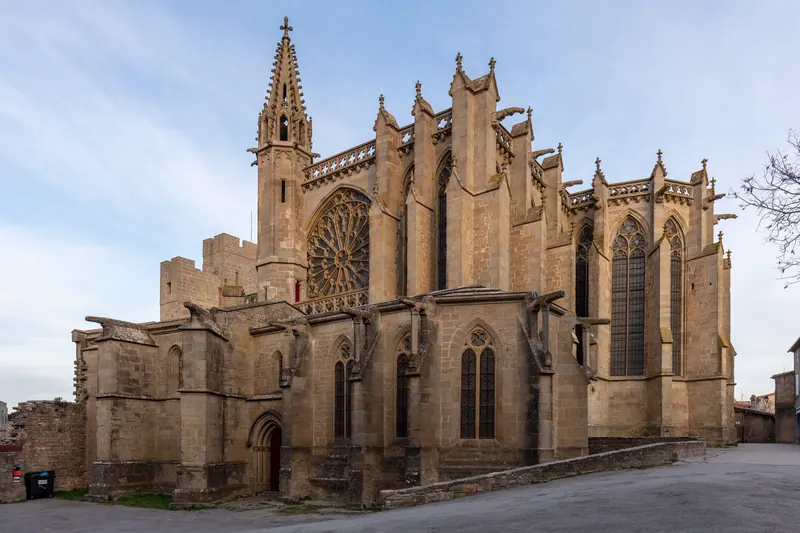
The Cité's cathedral until 1801: a Romanesque nave whose building stones Urban II blessed on 11 June 1096, welded to a Rayonnant Gothic transept and choir put up between 1269 and 1330. Entry is free, and the 13th- and 14th-century glass — which the Aude tourist board calls the finest in the Midi — is the reason to go in.

Free or cheap Quiet corner Works in the rain
Walking directions
View

Pont Vieux

Stone bridge under construction 1315, completed c. 1320; classified monument historique 1926; heavily restored 1820

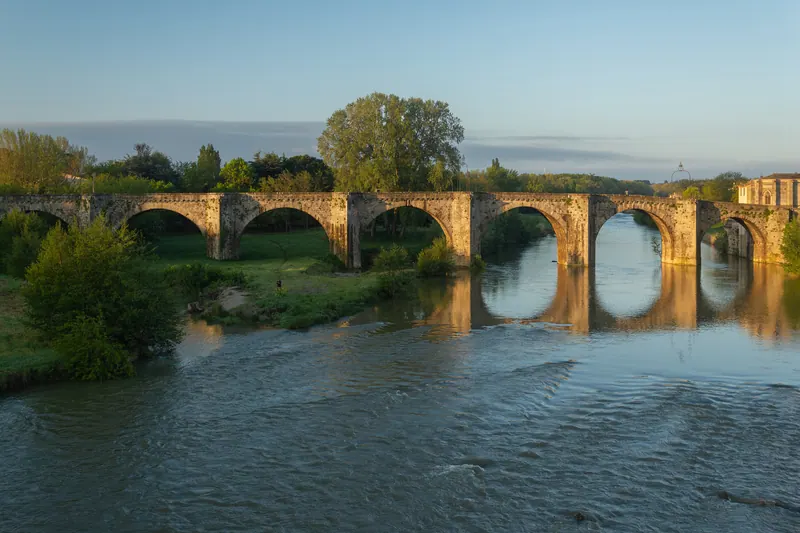
Twelve arches thrown across the Aude around 1320, and for five centuries the only way from the new town to the Cité. Cars were moved off it long ago, so it is now the one place in Carcassonne where you can stand still, in the middle of a river, and see the entire fortress at once — free, at any hour, and best in the twenty minutes after sunset.

Free or cheap Best in the evening Good with children
Walking directions
All articles