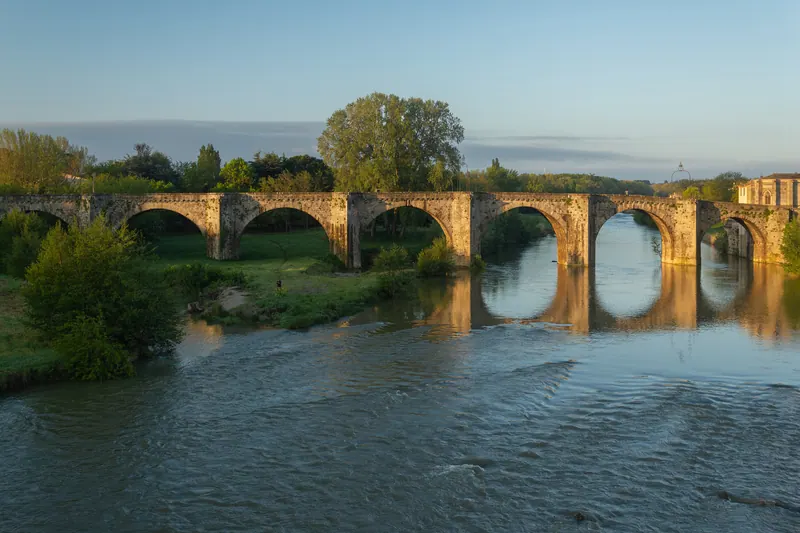
There was a crossing here by 1184, but the stone bridge is 14th-century: work was under way in 1315, it was probably finished around 1320, and it was paid for by a tax raised for the purpose and built arch by arch as the money arrived. Twelve semicircular arches of unequal span — the Ministry of Culture’s record gives openings of roughly 10 to 14 m — rest on piers with sharply pointed cutwaters, and small refuges were built out over the cutwaters so that people could stand aside from carts. It runs to over 200 m. It was classified a monument historique on 18 August 1926.
It was also a border. A gate under a semicircular arch stood on the third pier, topped by a cross, marking where the ville basse ended and the ville haute began: two towns, two jurisdictions, one bridge. Until the 19th century this was the only link between the Bastide Saint-Louis and the Cité, and in the Middle Ages the only way up to the fortress at all. It has been repaired hard — two arches collapsed in 1436, there was work in 1559, and a major restoration in 1820 changed its appearance considerably — so, like the Cité it points at, the bones are medieval and a good deal of the surface is not.
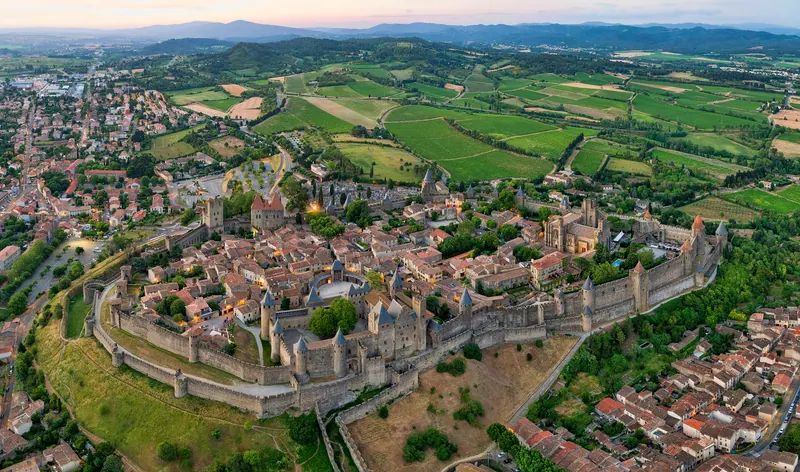
What you came for is the view east. From mid-span the whole silhouette lines up: the Cité on its ridge above the river, the double ring of walls, the Porte d’Aude climbing towards you, the bulk of the Tour de l’Évêque on the west side. Be honest with yourself about what you are photographing. Every pointed slate roof on that skyline is Eugène Viollet-le-Duc’s, added from 1853 onward; a 13th-century garrison saw flat tiled tower tops and a much lower, blunter profile. What is genuinely old is everything underneath — the wall mass, the tower drums, and, on the north and east sides you cannot see from here, Gallo-Roman courses of the late third and fourth centuries. The postcard is Victorian. The fortress is not.
Go at dusk. The Cité faces west-ish from the bridge, so it takes the last of the sun on its walls, and then the floodlights come up while the sky is still blue — that gap is the shot, and it lasts about twenty minutes. In the middle of the day the same view is flat and backlit.
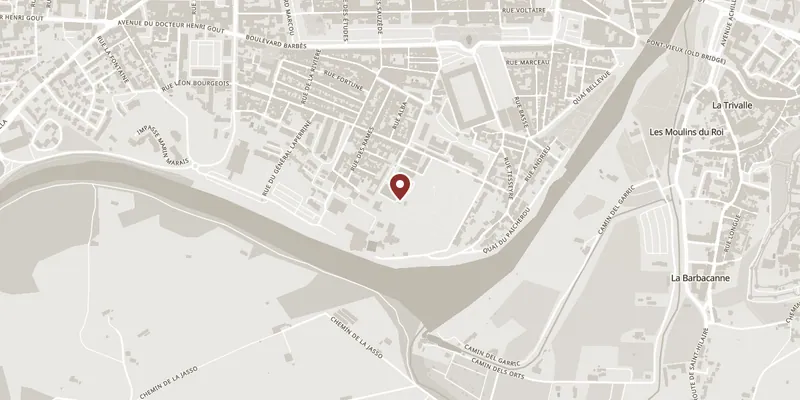
At the Bastide end stands the chapel of Notre-Dame de la Santé, 15th-century, on the site of the town’s oldest hospital. At the far end the bridge lands on rue Trivalle, at the foot of the climb to the Porte d’Aude — steep, cobbled and stepped in places, but the most satisfying way into the Cité there is, because you arrive under the walls instead of through a car park.