Visby has 3.4 km of 13th-century wall and, for eight days every August, several thousand people inside it wearing wool on purpose. Visby Medieval Week (Medeltidsveckan), in Visby, Sweden, is worth the ferry, because it is the one festival on this site where the whole walled town is the venue rather than a field next to one. It always runs from the Sunday of week 31 to the Sunday of week 32, so the 2027 edition is expected 8–15 August; the dates weren’t announced when we checked. The hard part is not deciding to go. It is the bed, and the bed is gone by February. By the end of this you’ll know what is free, what needs a ticket, and whether to sleep in the festival campsite or pay for a flat.
What is Visby Medieval Week?
Medeltidsveckan is an eight-day festival held inside and just outside Visby’s ring wall every August since 1984, run by Medeltidsveckan AB, which belongs to a non-profit foundation set up by Gotlands Museum, Region Gotland and the island’s medieval guild. The 2026 edition ran 2–9 August under the theme Kärlek (Love) and listed more than 800 programme items at over 40 venues.
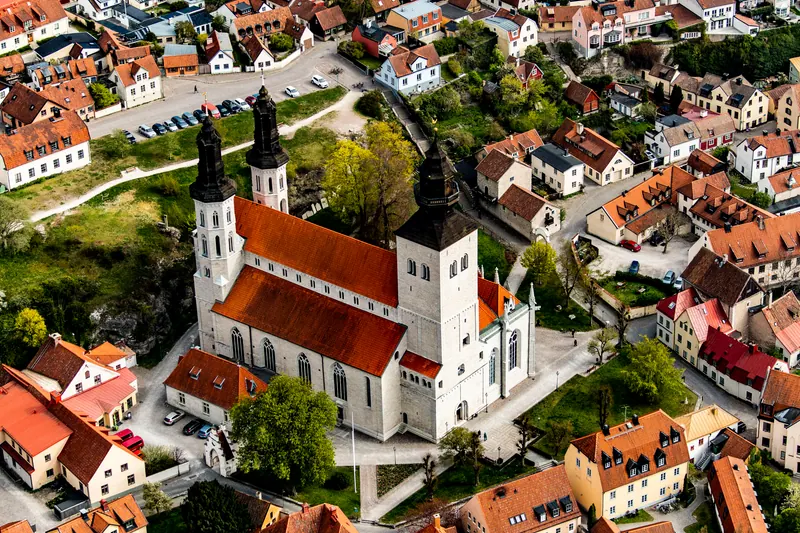
Most festivals build a medieval town on a field for a weekend. Visby doesn’t have to. The wall, the dozen roofless churches and the stepped-gable warehouses on Strandgatan were already here, so the festival moves in: the market runs through the lanes, the jousting is on Strandgärdet, the field below the wall by the shore, the camps sit in the old moat at Nordergravar and up on Galgberget, and the concerts are in churches with no roofs, which is glorious until it rains. The figure most sources quote is around 40,000 visitors across the week.
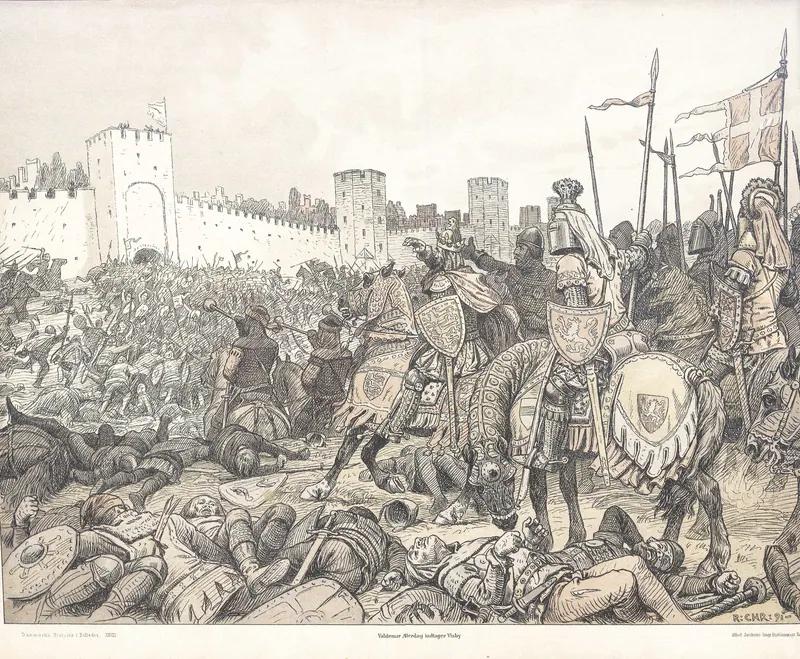
If you want the wall’s history, and the 1361 battle outside it that filled the mass graves at Korsbetningen, Elke has written it: Medieval Visby.
Book the ferry first and the bed second; argue about costume later.
What actually happens, hour by hour?
Market and camps in the morning, tournament and lectures in the afternoon, concerts and fire after dark, and the town never quite shuts. The programme is the organisers’ and changes every year; the rhythm below is ours, from weeks spent mostly on foot between the harbour and the arena.
Morning: the market and the camps
Be inside the wall by nine. The stalls are opening, the lanes up from the harbour are still damp, and the smell is woodsmoke and coffee, which by eleven will be woodsmoke and frying. Walk the market uphill, not down: the stalls nearest the harbour are where the plastic swords and the moulded drinking horns cluster, and the makers, the people who can tell you which sheep the wool came from, are further up.
The camps are the living-history half. Nordergravar is the old moat outside the north wall; Galgberget is the gallows hill above the town, and yes, that is what the name means. People there are cooking, sewing, sharpening and disagreeing about buckles. Open camp displays are covered by the wristband; the craft courses, which the programme lists each spring, are ticketed and, the organisers warn, often sold out before the opening Sunday.
Ask what is in the pot at any camp kitchen. It is the best free lesson in town, because the cook has nothing else to do until it boils, and they will also know where the nearest water tap is.
Afternoon: the tournament and the lectures
The joust, Tornerspel Gotland, is at the Medeltidsarenan on Strandgärdet. It needs a seat ticket on top of the wristband: 2026 seats were listed from about 270 SEK (roughly €24), more for the evening shows with the fire effects, and the 2027 prices will be on the official site. What you get is a staged show with a story and riders who can ride. Ticket in hand, get there early: the arena area usually opens well before the show, with a grill, a small market and the horses being walked, and a child will get more from the horses than from the joust.
The lectures are the thing people skip and shouldn’t. Gotlands Museum runs guided walks through the week, and the programme carries talks on the wall, the 1361 graves and whatever the year’s theme allows. Many are in Swedish. The programme says which are in English, and they are also the only hour of the day with a roof and a chair.
If the joust is sold out, the lectures are your afternoon. If the lectures are in Swedish, the camps are.
Evening: the taverns, the concerts, the ruins at midnight
After dark the town changes gear. The concerts and theatre are in the church ruins, St Nicolai among them, ticketed and sold early, and a roofless church with the sky going dark at 22:00 beats any stage in a tent. The partner taverns, which is the organisers’ word for the festival bars, fill with people in linen and people in Gore-Tex and nobody minds. A beer in one costs what a beer costs in Sweden, which is to say you will remember each one individually.
The fire shows are the late thing. Then walk the wall. The lanes empty faster than you’d expect, the towers stand black against a sky that never goes quite black, and the sea is right there on the other side.
Buy concert tickets the day they are released, and pick a ruin over a stage.
The parade day
The opening Sunday is the parade day. The ceremony and the fire-arrow show are free, and the opening has traditionally been a pageant of the Danish king’s 1361 arrival at the gates, the one bit of history the week acts out rather than exhibits. The programme gives the route and time each year, and the pavements along it fill an hour before, so take the first piece of rising ground you find: a procession is easier to see over heads than through them.
Who will love it, and who won’t?
It suits people who would rather live inside a festival than visit one: reenactors, families with a children’s programme to work through, anyone who likes a concert in a ruin. It will not suit you if you need a hotel at short notice, dislike crowds in narrow lanes, or came for a quiet town, because for this one week Visby isn’t one.
Money first. Sweden is expensive, Gotland in August more so, and the ferry, the bed, the wristband, a joust seat and a week of eating add up to a holiday’s budget, not a festival weekend’s. The streets are free. Almost nothing else is.
The weather does one thing reliably, which is change. A morning can start with drizzle off the Baltic and be hot by one, and by the time your wool has dried on you it is time for the jacket again. The wind is the constant.
The harbour end of the market is the tat end, and the lanes between the harbour and the cathedral at 14:00 on the Saturday are the one place all week we’d call unpleasant. Go up, go early, or go round by the wall.
Families get the children’s programme, crafts, archery and shows, and the tournament, which is the family event. They also get late concerts and fire, and lanes at 23:00 that belong to a different town. Pick one per day, the child’s day or the adult’s night.
If the bed problem beats you, Horsens Medieval Festival in Denmark is the August alternative: expected 27–28 August 2027, free, and held in a former state prison, which at least makes no promises about the accommodation.
How do you get there, and where do you sleep?
Destination Gotland ferries from Nynäshamn, south of Stockholm, and from Oskarshamn take about three hours; there are also flights to Visby Airport. For week 32, book the sailing as soon as summer departures are released, which is usually the winter before, and the bed by February. The organisers say ferries and lodging fill months ahead. They are not exaggerating.
The ferry is the pleasant part: Nynäshamn is about an hour from Stockholm on the commuter train, the boat has a restaurant and a deck, and if you have a car, bring it, because the beds still available in spring tend to be a long way from the wall.
The bed is where it goes wrong. Inside the wall there are hotels, hostels and a great many flats let for the week, and all three are spoken for long before the programme is published. Prices are Swedish summer prices with a festival on top; we won’t quote a figure because it changes with every cancellation. A hotel inside the wall means booking the summer before; a flat means February. After that you are looking at the rest of the island and a bus in each morning, or at the Visby page for the town outside the week, when it is quiet, cheaper and has the same wall. The Sweden list has the country’s other dates for anyone whose week won’t bend.
The festival runs its own campsite. It is the cheapest bed, it is close, it is where the people in gambesons are, and it is where you learn the difference between wool and polyester at six in the morning. I’ve slept there and in a borrowed flat; the flat wins on sleep and the campsite on everything else.
What should you wear and bring?
Costume is optional, and the organisers say so: you are as welcome in a raincoat as in a kirtle. A large share of visitors do dress up, and if you arrive in jeans and regret it by Tuesday there is costume hire in town and there are sewing workshops during the week. Nobody checks anything but the wristband.
Whatever you wear, make it wool or linen rather than polyester. The drizzle-then-heat pattern beats synthetics twice, cooking you at one and clinging at four; a wool layer over linen copes with both and dries on you. Shoes matter more than the cloak. Visby is a hill of cobbles and the lanes are steep, so leather soles are period and also a way to meet the ground.
Bring a refillable bottle: there are water points in the camping areas, on the festival grounds and on the east side of the arena, plus public taps at the Almedalen playground and outside the St Karin ruin, and at Swedish prices a bought bottle is a small tragedy. The longer kit list is in what to wear to a medieval festival; the short version is a contactless card and no cash, because Sweden is close to cashless and the other thing stalls take is Swish, a mobile payment you can’t get without a Swedish bank account.
Tips we’d give a friend
- Buy the wristband and your tournament and concert tickets online before you travel. The organisers say many programme points sell out before the opening Sunday.
- Read the programme for the lectures and the Gotlands Museum walks, and check which are in English. They are the only sit-down hour in the day.
- Refill at the festival taps (Almedalen playground, outside St Karin, the east side of the arena). You drink more than you think on a hill.
- Walk the shore north from the harbour on a hot afternoon. The sea is five minutes from any gate and the crowd is not.
- Do the market before eleven and the camps after lunch. The stalls are calm early, and the camps only wake up properly once the cooking starts.
- If week 32 is full, the same organisers run Medeltida Jul (Medieval Christmas) in Visby on 4–6 December 2026: smaller, the same wall, no ferry crisis.
Go if you can book by February and would rather live inside a festival than visit one. The case for it is a roofless church at 22:00, a concert just finished and the sky not yet dark. Its price is the ferry, the bed and a Swedish bar bill. If you are reading this in spring with no bed, take the December edition instead, and put February 2028 in the diary now.