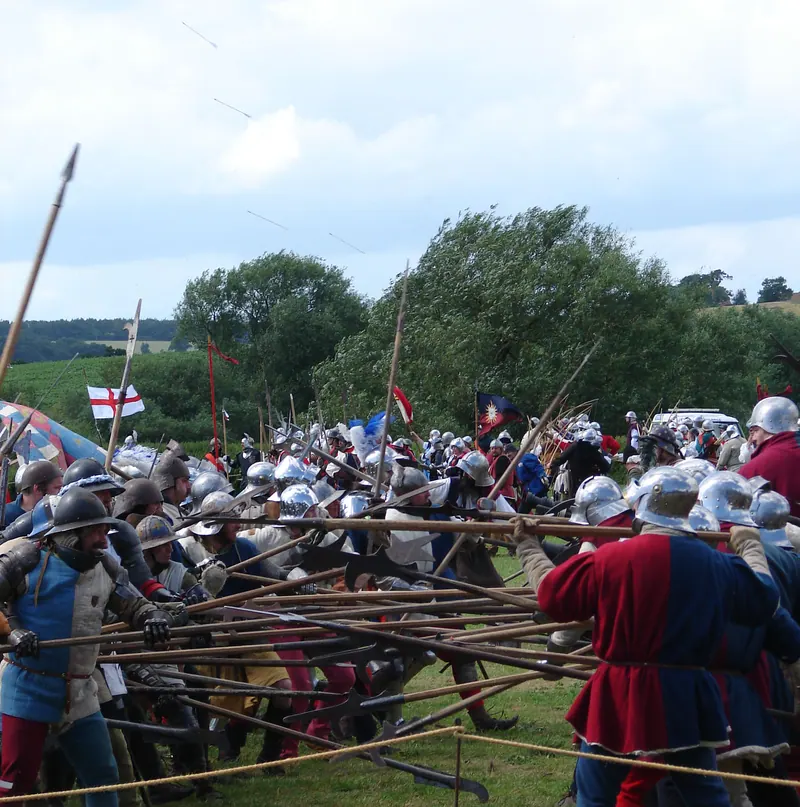
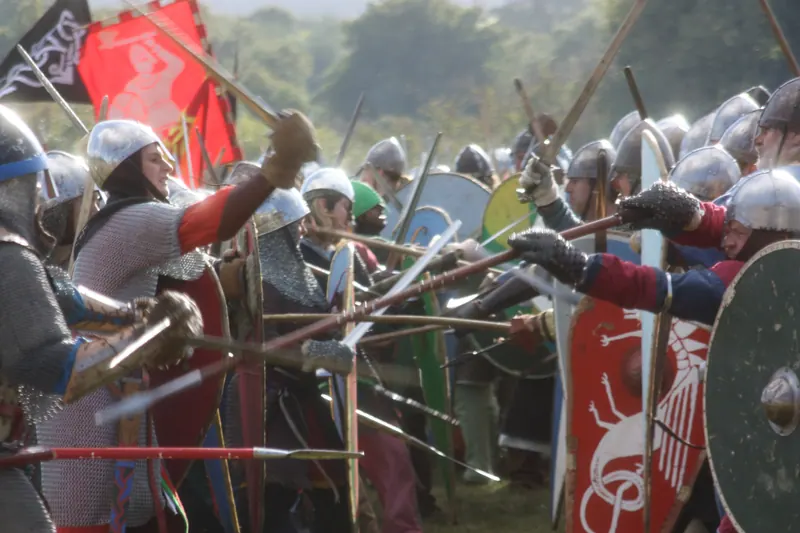
A field of rye near Stębark, a rope across it, and on the far side of the rope about 1,400 people in harness waiting for three o’clock. The Battle of Grunwald Reenactment, in Grunwald, Poland, restages 15 July 1410, when Władysław Jagiełło’s Polish-Lithuanian army broke the Teutonic Order on this ground, and it does so on the original field, for free, on the Saturday nearest the anniversary. The 2027 battle is Saturday 17 July 2027 at 15:00, already announced by the organisers. By the end you’ll know where to stand, when to arrive for a place on the rope, and how to get to a field 40 km from the nearest city and back out again.
What is the Battle of Grunwald reenactment?
The biggest battle reenactment we know of in Europe, and the only one where the spectator count is quoted in six figures. The organisers, the Marshal of the Warmia-Masuria region with Fundacja Grunwald, have staged it every July since 1998 with one pandemic gap; the 2026 battle was the 28th. Their figures for 2026: about 1,300 to 1,400 armoured fighters on the field, more than 3,500 people in the camps counting craftspeople, musicians and historians, and a crowd regularly quoted at around 100,000.
The battle is the centrepiece of Dni Grunwaldu, Grunwald Days, which usually run from the Wednesday to the Sunday of that week, with camp life, tournaments, archery, concerts, a fair and evening shows around it. The Museum of the Battle of Grunwald sits beside the field and is open all year, so the site works in October too, when it is a quiet hill with a monument on it and a lot of wind.
Everything except the parking and the museum is free. That is unusual for an event this size and is the reason the crowd is this size.
What happened at Grunwald in 1410?
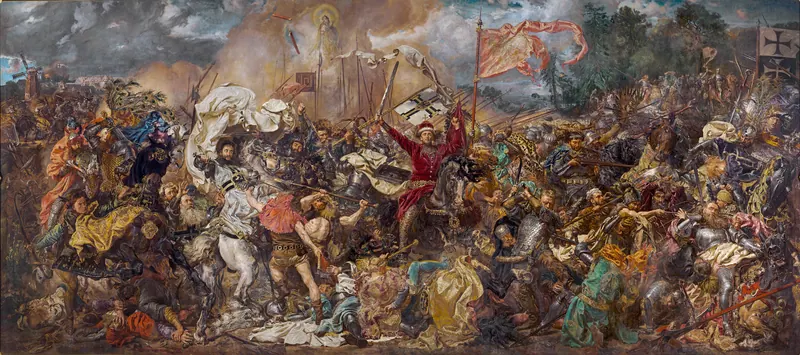
On 15 July 1410 the combined army of King Władysław Jagiełło of Poland and Grand Duke Vytautas of Lithuania met the Teutonic Order under its Grand Master, Ulrich von Jungingen, on these fields and destroyed it; von Jungingen died on the field with most of the Order’s senior command. Germans call it Tannenberg, Lithuanians Žalgiris, Poles Grunwald, and the three names are a fair summary of who has cared about it since.
Elke’s two paragraphs, kept to two: the battle broke the Order as a field army but not as a state. Jagiełło did not take Malbork, the Order’s brick fortress-capital 100 km or so to the north-west, and the war ended in a peace that changed little on the map. The real settlement came 56 years later with the Second Peace of Thorn in 1466, which took Gdańsk, Malbork and the Vistula mouth from the Order and left it a Prussian rump. If you are going on to the coast, our Gdańsk guide picks the story up there, and Malbork is on the road between.
What 1410 did decide was which side had the numbers, the allies and the momentum for the next half-century, and which side would spend it writing appeals to the Pope.
When is the Grunwald reenactment 2027?
Saturday 17 July 2027 at 15:00, announced by the organisers on the official site. The Dni Grunwaldu programme around it, usually Wednesday to Sunday, is still to be confirmed. For the rhythm: the 2026 edition ran 15 to 19 July with the battle on Saturday 18 July at 15:00, and the pattern is the Saturday nearest 15 July every year, so you can pencil 2028 before anyone publishes it.
Plan around the Saturday and add the Friday. The Friday has the camps at full strength, the museum without a queue and a fraction of the cars.
What actually happens, hour by hour?
The Saturday is long, the field is big, and the battle is one hour of it. Treat the rest as the festival it is.
Morning: the camps, the crafts, the fair
Come in before ten. The knights’ camps are the living part: cooking fires, kit on racks, a smith already at work, people in gambesons eating breakfast out of wooden bowls while someone in full harness tries to sit down. Children like this part best, because the craftspeople are there to be asked things and most of the camps let you close enough to see the stitching. The fair is the commercial strip: leather, wooden swords, honey, sausage on grills, the usual. It takes cash more reliably than cards, so bring złoty.
Walk the field itself while it is empty. The rise with the monument and the masts is the best viewpoint on the site, and at nine in the morning you can stand on it and see the whole ground the armies will use. By two you can’t.
Midday: tournaments, archery, the museum, the queue for shade
The tournament ground and the archery run through the middle of the day on the programme, and they are the easiest things to see at close range, because the crowd is spread out and the fighting is one-on-one. The museum beside the field is the other midday move: it is indoors, it is about the thing you are standing on, and the people in the queue have had the same idea, which is why we’d do it on the Friday instead.
The honest midday problem is shade. There is almost none on the field, and the trees at the edge are claimed by noon by families with blankets who arrived at nine for the purpose. Bring your own cover or accept the sun.
Eat at midday. Nobody is queuing for food at 15:00 and nobody is serving fast at 16:15.
Three o’clock: the battle
The rope along the spectator side fills well before 15:00. By lunchtime is not too early for a front place, and the people who arrive at 14:30 stand behind people who arrive at 13:00, who are taller than you and have a flag. What you want is a spot on higher ground with a clear line across the field, and a folding seat for the hour before, not the hour of: once the armies form up, everyone stands, and a chair becomes a thing to trip over.
Then the cannon, the arrows, the two lines closing, and about 1,400 fighters in a press wider than you can take in from one spot. You will not see all of it. Nobody sees all of it, including the people in it; I have been in the middle of smaller ones and could tell you which way was up and not much else. What you will see is the shape of the thing, which is the point of Grunwald rather than a town-park skirmish: the Order’s line, the Lithuanian wing, the moment it turns, and a very loud end. The commentary is in Polish, so read the two paragraphs above before you go and you will know what the noise means.
For the record, the Order loses every year. The men playing the Order know this and turn up anyway, which is accurate to the period.
After: the walk to the car, the traffic, the evening
When it ends, 100,000 people try to leave a field down a couple of rural roads. The organisers say so themselves: expect slow traffic on the access roads after the battle. You have two choices. Leave the moment the last cannon fires and beat the first wave, or stay for the evening concerts and shows and leave in the dark when the car parks have emptied. We’d stay. The camps after a battle are the best part of any reenactment, the fires are lit, and the cars are going nowhere anyway.
Who will love it, and who won’t?
Anyone who wants to see a medieval battle at the scale the period actually fought them, on the ground where it happened; families with school-age children, who get the camps in the morning and a battle in the afternoon for the price of the parking; reenactors, who will spend the morning in the camps and the battle on the rope with professional envy. Taking part is by registered group through the organisers, not by turning up in a gambeson, as far as we can establish.
Who won’t: anyone with a buggy or a toddler, because the ground is field, the distances are long and the crowd around the rope is a crush; anyone who needs a seat with a sightline, because there are none; anyone who wants to be away by four.
The downsides are the crowd and the ground. A six-figure crowd on farmland means long queues for everything, toilets included, which we won’t put a number on and you won’t enjoy. And the field in July is dry, dusty and open; you will be on your feet, in the sun, for most of a day, and there is no building to retreat to except the museum.
Getting there, parking and sleeping
The field is rural, about 40 km south-west of Olsztyn, reached by minor roads from Olsztynek or Ostróda. A car is the practical option. The organisers set out paid parking fields around the museum for the event; arrive before noon to get into the near ones, and accept that getting out is the slow part whatever you do. Gdańsk is about two and a half hours by car, by our rough reckoning; Warsaw further. We have not found a published spectator shuttle from Olsztynek or Ostróda stations, so if you are without a car, check the organisers’ practical-information page in the weeks before and have a taxi number.
Beds: Olsztyn is the city with the hotels, about an hour away; Ostróda is the smaller lakeside town and closer; both fill for the weekend, so book by spring. If you are coming from the coast, the sensible shape is Gdańsk, then Malbork Castle, the Order’s own seat and the largest brick castle in Europe by the usual reckoning, then Grunwald, then back; the Order’s side of the story in the order it happened. The Grunwald page covers the battlefield in the quiet months.
Tips we’d give a friend
- Arrive before noon. The near car parks, the trees at the edge and the good rope spots go in that order.
- Water, more than you think, and a hat or an umbrella; the umbrella doubles as a flag for finding each other.
- A folding seat for the waiting, not the watching, and a blanket to mark your place.
- Cash for the fair and the food; card readers exist and are not to be relied on in a field.
- Do the museum on the Friday. On the Saturday it is the only building on the site, and the queue knows it.
- Stay for the evening. The traffic goes nowhere for an hour anyway, and the camps after dark are better than the battle.
- Wear boots or trainers, never sandals, and read what to wear to a medieval festival and how to behave at a medieval fair before you walk into a camp where people have been sleeping since Wednesday.
Other battle reenactments worth the trip
For the same ground-is-the-ground reason: the Battle of Hastings Reenactment in October, ticketed by English Heritage at £24 for adults in 2026, more than 500 reenactors on the real slope below the abbey. And Tewkesbury Medieval Festival in July, free, on a river meadow that was part of the 1471 battlefield and behaves like a meadow when it rains. The rest of the battles are under Reenactment & Battles, the Polish calendar under Poland, and the month’s options under July; if you are in the north of Poland a week later, St Dominic’s Fair in Gdańsk runs from late July and is the other reason to be there.
Get to the rise by nine, walk the empty field, and then pick your place on the rope and hold it. At three the ground you are standing on does the one thing no arena can: it is the same ground. That is what you drove 40 km of minor roads for.