The Battle of Hastings was fought about 11 km from Hastings, and the re-enactment is staged where the battle was: on the slope below Battle Abbey, in Battle, East Sussex, England. On Saturday 10 and Sunday 11 October 2026 the Battle of Hastings Re-enactment (Hastings Re-enactment) returns, 10:00 to 17:00 both days, confirmed by English Heritage, 960 years after Harold Godwinson’s shield wall broke in the evening of 14 October 1066. Advance tickets are £24 an adult. By the end of this you’ll know what the day contains, where to stand, which day to pick, and whether it is your kind of battle. It is a hill, not a joust. I mean that as praise.
Is the Battle of Hastings re-enactment in Hastings?
No. It is in Battle, the small town that grew up around the abbey William built on the battlefield, about 11 km inland from Hastings. Battle station is on the London Charing Cross to Hastings line, roughly 16 minutes from Hastings by train, and the abbey gatehouse on the High Street is ten to fifteen minutes’ walk from the platform. The postcode English Heritage gives is TN33 0AE.
Here is the short version of 1066, because the long one is elsewhere: Harold’s army held the ridge where the abbey now stands, William’s Normans came at it from the low ground to the south, and the shield wall held most of the day and broke as the light went. Harold died on the hill. William founded the abbey in penance and, by tradition, had its high altar set on the spot where Harold fell; a stone marks it now. You will walk past that stone between the camps, and if it does nothing to you, this is not your event.
What actually happens on the day?
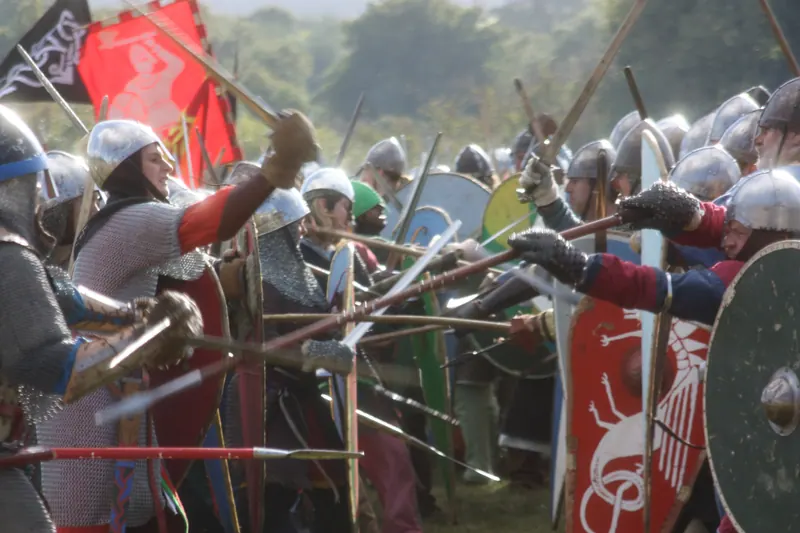
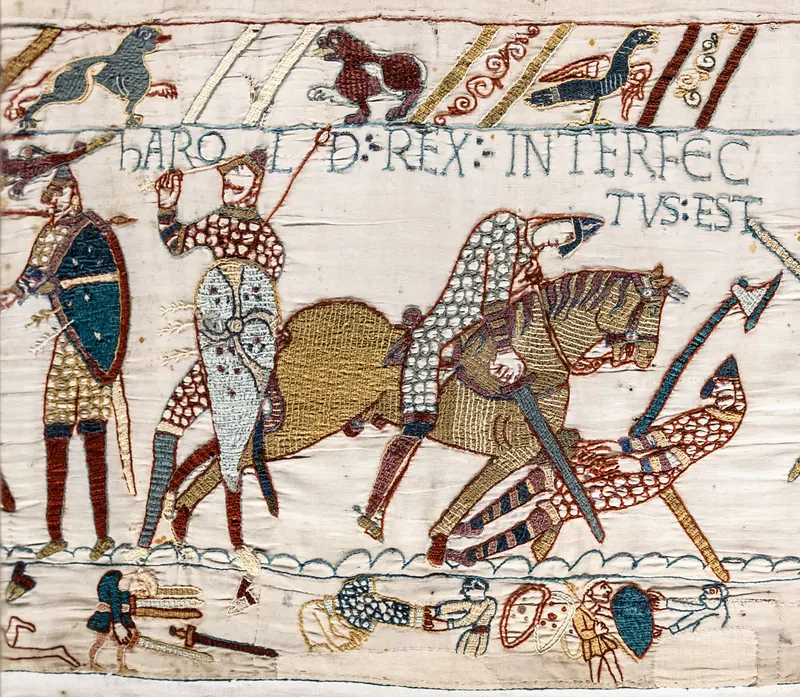
The site opens at 10:00 and the camps are the first hour’s job. Saxon and Norman living-history camps are pitched across the battlefield and you walk between them: cooking fires, mail on stands, someone re-riveting a hauberk who will explain the rings if you stand still long enough. Replica weapons and armour are there to be handled. The sword school takes children through a mock combat of their own, and around that English Heritage lists falconry, period music, a performance built on the Bayeux Tapestry’s telling of the invasion, Battle’s jester, a market, and on both days a British Sign Language battlefield tour with a meet-and-greet at the gatehouse between 10:00 and 11:00.
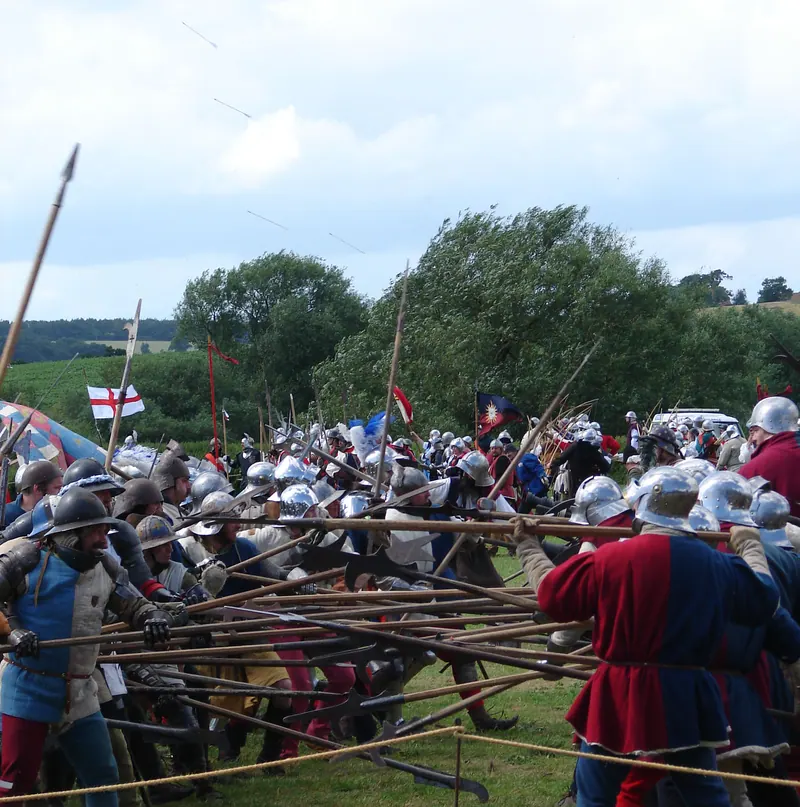
Once a day the battle is fought, and the day builds to it, which is English Heritage’s own phrase and a fair one. Cavalry, archers and two shield walls on the slope beneath the abbey ruins, more than 500 reenactors between them by the organiser’s count. The exact time is in the timetable English Heritage posts on the event page. We had not seen the 2026 one when this was written, so we are not going to guess it.
What we will say is where to stand. The rope along the bottom of the slope fills a good hour beforehand, and the bank behind it is a slope too, so the second row sees over the first. Stand uphill of the rope with the abbey at your back and the Normans come up the field towards you, which is the view Harold had, minus the outcome.
What does the ticket include, and what does it cost in 2026?
Advance prices for 2026 are £24 for an adult, £12 for a child aged five to seventeen, £21 for a concession, £60 for a family of two adults and £36 for a family of one. English Heritage members pay £8 an adult and £4 a child. On the day an adult is £30 and a two-adult family £75, which is the 20% English Heritage says you save by booking, and a good reason to, because the weekend sells well and a wet forecast empties it less than you’d hope.
The ticket is the whole site: the abbey ruins, the gatehouse exhibition and the battlefield walk, as well as the event. Allow the full day.
The abbey after the battle, when the crowd is walking back to the station, is the quietest it will be all weekend.
Who will love it, and who won’t?
Anyone who has stood on a battlefield knowing what happened there will get more from this hill than from a bigger battle on a prettier field. The nine-year-old gets the sword school and the falconry, and the walk between the camps is short enough that nobody has to be carried. Reenactors will find the camps honest: 11th-century kit, mail and nasal helms, no plate, no gunpowder, and the groups who do this period take the ground seriously.
Skip it if you want a joust. There is no tilt here; the Normans had cavalry and the Saxons had axes, and the re-enactment respects that. Skip it, too, if you need a dry shoe: the site is grass on a slope in mid-October, and English Heritage’s own note is that it “can be muddy”, which it can.
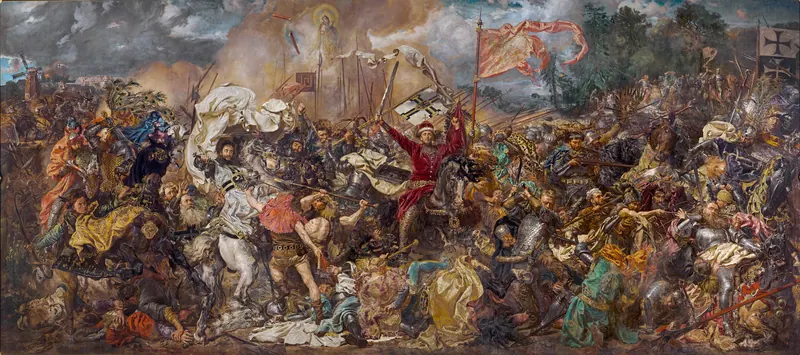
Know the scale before you go, as well. More than 500 reenactors is a good field, not a vast one. Tewkesbury Medieval Festival puts around 2,000 on its meadow by the organisers’ count and charges nothing at the gate; the Battle of Grunwald Reenactment in Poland is bigger again. Hastings wins on the ground and on nothing else. That is enough.
Saturday or Sunday?
Both days run 10:00 to 17:00 and English Heritage advertises the same programme for each; if the two differ in detail, the posted timetable will say so. Our call is the Saturday for the camps, because at any two-day event the camp is fullest on the first day and some groups are packing the van before the second battle ends. The Sunday buys a slightly emptier rope and a quieter abbey afterwards. With a child in school, take the Saturday, and spend the Sunday drying things.
Tips we’d give a friend
- Boots, not trainers. The slope is grass, October is October, and “can be muddy” is written in the tone a builder uses for “might need a bit of work”.
- Take the train. Battle is about 16 minutes from Hastings and around an hour and a half from London Charing Cross, the gatehouse is a short walk from the station, and the town’s car parks were not built with a Norman invasion in mind.
- Bring something to sit on. The bank below the abbey is the grandstand and it is damp by 14:00.
- Arrive at 10:00 for the camps, not at the battle hour for the battle. The camps are where you learn something; the battle is where you watch it.
- Do the abbey after the battle, when the crowd goes, and the battlefield walk before it, when your feet are still dry.
- Book the London add-on now. The Bayeux Tapestry is at the British Museum from 10 September 2026 to 11 July 2027, the first time it has been lent to Britain, and tickets up to 31 December had sold out when we checked; the next batch, for January to March 2027, was due to go on sale on 21 October 2026. The tapestry’s home town holds its own Fêtes Médiévales de Bayeux on the first weekend of July, expected 2–4 July 2027, and Bayeux, with a cathedral consecrated in 1077, is worth the crossing on its own.
- Read what to wear and ignore the costume half; at Hastings nobody dresses up but the people fighting. How to behave at the rope applies double when the man behind it is holding an axe.
Where else to see a battle
If Hastings is your first, the next two on our list are free and larger. Tewkesbury Medieval Festival, in Tewkesbury, England, refights 4 May 1471 on fields beside the original battlefield on the second full weekend of July; the 2027 dates, 10–11 July, are confirmed, entry is free, and around 2,000 reenactors take the field by the organisers’ count. Its honest guide from the field has the parking and the campsite. The Battle of Grunwald Reenactment, in Grunwald, Poland, restages 15 July 1410 on the Saturday nearest the anniversary; 17 July 2027 at 15:00 is confirmed, entry is free, and the Grunwald guide explains why you will want shade. Everything else the year offers in the way of fighting is under reenactments and battles, the rest of the month under October, and the rest of the country under the United Kingdom; if you can only manage one autumn weekend, the September and October round-up puts Hastings against the others.
The real battle ended when the light went, and in Battle in mid-October the light goes a little after six; the re-enactment finishes well before that. Walk up to the abbey anyway, and stand there for the last of it.