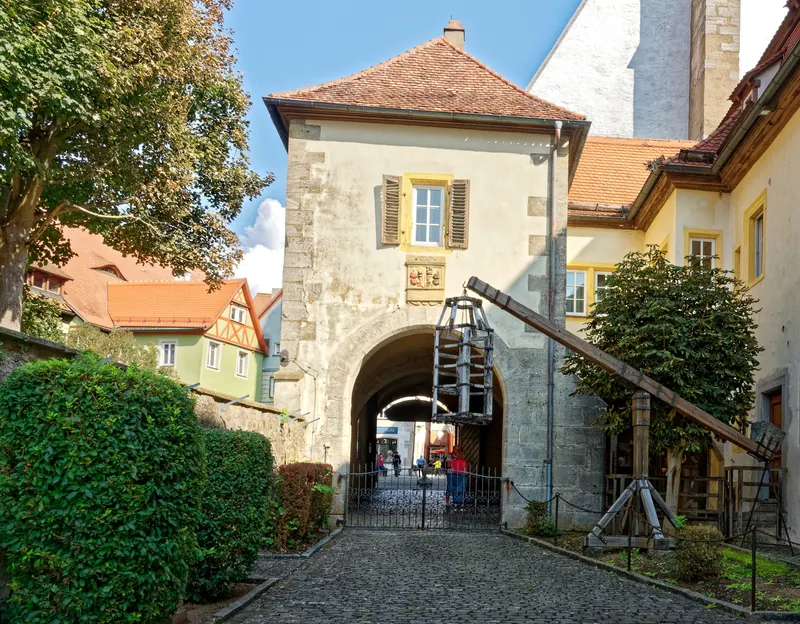
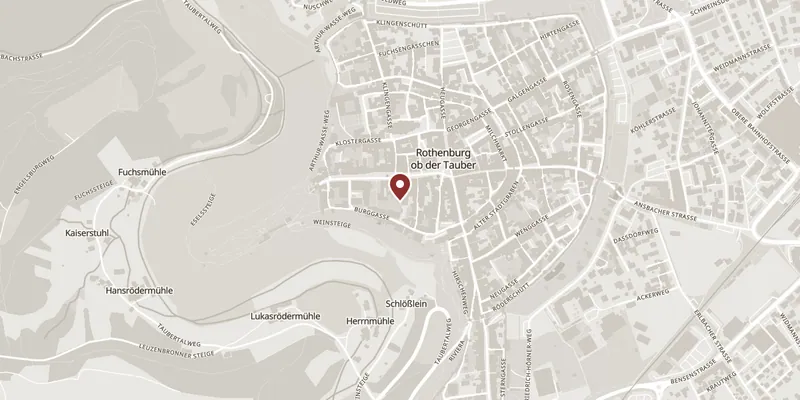
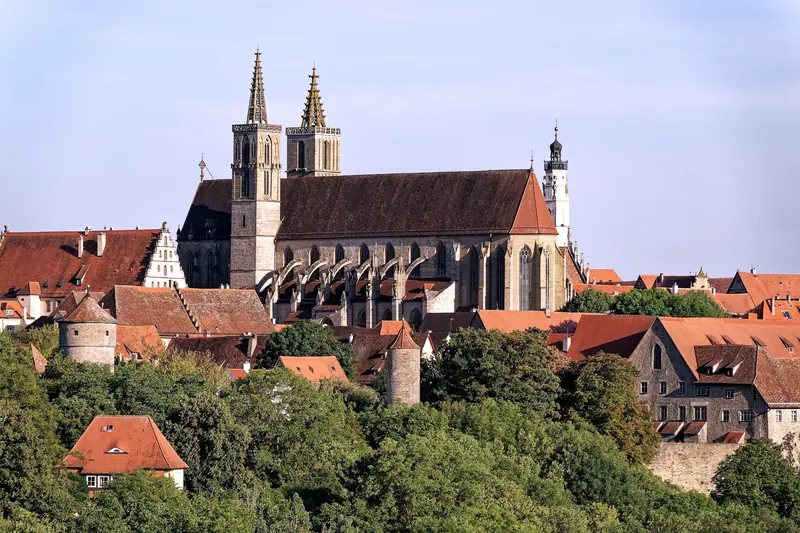
The museum has occupied the former commandery of the Knights of St John at Burggasse 3–5 since 1977; the building went up with the adjoining Johanniskirche between 1393 and 1410. It holds more than 2,000 objects covering a thousand years of European legal history, with the weight of it on the Middle Ages, and it is a research institution with its own library as well as a display.
What it actually is matters, because the name misleads in both directions. The organising idea is procedure: how a court was constituted, what counted as proof, where church law ended and imperial law began, how a sentence was carried out and by whom. The strongest material is documentary — court records, law books, judicial manuscripts, printed sentences. The instruments of torture and execution exist, they are real, and they are in the cellar, presented inside the legal framework that authorised them and set limits on them. The museum’s own director has published on exactly that: what medieval law permitted an executioner to do, and what it did not.
The objects to look for are the ones about shame rather than pain. The collection of Schandmasken — iron masks with pigs’ snouts, donkeys’ ears and long protruding tongues, locked onto the head and worn in public — punished gossip, slander and scolding. So did the neck violin that clamped two quarrelling women face to face, and the shame flute hung on a bad musician. There are executioners’ swords, and on the third floor a set of replicas of the imperial regalia — crown, sceptre and orb — which is the right emblem for a free imperial city that answered to the emperor and to no local lord.
One honest caveat. The iron maiden, the museum’s most famous single exhibit, is the best-known object of a type most historians now regard as an early-modern or 19th-century construction rather than a medieval punishment. Take it as a piece of the history of the idea of medieval cruelty; the court records upstairs are the history of the thing itself.