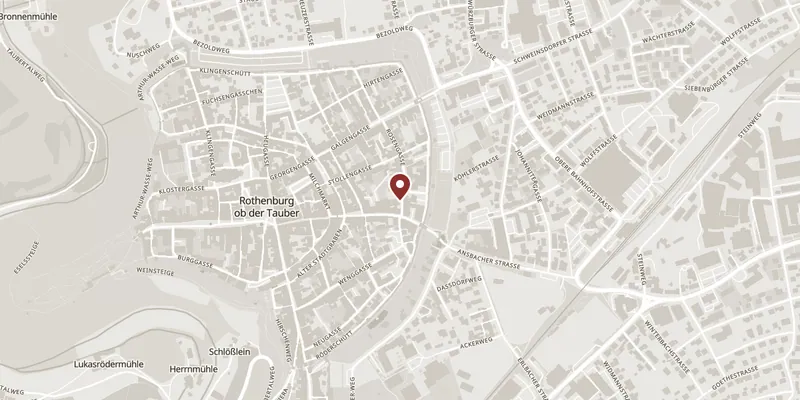
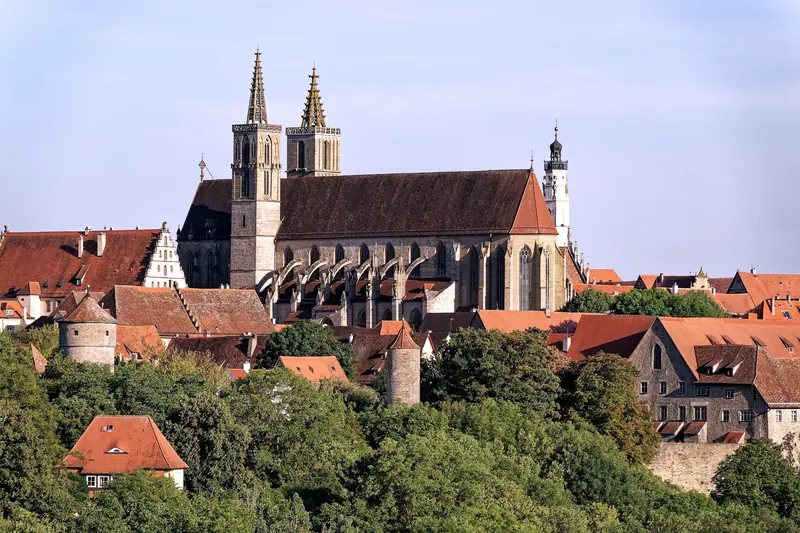
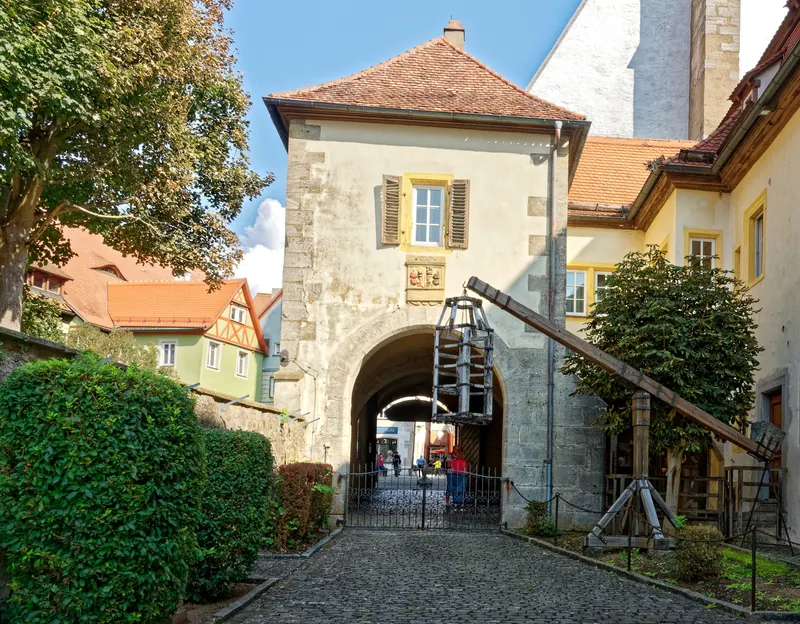
Rothenburg’s defences enclose the old town in a circuit the tourist office gives as “circa vier Kilometer”, with six main gates — Rödertor, Galgentor (Würzburger Tor), Klingentor, Kobolzeller Tor, Burgtor and Spitaltor — plus smaller foot gates. The same office counts 42 towers on the wall on one page and 46 historic towers in the old town on another; either way, no other German town of this size has kept so much of its enceinte. Roughly 2.5 km is walkable inside the covered Wehrgang, a roofed timber gallery about five metres above the ground, reached by open stone stairs at the gates. There is no ticket, no gate and no closing time.
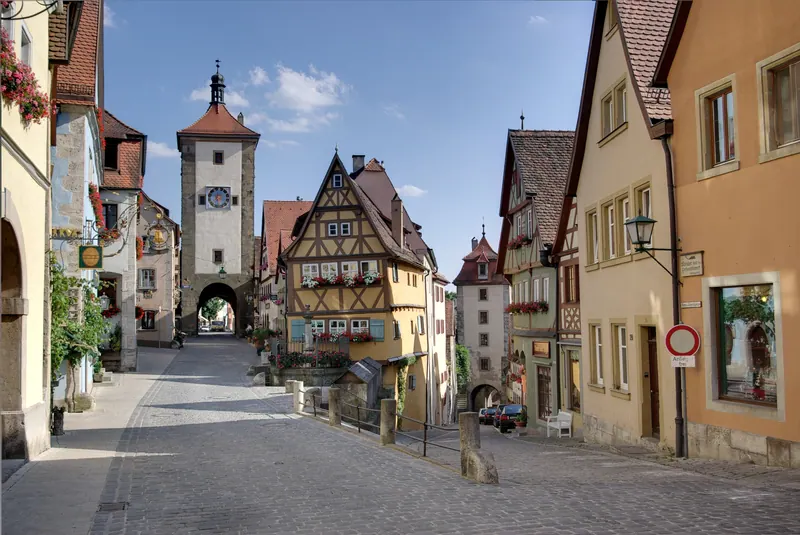
If you walk one stretch, walk the eastern side: Spitalbastei → Rödertor → Klingentor, about an hour at a slow pace. The Spitalbastei at the south end is the youngest part of the fortification, finished in 1537 — a double-ringed bastion where you pass through gate after gate in sequence, built when artillery had made simple gate towers useless. Two minutes inside the wall from its north side is the Plönlein, the forked corner where the lane splits downhill to the Kobolzeller Tor and up to the Siebersturm. It is the most photographed corner in Germany and at eight in the morning nobody is in it.
Be clear about what you are walking on. On 31 March 1945 sixteen aircraft dropped nine tons of incendiary and phosphorus bombs on the eastern old town: 39 people were killed, including nine children, 306 houses burned, and nine towers and close to 1,000 metres of wall came down — around 40% of the inner town. Rebuilding ran to 1956 and deliberately restored the old townscape rather than modernising it. The wall-walk itself was reconstructed 1948–53 by public subscription: 49 Deutschmarks bought one metre and a plaque. That scheme never stopped. The stones with names and home towns from Japan, the United States and Australia are donors, and the tourist office still sells a stone from about €1,500.