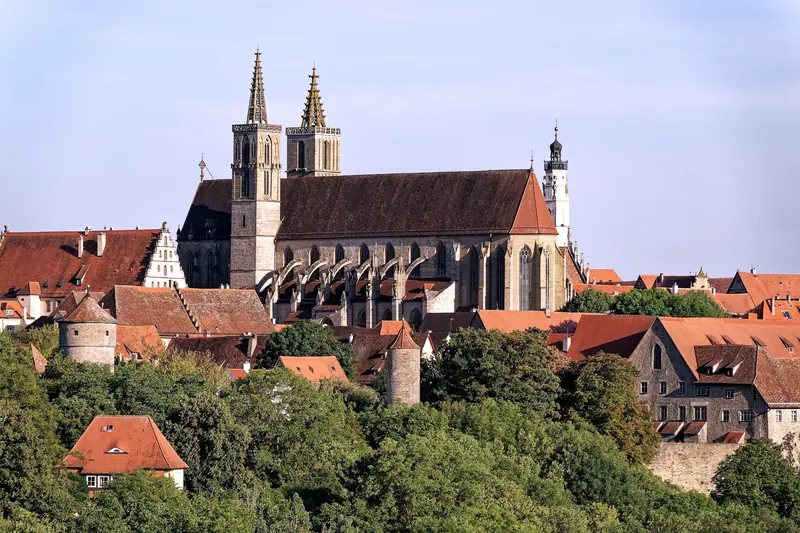
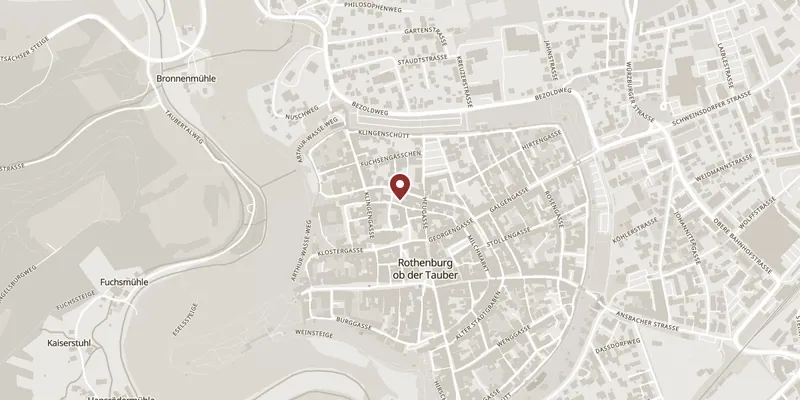
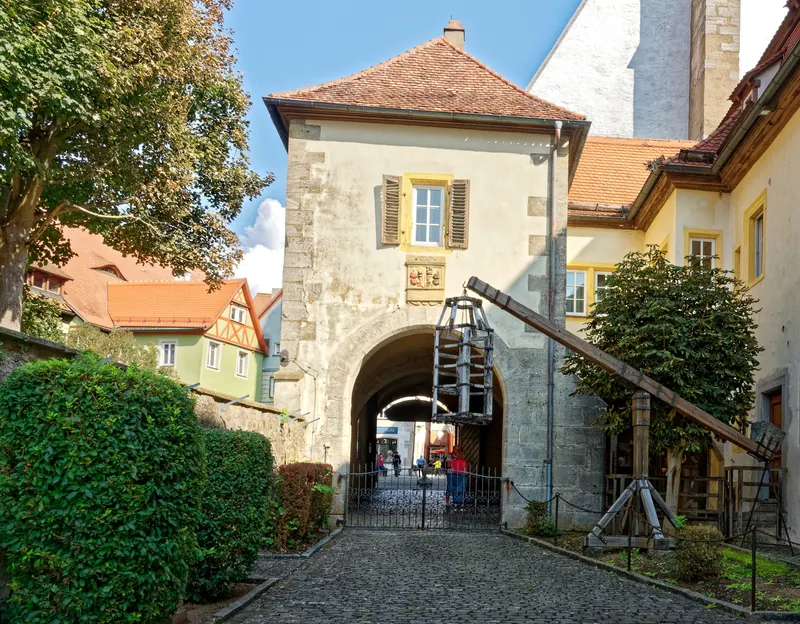
Building took nearly two centuries: the east choir was finished in 1322, the nave went up 1373–1436, and the west choir with its Holy Blood chapel — built across a street, on an arch you walk under — followed in 1453–1471. The church was consecrated in 1485. The two west towers are deliberately unequal, 55.2 m and 57.7 m. It has been Lutheran since 1544, which is why the medieval furnishings survived instead of being replaced in the Baroque.
The reason to pay the entry is up the stairs at the west end. The Altar of the Holy Blood was commissioned for the relic chapel: the contract with Tilman Riemenschneider for the figures is dated 15 April 1501, the shrine was set up on 8 May 1502, and the carving was finished by January 1505. Above it, in the reliquary cross, sits a rock-crystal capsule of about 1270 holding a cloth stained with consecrated wine, venerated in the Middle Ages as drops of Christ’s blood and the reason pilgrims came here at all.
The thing to look for is the composition. Riemenschneider carved the Last Supper with Judas at the centre of the shrine, taking the morsel, and put Christ off to the side — an inversion no other altarpiece of the period risks. The Judas figure is a separate insert: it lifts out of the group, and it covers the joint between the two blocks of the relief. It is said to have been removed in Passiontide. Riemenschneider left the limewood unpainted and worked the surfaces to catch the light coming in through the side windows, so the altar changes completely between morning and late afternoon.
Downstairs at the high altar, Friedrich Herlin’s Twelve Apostles Altar of 1466 is worth five minutes for one panel: the town’s tourism office describes its painted background as the earliest known depiction of Rothenburg’s market square. The bombs of 31 March 1945 fell on the eastern quarter; this end of the old town, and everything in this church, came through.