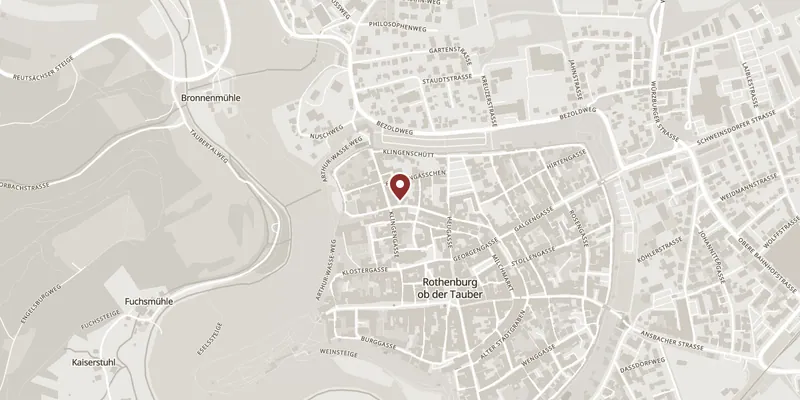
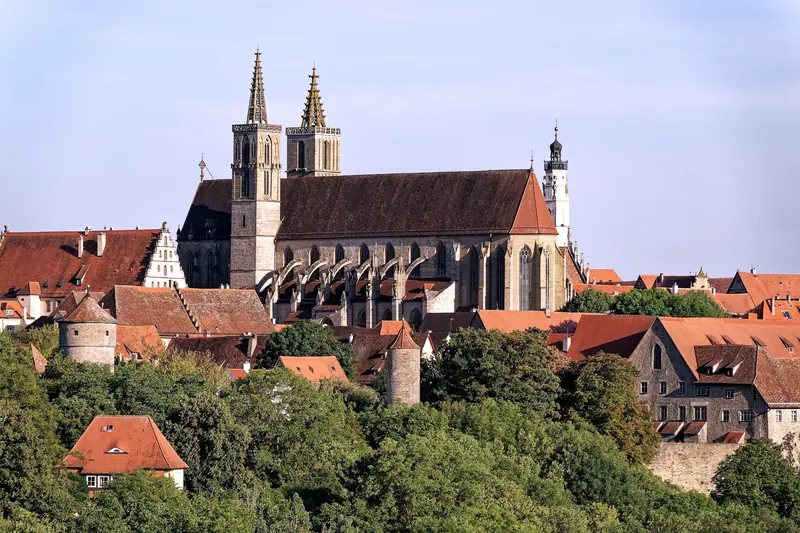
The Dominican convent stood on this site from 1258 to 1554, and the town’s museum has been in its buildings since 1936. It runs to about 2,500 square metres over eight centuries of Rothenburg material. Note the name: it was the Reichsstadtmuseum until 2019, and older signs, books and road signs still say so — you are looking for the same building at Klosterhof 5, two minutes north-west of St Jakob’s.
Go for the kitchen. The convent kitchen survives complete, with its hearth, its smoke hood and its vaulting, and it is the oldest thing in the museum: the town dates it to the 13th century, the museum to around 1240, and dendrochronology on its timbers has given 1262. It is generally described as the oldest surviving convent kitchen in Germany, and it is still occasionally used — children’s groups cook medieval dishes in it. In a town where roughly 40% of the inner fabric burned in March 1945 and was rebuilt, this room is the real thing, unrestored and in place.
The second reason is Room 10, the Judaica department. Jews expelled from the Rhineland settled in Rothenburg from the 13th century, and the town was home to Rabbi Meir ben Baruch of Rothenburg, the leading rabbinic authority in Germany of his generation. The room’s central object is the Pogromstein, a stone carrying Hebrew inscriptions to the dead of the Rintfleisch pogrom of 1298. Under the Third Reich it was reused as the pedestal for a Nazi eagle; it was rediscovered in 1980, restored, and is now displayed with medieval Jewish gravestones from the town. There is nothing else like it in a museum this size.
Be realistic about the armour. The Baumann Foundation collection is genuinely large — the history of weapons in Europe from the Stone Age to the 19th century — but the pieces the museum names as its highlights are early modern: Marie Antoinette’s hunting rifle, Metternich’s duelling pistols, Jérôme Bonaparte’s hunting ensemble. If you came for 14th-century harness, this is a good collection of the wrong centuries, and the medieval half of your day is the kitchen, the Judaica room and the town’s own painted and carved work.