Visby, on the island of Gotland in Sweden, kept its wall because it ran out of money at the right moment. The ring wall went up in the late 13th century, paid for by Hansa trade and aimed partly at Gotland’s own farmers, and still runs about 3.4 km round a town you can cross in twenty minutes. Inside it: a cathedral consecrated in 1225, a dozen roofless churches, and a museum where the dead of 1361 are still wearing their mail. Visby Medieval Week (Medeltidsveckan) fills it for eight days each August, usually ISO week 32. By the end you’ll know what is original, where to stand, and when to come. We’d say May.
Why does Visby have a wall at all?
Money, and then a quarrel about the money. Hansa trade made Visby rich in the 12th and 13th centuries; the wall was begun in the late 13th, and its landward stretch dates from 1288, when the town fought a civil war against Gotland’s own farmers. Visby built its wall against the island at least as much as against anyone arriving by sea.
That is the odd part, and it explains the scale. Gotland’s farmers had been sailing to Novgorod and back since the Viking Age, and they did not enjoy watching the German merchants who settled in Visby in the 12th century take the trade over. The merchants, for their part, had the silver and the stonemasons. A circuit of 3.4 km round a settlement this small makes sense only for people who expect trouble from both directions and can pay for it in advance.
Decline did the rest. After the 14th century the money went elsewhere, almost nothing was rebuilt, and in 1995 UNESCO inscribed “Hanseatic Town of Visby” on the World Heritage List, which is a polite way of rewarding a town for six centuries of being unable to afford improvements.
Walk the outside of the wall first, from the harbour up the landward side. The inside is prettier; the outside is the argument.
What is medieval in Visby, and where do you stand to see it?
Most of what is built of stone. The ring wall and its towers, the cathedral, the roofless churches and the merchants’ houses along Strandgatan are 13th- and 14th-century work with later patching. Timber houses and the rose gardens that fill the postcards are mostly later, which makes them a different pleasure rather than a lesser one.
The ring wall and the towers
The ringmur is about 3.4 km long, begun in the late 13th century and finished, by most accounts, in the early 14th, and it is the most complete town wall of its age in Scandinavia. Of the 29 large towers, 27 still stand; the count climbs into the thirties once you include the small ones, which the guidebooks can’t agree on. There is no public walk along the top, as there is at York. This is a wall to walk beside.
Stand outside it on the east side an hour or two before sunset, when the sun is behind you and the towers throw long shadows across the grass. Then go round to the seaward side for the wind. There is usually wind.
The cathedral (St Mary’s, 1225)
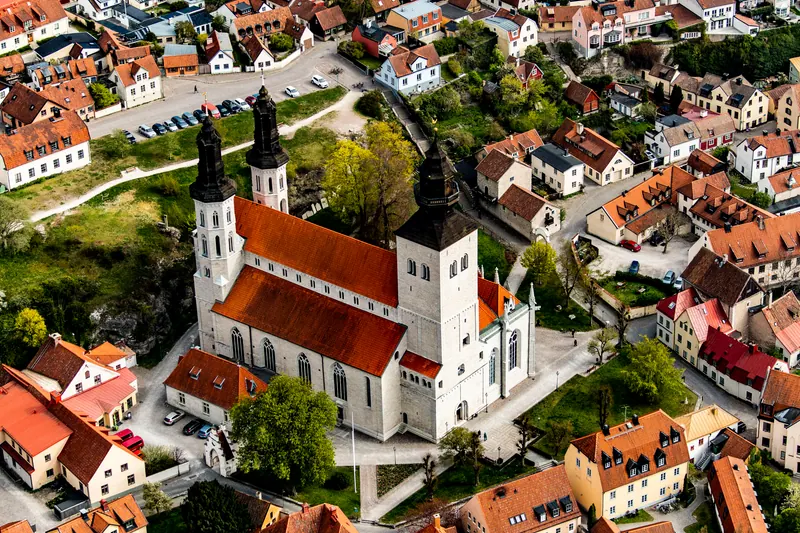
St Mary’s (Sankta Maria) was consecrated in 1225 as the church of the German merchants and has been the cathedral since 1572. It is the only one of Visby’s medieval churches still under a roof, and its three towers are the only roofed church towers of that age in town, which tells you most of the story of the other dozen before you’ve visited any of them. The doors are open most days because it is a working church, so you may walk in on a service. Go in anyway. Sit at the back.
The ruins
A dozen roofless churches inside one wall isn’t normal, and the reason is the decline that saved everything else. Visby had supported parish churches, a Dominican friary and a Franciscan one, and couldn’t keep the roofs on once the trade left; by the 16th century most had fallen in. Nobody has put them back, and nobody should.
Which to see, and what they’re used for now:
- St Nicolai, the largest, once the Dominicans’ church, is a concert venue through the summer. Check the listings before you come, because a July evening inside those walls is the best seat on the island.
- St Karin stands on Stora Torget, the main square, with the square’s café tables running up to its door. It was the Franciscans’.
- Drotten and St Lars sit almost side by side a short walk uphill from the cathedral. St Lars has a cross-shaped plan and walls thick enough to hold passages, and historians have spent a century arguing about whether that is eastern influence.
- Helge And (Holy Spirit) is octagonal and two storeys high, and the theories about why fill a shelf.
- St Hans and St Per share one plot near the centre, and a café has set its tables where the nave was. Order coffee, sit where the altar isn’t, and you have the title of this piece.
Some ruins are fenced and open only in summer; all of them can be seen from the street, which is where most of the pleasure is anyway.
The warehouses and the harbour
Strandgatan, running along the bottom of the town, has the stone merchant houses with stepped gables that the Hansa left behind, and Gotlands Museum, where the 1361 armour and the Spillings hoard (about 67 kg of Viking-age silver, found north of town in 1999, and usually called the largest Viking silver hoard ever found) share a building with the island’s picture stones. The park at Almedalen occupies the site of the old harbour; today’s ferry terminal is a few minutes’ walk further out. Give the museum two hours, not one. Do the picture stones before the armour, because you won’t have the attention for them afterwards.
What happened at Visby in 1361?
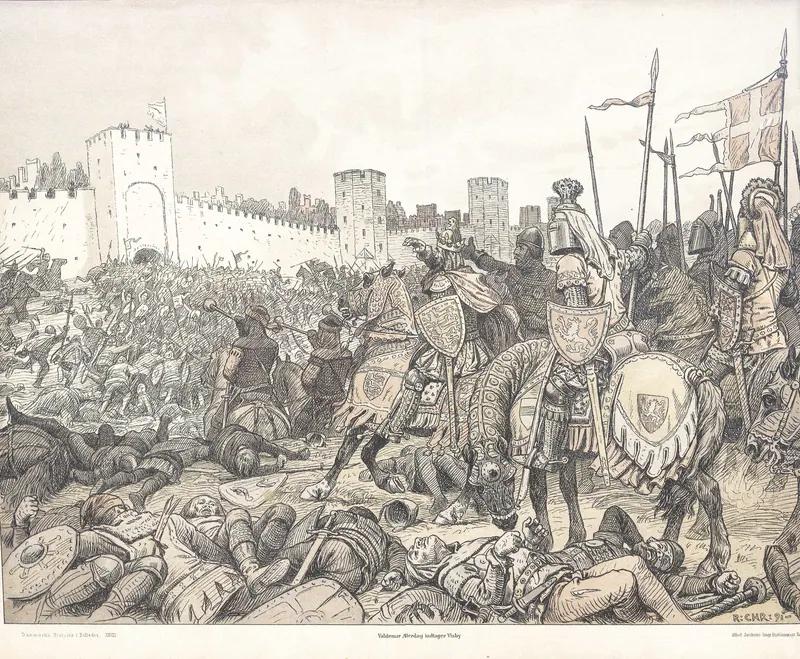
On 27 July 1361 the Danish king Valdemar IV Atterdag landed on Gotland, met an army of the island’s farmers outside Visby’s wall, and destroyed it. The town had a wall and stayed behind it. He took it anyway. The mass graves at Korsbetningen, excavated between 1905 and 1928, held some 1,800 dead, many buried in their mail and coats of plates; the usual explanation is haste in the July heat. Those finds, in Gotlands Museum, are the closest thing Europe has to a photograph of a 14th-century battle, a record of wounds no chronicle thought to keep. See them after the wall, not before; the armour makes more sense once you know what it never reached.
Tradition says Valdemar then ransomed the town for three beer vats of silver and gold. Treat the vats as a story and the graves as the evidence.
Is Visby worth it outside Medieval Week?
Yes, and for most readers of this page more so. The wall, the ruins and the museum are there all year, the town is light past nine in the evening and nearly empty from late May to midsummer, and beds cost a fraction of their week-32 price. Skip the quiet months only if you want the costumes and the crowd, which is a different trip and a louder one.
Medieval Week has run every August since 1984, always from the Sunday of ISO week 31 to the Sunday of week 32; the 2027 edition is expected 8–15 August and hadn’t been announced on the official site when we checked. Walking the town, the market and the camps is free, while the tournaments and concerts are ticketed and, the organisers warn, often sold out before the opening day. Tom Saxby has done the queueing. His guide to Visby Medieval Week covers beds, costume and everything we’ve left out here on purpose.
The rest of the country’s calendar is under festivals in Sweden. If you like the Hansa more than the jousting, Tallinn Old Town Days in early June is the gentler sibling, with concerts in courtyards where Visby has tournaments on a field, and our Tallinn guide explains why that wall survived too.
When should you go?
Late May to midsummer for the light and the empty streets; week 32 for the festival; never the last week of June unless you are a politician.
- Late May to mid-June: light until well past 21:00, some cafés still shuttered, the ruins to yourself. The famous roses aren’t out yet. The walls don’t need them.
- Late June: Almedalen Week, Sweden’s political festival, fills every bed on the island. In 2026 it ran 22–26 June; check the dates before you book anything near them.
- July: Swedish school holidays, the roses, and the most people you’ll see outside the festival. Fine, but book.
- Week 32: Medieval Week, expected 8–15 August 2027. Other festivals in August are listed if that week is full.
- September: quiet again, the light going, the wall and the museum at their best without the summer crowds.
- Early December: the same organisers run a small Medieval Christmas (Medeltida Jul); the 2026 one is 4–6 December. Much of the summer trade is shut by then, so come for the market, not the cafés.
If you have one visit in you, make it the last week of May. The light does the work the crowds do in August, and you’ll get a bed inside the wall without pleading.
What to eat
Saffranspannkaka first, because it is rarely seen off the island and because it is better than it sounds: a baked rice pudding coloured with saffron, served with salmbärssylt (dewberry jam) and whipped cream, Gotland’s own dish and on most menus. Order it at fika time rather than after a plate of lamb. We made that mistake once and saw the rest of the ruins from a bench.
Lamb second. Gotland has been sheep country since before the wall, the island’s emblem is a ram, and the lamb on menus here is usually the island’s own, which is the thing to ask. Expect Stockholm prices inside the wall and a view surcharge along the harbour; the places on the back streets uphill usually feed you the same lamb for less.
One saffranspannkaka, one lamb, and skip anything a laminated menu describes as Viking.
Getting there and around
Destination Gotland ferries run from Nynäshamn, south of Stockholm, and from Oskarshamn further down the mainland coast, about three hours either way; flights to Visby Airport take under an hour in the air from Stockholm. The ferries carry cars and sell out in July and early August. For the festival week, book months ahead, and for Almedalen Week the same.
Inside the wall you walk: twenty minutes corner to corner, longer if you stop, and you will stop. Beyond the wall, hire a bike. Gotland is flat, and the countryside keeps 92 medieval parish churches, more than anywhere else in Sweden, most of them an easy ride from the next.
Sleep inside the wall if you can, because the town at 07:00 and at 23:00 is the one you came for, and everyone staying outside misses both. Beds inside are few and not cheap in summer. The cheaper alternative is the campsites and cabins along the coast north and south of town, a short ride away, fine in June and hard to get in August.
Come in the last week of May if you want the wall to yourself; come in week 32 if you want it with the 40,000 or so the organisers say turn up, and read Tom first. Either way, leave the museum until last. The coats of plates from Korsbetningen were buried on men who walked in from the farms to fight for the island while the town stayed behind its wall, and you will look at that wall differently on the way out.