Gdańsk, in Poland, was about 90 percent rubble in March 1945, and the Main Town you walk through today is a 1950s and 1960s rebuild of a city the Teutonic Knights seized in 1308 and the Hansa made rich. What survived, or was put back round original brick, is the part worth your morning: St Mary’s, built 1343 to 1502 and one of the largest brick churches in the world; the Crane on the Motława, finished 1444; the Great Mill of 1350. The city’s oldest fixture is not a building at all but St. Dominic’s Fair (Jarmark św. Dominika), granted by papal privilege in 1260 and still filling the same streets for three weeks from late July; the 2027 fair is expected 24 July to 15 August. By the end you’ll know which brick is old, why 1308 still comes up in conversation, and how to add Malbork and Grunwald for a weekend. Bring an amber budget.
What is actually medieval in Gdańsk?
Less than it looks, and more than a rebuilt city has any right to. About 90 percent of the Main Town was destroyed in March 1945. The reconstruction restored the street plan and the Gothic and Renaissance fronts along Długa and Długi Targ, and deliberately left out the 19th-century Prussian additions, so the city you see is a curated version of its own past. The brick interiors were often rebuilt simplified. The big churches, the mill and the Crane kept real medieval fabric, and that is where to spend your attention.
St Mary’s Church (Bazylika Mariacka)
Begun in 1343 and finished in 1502, St Mary’s is about 105 m long with room, the usual figure says, for some 25,000 people standing, which made it a parish church the size of a cathedral for a city that never had a bishop. The walls are brick because the Baltic plain has no building stone to speak of, and the effect inside is a whitewashed hall the height of a ship’s mast with the light coming in sideways. The astronomical clock made by Hans Düringer in 1464–70 survives inside. Memling’s Last Judgement, which a Gdańsk privateer called Paul Beneke took off a ship in 1473, used to hang here and belongs to the National Museum — though it has been off display for conservation since February 2025 and is not due back until December 2026, so do not plan a morning around it. A copy stands in the church and looks slightly embarrassed about it.
Climb the tower if your knees allow. The city below is the clearest lesson in what was rebuilt, because from above the roofs are tidy in a way no 700-year-old town ever is.
The Crane (Żuraw) and the Motława waterfront
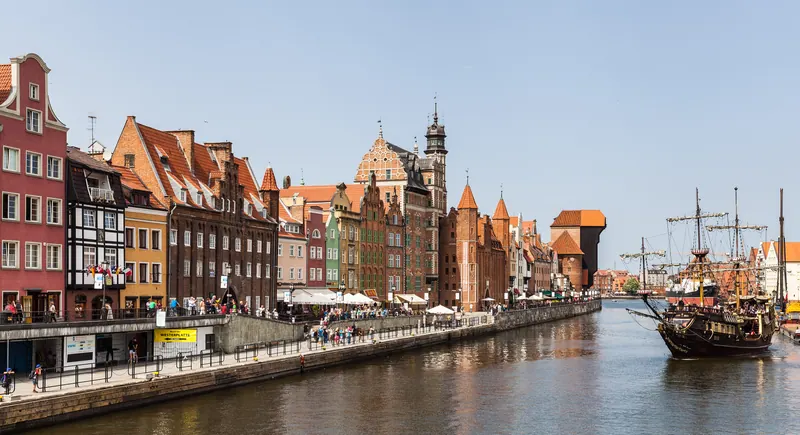
The Crane is a port gate with a hoist in it, completed in 1444, and the hoist was powered by men walking inside two great treadwheels, like hamsters on a Hansa contract. It could lift about two tonnes and was also used to step ships’ masts. Burnt out in 1945, it was rebuilt round the surviving brick towers and is now part of the National Maritime Museum, with the rest of the museum on Ołowianka island across the water. Walk the Długie Pobrzeże waterfront from the Green Gate north to the Crane in the early evening, when the light is on the brick and the tour boats have stopped.
The Great Mill and the Old Town that isn’t the old town
Gdańsk’s naming will trip you. The Main Town (Główne Miasto) is the grand rebuilt centre with Długa and St Mary’s. The Old Town (Stare Miasto), north of it across the Radunia canal, is older in origin but plainer, and it is where the Great Mill stands: built under the Teutonic Order around 1350, one of the largest industrial buildings of medieval Europe, now housing the Amber Museum. There was also a New Town, founded by the Order in 1380 and flattened by the citizens themselves in 1455, which tells you what they thought of their landlords.
See the mill from outside at least; the Amber Museum inside is the place to learn what Baltic amber is before you buy any on Mariacka.
Gates and the Long Market
The Golden Gate at the top of Długa is 1612, the Neptune fountain outside Artus Court is 1633, and most of the tall narrow fronts along Długi Targ are Renaissance and Mannerist in style and 1950s in substance. Artus Court itself, the merchants’ hall named after King Arthur, has been on that spot since the mid-14th century and was rebuilt in 1476–81; its tiled stove of 1545, over 10 m high with more than 500 tiles, is the largest of its kind in Europe and the best reason to pay to go in. The Green Gate at the bottom is 16th-century too.
Enjoy the Long Market as a very fine piece of 20th-century conviction about what the 16th century looked like, and look for your Middle Ages in the brick.
Who were the Teutonic Knights and why does Gdańsk still talk about 1308?
A crusading order of German knights who ran a state on the Baltic, and because in November 1308 they took the city by treachery and stayed for 146 years.
The Knights had been called in, by most accounts, to help the Polish duke against a Brandenburg attack. They cleared the Brandenburgers out, then kept Gdańsk and killed a number of its townspeople; Polish complaints to the pope claimed 10,000 dead, modern estimates run from a few dozen upwards, and the argument has been going for seven centuries. Under the Order the city switched to Kulm law in 1346 and joined the Hanseatic League between 1358 and 1361, and its merchants grew rich shipping Polish grain down the Vistula to Flanders and England. The Knights were bad landlords and good for business. That is the uncomfortable truth behind the brick. The same Order bought Tallinn from Denmark in 1346, and our Tallinn guide covers the quieter end of the same story.
In 1410 the Polish-Lithuanian army broke the Order at Grunwald, some 150 km to the south-east. Gdańsk waited another generation, then in 1454 rose with the Prussian Confederation, demolished the Knights’ castle in the city so thoroughly that you will not find it, and swore allegiance to King Casimir IV. The Great Privilege of 1457 gave the city its own laws and coinage and control of the Vistula trade; the Second Peace of Thorn in 1466 confirmed it. By 1500 Gdańsk had some 30,000 people and was the largest and richest city of the Polish crown.
That is why 1308 still comes up. The city’s whole golden age was built on having thrown the Knights out, and the 1950s rebuilders, stripping out the Prussian century, were making the same point in brick.
When is St. Dominic’s Fair, and is it medieval?
The fair opens on the last Saturday of July and runs for just over three weeks; in 2026 that was 25 July to 16 August, and the 2027 edition is expected 24 July to 15 August, not yet announced on the official site when we checked. Entry is free.
The date is medieval; the stalls are not.
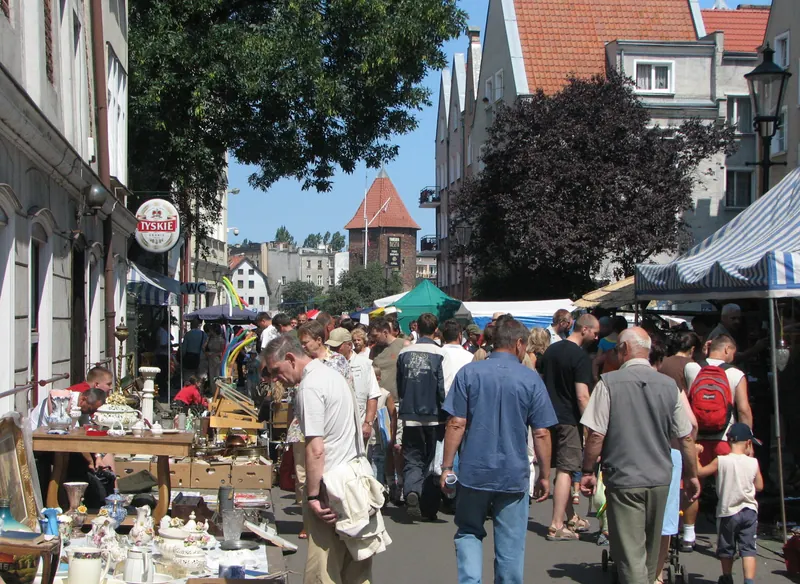
In 1260 Pope Alexander IV granted the Dominican friars of Gdańsk the right to hold a fair on the feast of their founder, and the 2026 fair was counted as the 766th. The Hansa-era fair drew merchants from round the Baltic. The modern one, revived in 1972 after the war’s interruption and run for the city by Gdańsk International Fair, is a street market: in 2026 there were 715 stalls from around 400 exhibitors along Długa, Długi Targ, Targ Węglowy and Targ Drzewny, with zones for regional food, crafts, antiques and collectables, and more than 200 concerts, theatre pieces and events on open-air stages. No one is in costume except by choice. The organisers talk in millions of visits; press reports put 2024 at around 1.5 million people, which over three weeks in a town centre means weekend afternoons on Długa are shoulder to shoulder. The rest of the country’s calendar is under Poland.
Amber is the thing to buy, and Mariacka, the street of stone porches running from St Mary’s to the water, is where the established dealers are all year; the fair’s stalls are where the bargains and the fakes both live. Real Baltic amber is warm to the touch and light in the hand, and if a price looks too good on a Saturday afternoon, it is. Go on a weekday morning before the stalls are fully awake, buy the amber from a shop on Mariacka and the food from the fair, and leave the collectables to the collectors.
Which day trips make it a medieval weekend?
Two: Malbork Castle for the Knights, and the Grunwald battlefield for their defeat, and they go in that order.
Malbork (Marienburg) is about 60 km south-east and well under an hour by train on most services. It was the Order’s headquarters, it is usually called the largest castle in the world by area, and it has been a UNESCO site since 1997. Allow a whole day; the brick goes on for ever. Each July the castle museum stages the Siege of Malbork 1410 (Oblężenie Malborka), a festival with a craft fair on the castle grounds and a night-time battle spectacle on the ramparts; in 2026 it ran 24–26 July, the 25th edition, with the battle shows on the Friday and Saturday at 22:00. The 2027 dates were not announced when we checked, so ask the castle’s site.
The Battle of Grunwald Reenactment is the other half. The battlefield is roughly two and a half hours from Gdańsk by car, and on the Saturday nearest 15 July several thousand reenactors refight 1410 in front of a crowd the organisers put at about 100,000; the 2027 battle is confirmed for 17 July at 15:00, and entry to the field and camps is free. Tom Saxby has stood in that field in a gambeson and our Grunwald guide is his account of the parking. If you are in the region in July, the month’s calendar also has the Wolin Viking Festival, expected 29 July to 1 August 2027 on the far side of the Polish coast.
Malbork first, Grunwald second. The castle shows you what the Knights built; the field shows you why they stopped.
When should you go?
Mid-July to mid-August if you want the fair, the siege and the battle in one fortnight; September if you want Mariacka and St Mary’s with nobody in them.
- Mid-July: Grunwald on the Saturday nearest the 15th, then the Siege of Malbork the following week. Book Malbork’s festival tickets ahead.
- Late July to mid-August: St. Dominic’s Fair. Hotels near the Motława fill, and the Long Market is a crowd from noon to dusk every day of it.
- September and early October: the best weeks for the brick, because the Baltic is still mild, the waterfront cafés still have tables out, and you can hear yourself in St Mary’s.
- November to March: cold, dark by four, and the Amber Museum is the warmest building in the Old Town. Fine for a museum weekend, wrong for the waterfront.
If you can only come once, make it the last week of July, and stay a weekday longer than you planned.
What to eat and drink
Pierogi, and not the ones on the Long Market with a laminated menu. Ruskie, filled with potato and curd cheese, and the sauerkraut-and-mushroom ones are the two to order, and the small places in the Old Town north of the canal do them for noticeably less than the Długa price. Baltic herring is the other local thing, in oil with onion or in cream, and better than it sounds to anyone who grew up on the tinned version.
Goldwasser is the Gdańsk drink, a herbal liqueur with flakes of gold leaf in it, first made in the city in the 16th century, so not medieval and the bottle doesn’t claim otherwise. One glass, cold, for the flakes. We’d skip the second on price alone.
Getting there and around
Gdańsk Lech Wałęsa Airport has flights from across Europe and is about half an hour from the centre by train or bus. Trains from Warsaw take roughly three hours on the fast service and arrive at Gdańsk Główny, from where the Main Town is 10 minutes on foot through the Upland Gate. Malbork is on the Warsaw line, which is why the day trip is so easy.
Inside, you walk. The Main Town is 15 minutes end to end, the Old Town another ten, and the Maritime Museum islands are a ferry hop or a footbridge across the Motława. Sleep near the Motława or on the Main Town’s side streets if you want the waterfront in the morning; the rebuilt granary islands across the water have newer hotels and the view back at the Crane, which is the better direction to be looking. During the fair, book early and expect street noise until late; the stalls pack up after the concerts, not before.
Come in the last week of July, do Malbork on the Friday and the siege that night, walk the fair on a weekday morning, and end in St Mary’s. The brick there went up over 160 years for a city that had just thrown out its landlords, and it was standing again within a generation of the next lot flattening it. That is the thing to take home from Gdańsk, along with the amber.