Medieval Booker

Church ◆ Visby

S:t Lars Church Ruin

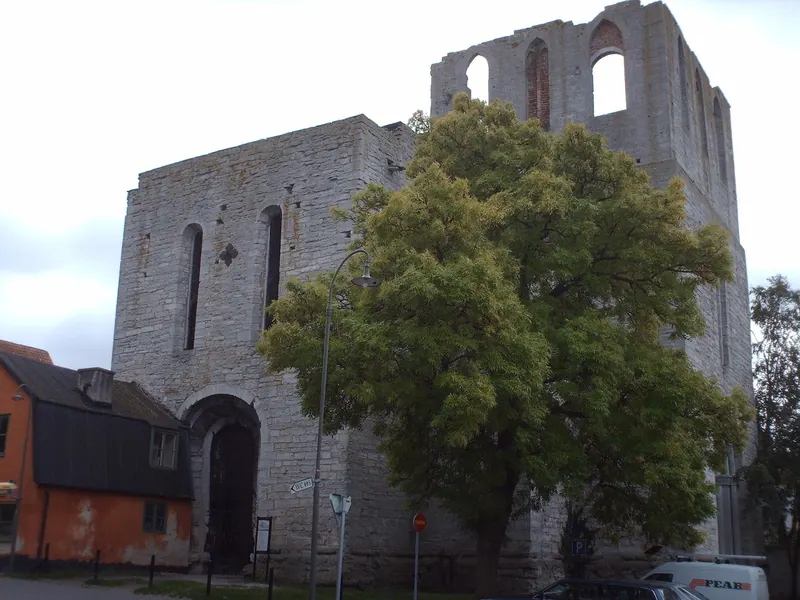
A 13th-century parish church two minutes off Stora Torget whose plan owes more to Orthodox churches than to anything else in the Baltic, and whose walls are hollow: narrow stairs and passages run inside the masonry from level to level. Free, and open on the same 1 May – 4 October season as the rest of Visby's ruins.

Where and when

Where
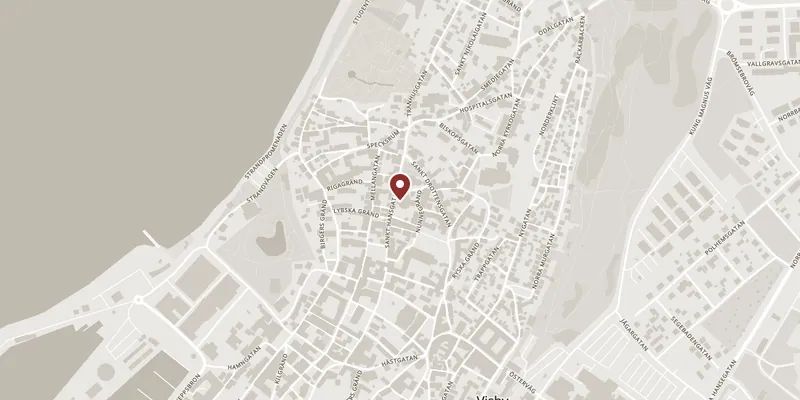
Syskongatan, Visby, Visby, Sweden Open in Google Maps Walking directions
Era
13th century (parish usually dated c. 1210–1220); the Gotlanders' parish church, roofless since after the Reformation
Opening
Season 1 May – 4 October 2026, daily 09:00–17:00, per Gotlands Museum, which maintains the ruins. Note that other listings give narrower hours (June–September weekdays 10:00–16:00, October weekdays 10:00–15:00) — the museum is the operator, so check gotlandsmuseum.se on the day. Closed outside the season and during pre-booked events (as of August 2026)
Price
Free. Guided ruin tours are a separate paid booking through Gotlands Museum (bokningen@gotlandsmuseum.se) or goGotland (as of August 2026)
Best time
In season, any dry morning — the stone passages are the point and they are treacherous when wet. Pair it with Drotten and S:ta Karin in one loop of about forty minutes.
Good for
Free or cheapQuiet corner
Official site
gotland.com
Map showing where S:t Lars Church Ruin is
Open in Google Maps Walking directions © MapTiler © OpenStreetMap contributors

Checked

What is S:t Lars Church Ruin?

S:t Lars is the odd one. The plan is not the usual Baltic parish box but something close to a Greek cross — four short arms around a centre — and the National Property Board’s own description says the room shows clear traits of the Orthodox or Byzantine church interior. That is not a stylistic accident. Visby’s merchants traded east into Novgorod, and the building looks like it.

The dating is not settled. SFV puts it in the 1200s, Gotland’s tourism board says the middle of that century, and the usual dating of the parish itself is around 1210–1220, with the choir possibly older again. What is agreed is that this was the Gotlanders’ own parish church, in the middle of town, and that it lost its roof after the Reformation along with every Visby church except St Mary’s.

The reason to walk here rather than to one of the other nine is that the walls are hollow. Narrow stairs and passages are built into the thickness of the masonry and run from level to level; in the medieval church you could move around almost the whole building without leaving the wall, most probably for processions and for carrying lights. The ruin is tall, and it is not a shell — it is a structure with an inside.

The honest caveat, because it matters here. Neither Gotlands Museum, the National Property Board nor gotland.com states in writing that visitors may climb those passages today; all three describe them in the past tense, and it is second-hand accounts that say people go up in summer. Treat the climb as a bonus, not as the plan. The stairs are steep, unlit and uneven, and nothing in the building is level.

It stands on Syskongatan, a couple of minutes from Stora Torget. Drotten, the other unlocked ruin in this corner of the old town, is a short walk away just north of the square and keeps the same season and hours — if you have half an hour rather than fifteen minutes, that is the pair to do. Entry to both is free.
What visitors say

4.6 from 101 ratings

  • William Wright

    5 out of 5 2 years ago

    Nice ruin, which you can enter and walk through. The Dotters ruin is next door and a ailable too. Wish we had more time. But we had a full agenda today.

    Read this review on Google
  • Juergen

    5 out of 5 4 years ago

    St Lawrence's Church has a different shape from the other churches of Visby. Whereas they were inspired by German ecclesiastical architecture, St Lawrence's resembles the Byzantine churches of the east. The church is dedicated to St Lawrence, who was martyred in the 3rd century by being roasted on a grid. The church was built in the 13th century. For all its exotic design, it was the work of the island's own craftsmen, as witness the dressing of the stone and the masonry technique. The numerous staircases and passages in the walls are a distinctive feature. The passages lead from one level to another, almost the whole way round the building. St Lawrence's was abandoned at the Reformation in the 16th century.

    Read this review on Google
  • Allen Lin

    4 out of 5 4 years ago

    Much better than the ruins across the street and this ruins is across the street as it is bigger and has a second floor. The fact that it has a second floor you can go explore makes it different from the one at town square. It also has no entrance fee which is nice and is walkable from the cruise port

    Read this review on Google

Ratings and reviews from Google. See all on Google Maps

Frequently asked questions

When is S:t Lars ruin in Visby open?

Gotlands Museum, which maintains it, gives a season of 1 May to 4 October 2026, daily 09:00–17:00, free of charge. Some other listings publish narrower weekday-only hours, so check gotlandsmuseum.se before you go. It is closed outside the season.

Can you climb the stairs and passages inside the walls at S:t Lars?

The passages exist and run inside the thickness of the walls from level to level. Whether visitors may use them on any given day is not stated by Gotlands Museum, SFV or gotland.com — their descriptions are in the past tense — so treat the climb as a bonus rather than a plan, and expect steep, unlit, uneven stone.

Why does S:t Lars look Byzantine?

Its ground plan is close to a Greek cross rather than the usual Baltic parish layout, and SFV's description notes clear traits of the Orthodox or Byzantine church interior — a reasonable echo of Visby's eastern trade towards Novgorod.

How old is S:t Lars?

13th century. SFV dates it to the 1200s and gotland.com to the middle of that century, while the parish is usually dated to around 1210–1220 and the choir may be older still. It was abandoned after the Reformation.

Which Visby church ruin should I see if I only have time for one?

S:ta Karin on Stora Torget for scale and convenience — it is the largest and you walk past it anyway. S:t Lars if you would rather have the strange one: the Orthodox-influenced plan and the passages inside the walls. Both are free and both close on 4 October.

Festivals in Visby

Medieval festivals in Visby
Featured
Medieval Markets & Fairs Jousting & Tournaments +1

Visby Medieval Week

Visby, Sweden

Medeltidsveckan fills the walled Hanseatic town of Visby on Gotland with eight days of medieval markets, jousting, concerts, lectures and camps every August. Founded in 1984, it is Scandinavia's largest medieval festival and draws around 40,000 visitors, many of them in costume.

Expected 2027
Family

More places in Visby

Places in Visby
Landmark Start here

Visby Ring Wall (Ringmuren)

Seaward wall c. 1250; landward wall 1270s–80s; raised 3–4 m in the 1350s; Kruttornet c. 1160

3.4 km of 13th-century town wall, up to 11 m high, with 27 of its original 29 ground towers still standing — the oldest surviving town wall in northern Europe and the only complete circuit left in the Nordic countries. Walk the outside of the landward stretch between Norderport and Söderport, and know before you come that there is no rampart walk: you cannot get onto the top of it.

Free or cheap Quiet corner Good with children
Walking directions
Museum

Gotlands Museum (Fornsalen)

Museum founded 1875; collections from prehistory to the Middle Ages, with the Spillings hoard of the 870s and the 1361 battle finds

The island museum on Strandgatan, holding the Spillings hoard — about 67 kg of Viking-age silver — Gotland's picture stones, and the armour and skulls dug out of the 1361 battle graves at Korsbetningen. It is the room where everything else you look at in Visby is explained, and under-19s get in free.

Works in the rain Good with children
Walking directions
Church

Visby Cathedral (Sankta Maria)

Consecrated 27 July 1225 as the German merchants' church; cathedral of the diocese of Visby since 1572

Consecrated on 27 July 1225 as the church of the German merchants in Visby, and the only one of the town's medieval churches that still has a roof and a congregation. Entry is free, and from late June to mid-August it stays open until 21:00 — the one medieval interior here you can sit in during the evening.

Free or cheap Quiet corner Best in the evening
Walking directions
All articles