Kruttornet is the seed the rest of Visby’s defences grew from. It went up around 1160–61, free-standing, on the north side of the entrance to the town’s harbour, and everything else — the seaward wall of about 1250, the landward wall of the 1270s and 80s, the whole 3.4 km circuit — came later and was eventually tied to it. It is the oldest tower in the ring wall and is usually described as the oldest preserved profane, that is non-church, building in the Nordic countries.
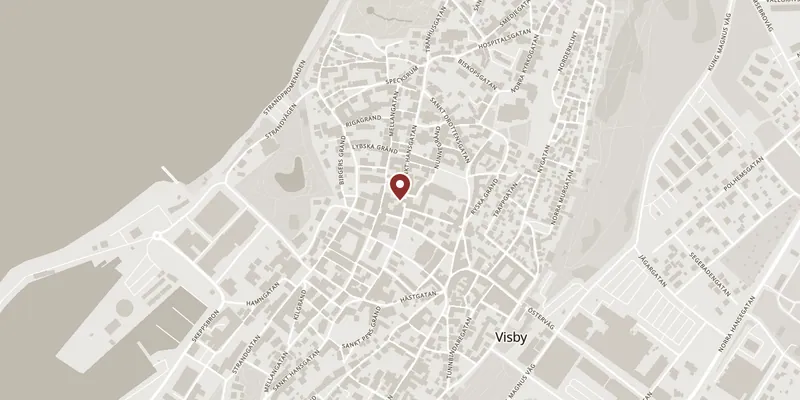
The orientation fact worth having. The harbour it guarded is not there any more. The water silted up, and the basin the tower once looked down into is now Almedalen, the lawned park where Swedish politics holds its annual week every summer. Stand at Fiskarplan with your back to the tower and you are standing in a medieval harbour. Nothing else in Visby rearranges the town in your head quite so fast.
The detail our sort of reader wants. It was built without a door. There was no entrance at ground level: you went up a ladder to a small opening several metres up the face, and then you pulled the ladder up behind you. Crossbowmen shot downwards from it at anything coming into the harbour mouth. That is also, incidentally, why a tower of this age has so little to walk into.
The name is modern by the standards of the building. It only became the powder tower around 1710, when it was converted into a gunpowder magazine after Visborg castle at the south end of town was destroyed. Before that it had been, at various times, defence work, watchtower and prison.
And the catch, stated plainly. Gotland’s official tourism site lists the tower, its date and its function, and publishes no opening hours and no admission price; neither does Gotlands Museum, which does publish both for the Kajsarn prison tower a few hundred metres away. Second-hand sources say it opens in summer for a small fee with a small display inside, and Gotlands Museum has run guided lunch visits to it, but we could not confirm any of that against an official page. Go for the outside of it, which is free and always there, and treat an open door as luck.