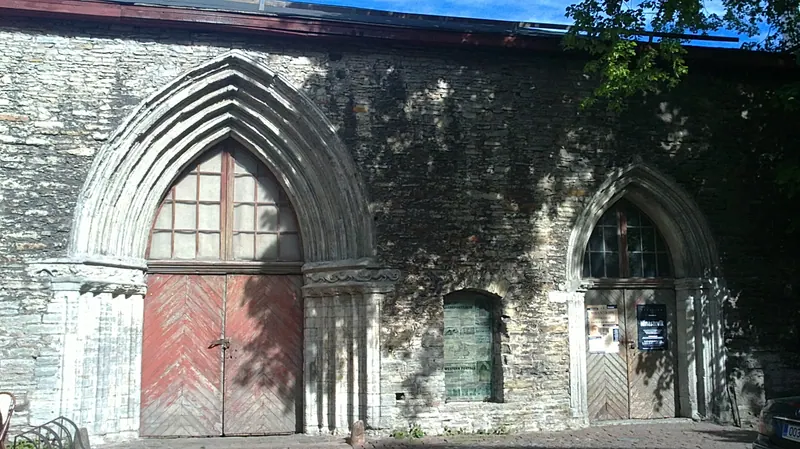
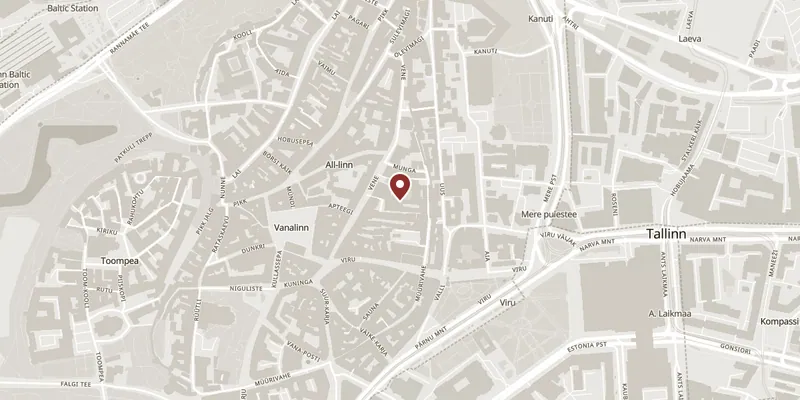
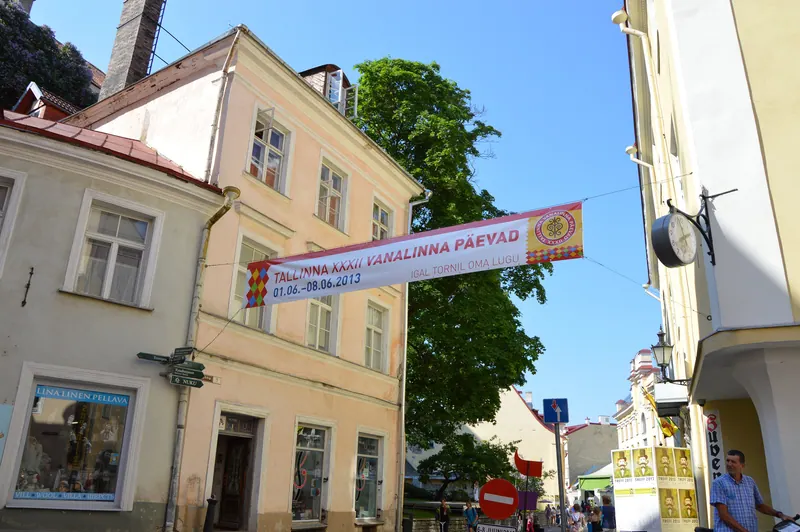
St Catherine’s Passage (Katariina käik) runs from Vene street, along the southern side of the old Dominican monastery, through to Müürivahe. Tallinn’s tourism office describes the buildings down its southern side as predominantly 15th to 17th century, notes that it was formerly called Monk’s Alley, and dates the church that gave it its name — St Catherine’s — to more than 700 years ago. The lane was restored in 1995. It is free and open at any hour.
Set into the church wall along it are the grave slabs of the Dominican monastery, carved limestone of roughly the 14th to 16th centuries. They covered the tombs of the people who ran the town: councillors, members of the Great Guild, brothers of the Blackheads. Named among them are Kunigunde Schotelmund, an alderman’s wife who died in 1381, and Diderick Bucholt, who died in 1501. The stones did not stay where they were cut — they were reportedly moved out to Rocca al Mare in 1882 and only brought to this wall around 1959–60 — so read them as a lapidary display, not as graves in place.
The working part is Katariina Gild, an association of craftspeople that has held the studios along the passage since 1995. Estonia’s national tourism board lists eight workshops — leather, textiles and patchwork, glass, jewellery, hats and ceramics — and the makers are named individually on the guild’s own site. The studios are open to walk into, and the point is that the work is happening in front of you. This is not a row of souvenir shops selling imported stock; it is people at benches who will sell you what they have just made, and take a commission if you ask.
If you only put your head through one door, make it the ceramics hall: six ceramicists share it, working in a spare Nordic style, and the potters there run courses for people who want to try it themselves. No price is published for those — email or ask at the door.
Be clear about what this is not. Nobody here is forging plate armour or binding books in calf. What you get is a genuine medieval alley with a genuine guild of makers still working in it, which is rarer in a European old town than any single museum on this list.