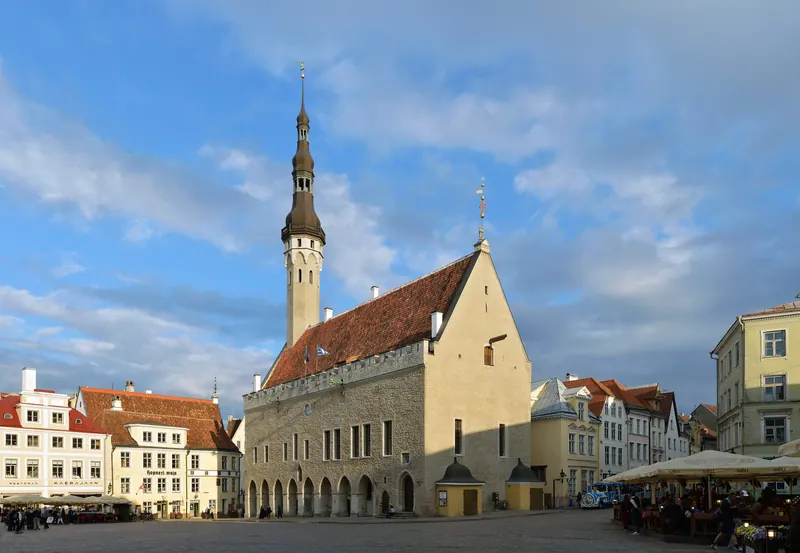
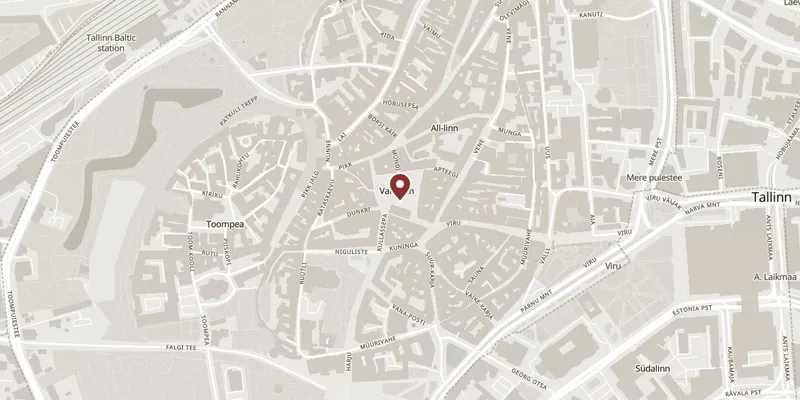
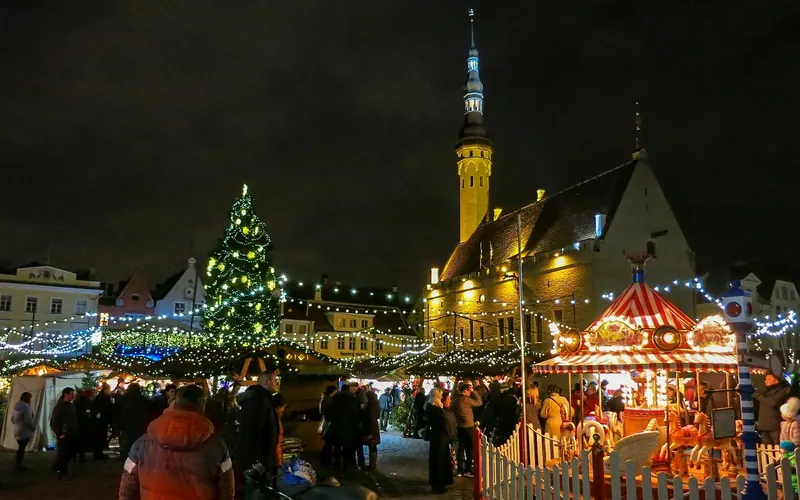
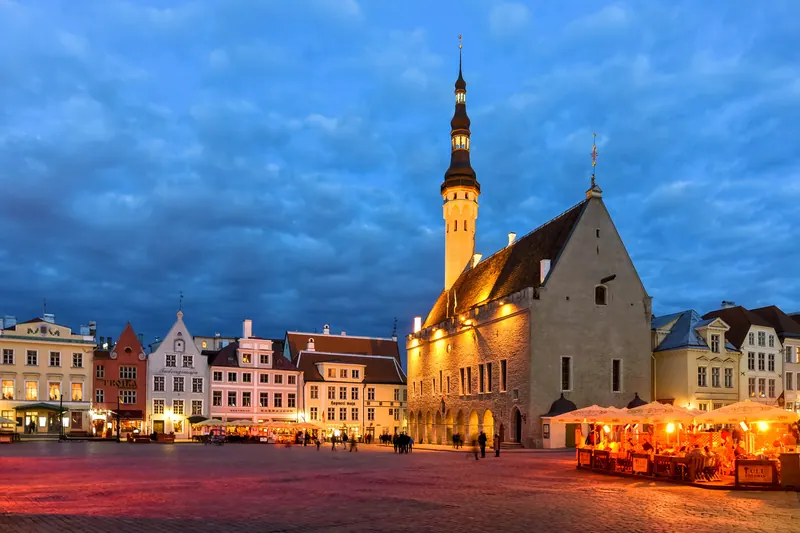
A town hall is first mentioned on this corner of the market square in 1322, and the building history goes back into the 13th century. Between 1402 and 1404 the council rebuilt it as the two-storey hall that still stands: festive halls and offices upstairs, utility rooms below, the projecting upper floor carried on an arcade of pointed arches along the square front, and a tower on the west end. That is the fabric — nothing on the square in northern Europe survives from the Gothic period as completely.
The Council Hall (Raesaal) holds the two things worth the ticket. The older set of carved oak benches dates from 1371–74 and its side panels show the meeting of Tristan and Isolde under the tree on one face and Samson’s fight with the lion on the other — courtly romance and Old Testament on the same piece of furniture, and among the oldest wood carving in Estonia. A second set from the 1402–04 rebuild carries Samson and Delilah, and Aristotle ridden by Phyllis, a favourite medieval joke about the wisest man in the world. The Bible lunette paintings above them are later: the council ordered them from the painter Johann Aken in 1667, when the interior was modernised and the square-front arcade was walled up. The arcade is open again today.
The visit runs over four floors, cellar to attic — the medieval entrance hall now called the Citizens’ Hall (used for civil weddings), the council offices, the kitchen and the kämmerei. The attic is only open in high summer.
On the spire stands Old Thomas (Vana Toomas), the weathervane soldier that has kept the position since 1530. The one up there is the third: the original fell when the spire burned in the Soviet air raid of 9 March 1944, a copy went up in 1952 and another in 1996. Do not come here to see the 1530 figure — it left the building in January 2025 for a climate-controlled case at the Tallinn City Life Museum. The 1952 one is shown in the Town Hall instead.
The tower is a separate ticket and opens only from 1 June to 31 August.