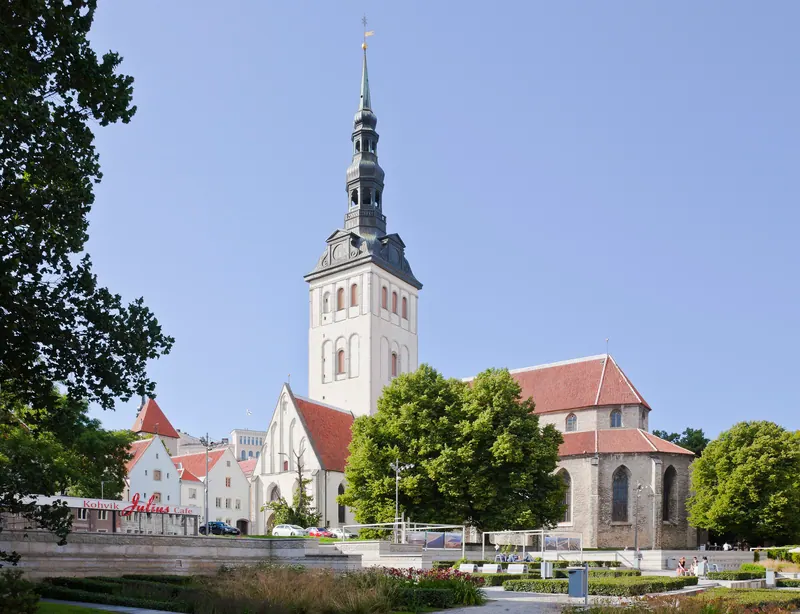
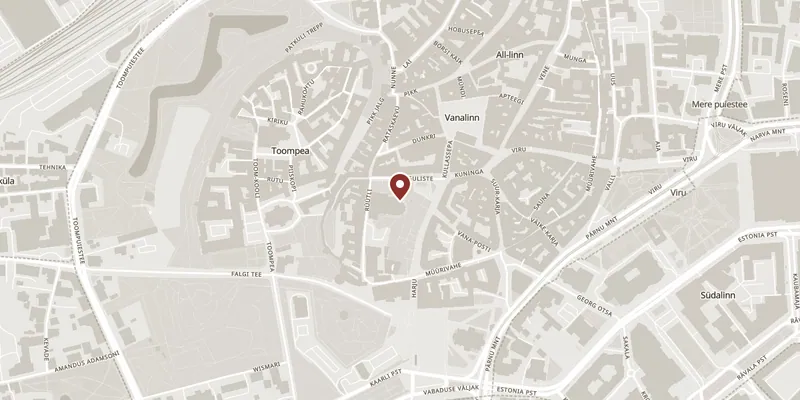
St Nicholas’ was the church of the German merchants who settled the lower town, begun in the 13th century and among the oldest buildings in Tallinn. It was the one Tallinn church that escaped the Reformation iconoclasm of 1524 — the story is that the warden poured molten lead into the locks — which is why so much of its medieval furnishing survived to be looted, evacuated or burnt later. The Soviet air raid of 9 March 1944 gutted it. Restoration took decades, and since the 1980s the shell has held the Art Museum of Estonia’s collection of medieval and early modern ecclesiastical art, much of it shown where it originally stood.
The object to come for is in the side chapel: the fragment of the Danse Macabre painted in the workshop of Bernt Notke of Lübeck at the end of the 15th century. Death, in a series of dancing figures, takes the Pope, the emperor, the empress, the cardinal and the king in turn, each with a verse. About seven and a half metres survive of a canvas thought to have run some thirty metres. Notke painted a larger Dance of Death for St Mary’s in Lübeck; that one burned in the air raid of 1942, so the painting in this room is the only one of his left. A multilingual audio presentation on it runs daily at 13:00.
Behind the high altar stands the second reason: the retable made by Hermen Rode’s Lübeck workshop in 1478–81, a huge many-winged altarpiece still in the church it was commissioned for. In the Small Chapel, over two floors, are sculptures and altarpieces of the 13th to 16th centuries brought in from churches across Estonia. The tower holds the church bells, and a glass lift now runs up beside the medieval stair to a viewing platform over the Old Town roofs and Tallinn Bay — included in the ticket.
Organ recitals of half an hour are played on Saturdays and Sundays at 16:00 and cost nothing extra.