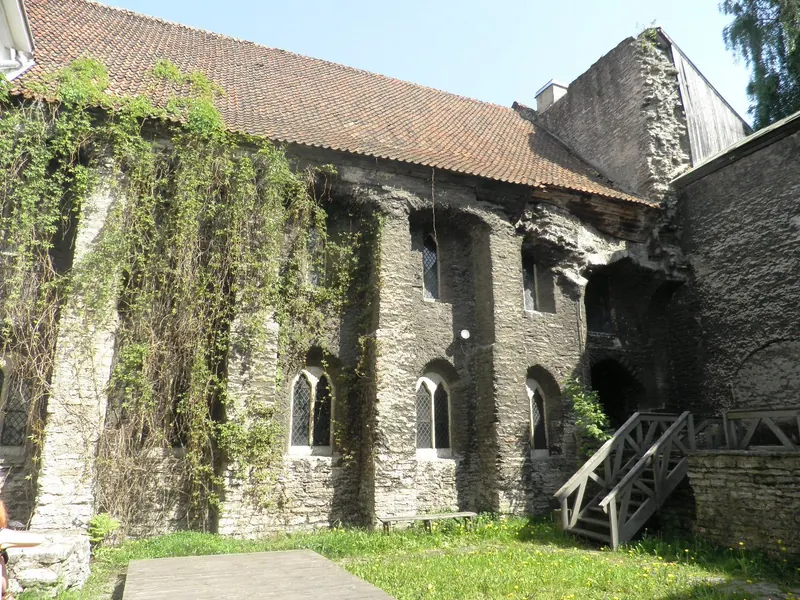
The Dominicans are documented on this block from 1246, which makes this one of only two medieval monastic complexes left in Tallinn and one of the oldest buildings in the city. The friars chose the site for the preaching and for the business: the house ran a brewery producing four kinds of beer, traded in fish, and had a reputation for scholarship. The Reformation destroyed it in 1524, and only fragments of a once very large precinct survive. The finest piece you can see for nothing is the carved portal visible from St Catherine’s Passage, round the corner.
What you buy a ticket for is the preserved eastern wing, and it is fabric rather than reconstruction. The operator lists the rooms you walk through: the prior’s room, the library, the chapter hall, the dormitory, the sacristy and the upper gallery. That is the ordinary working geography of a friary — where the community slept, where it met to decide things, where the vestments were kept — and very little of it survives anywhere on the Baltic.
With the rooms goes a permanent display of medieval carved stone, and a gallery in some of the spaces that changes its exhibition roughly every two months, usually photography. That contemporary art in a 13th-century chapter house is a jarring pairing is fair comment; it is also part of why the building is kept up.
The catch is the calendar. It opens daily from 9 May to 27 September, 10:00 to 16:00 — four and a half months, six hours a day. Outside that window it is advance booking only, arranged by email with the operator. Tickets are a flat €5, €10 for a family, free with the Tallinn Card, which makes it the cheapest medieval interior in the Old Town by a wide margin.
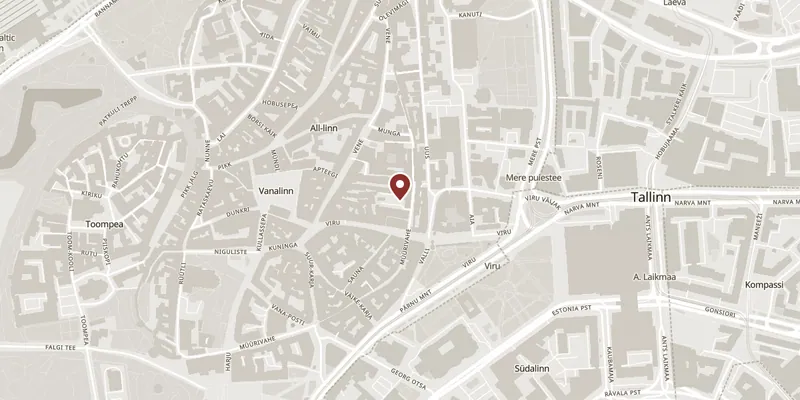
One practical point that catches people out: the entrance is at Müürivahe 33, on the town-wall side of the block, not on Vene street where most visitors go looking for it.