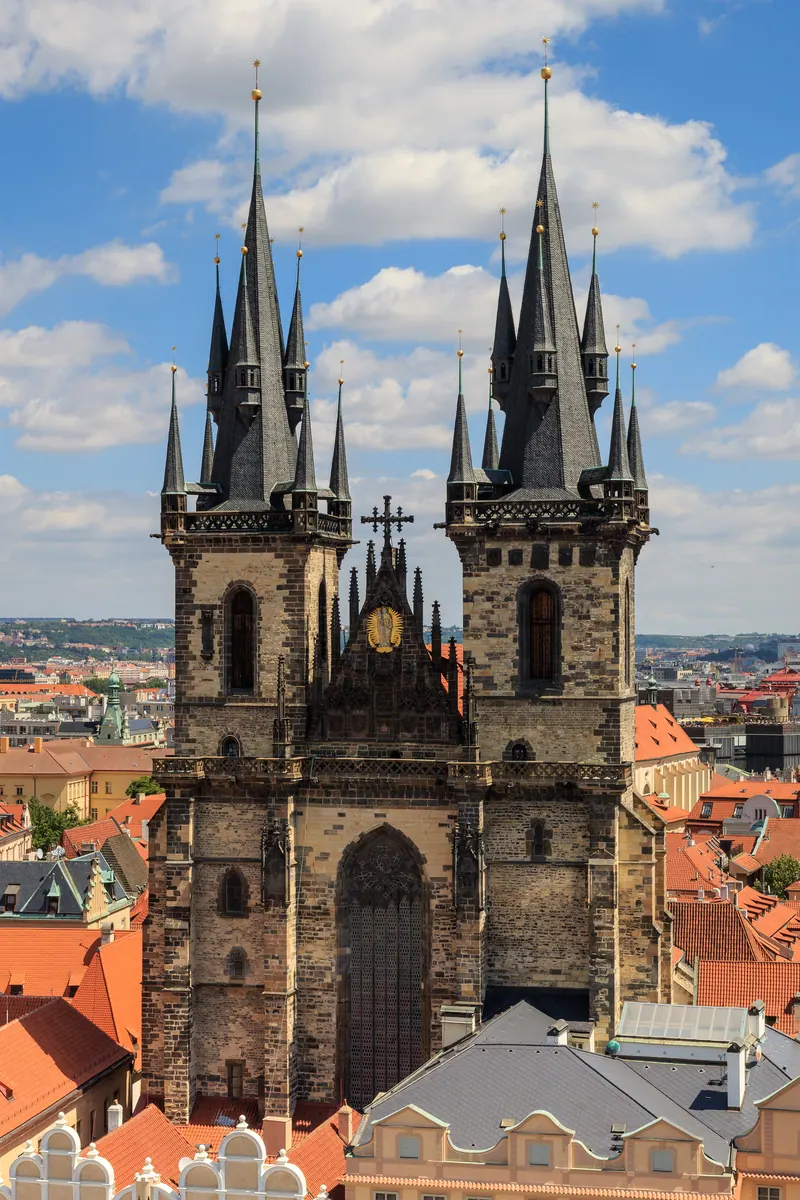
Building started in the mid-14th century on the site of a 13th-century church serving the Týn, the fortified merchants’ compound behind the square. The two west towers, nicknamed Adam and Eve — they are not the same width — reach about 80 m; the south one was finished in 1511. From the 1420s to 1621 this was the Utraquist mother church, the pulpit of the moderate Hussites. Jan Rokycana, the archbishop the Hussites elected and Rome never recognised, was its parson and is buried in it.
The gable between the towers carries a gilded Madonna. It stands where a golden chalice — the emblem of the Hussite communion in both kinds — and a statue of King George of Poděbrady stood until the Catholic reconquest after 1620; the gold of the chalice is said to have been recast into the figure and its halo. Standing in the square and knowing that is the single best thing this church gives you, and it costs nothing.
Inside, the Baroque altars are loud and the Gothic is in the details. Find: the stone canopy of 1493 by Matěj Rejsek, a late-Gothic honeycomb over what was a Hussite tomb; the tin font of 1414, the oldest in Prague; roughly sixty medieval and Renaissance tomb slabs set in the floor and walls; the oldest organ case in Prague, of 1673; and, by the chancel steps, the red marble slab of Tycho Brahe, imperial mathematician, who died in Prague in 1601. The tympanum of the north portal, a Crucifixion from Peter Parler’s workshop, is a copy — the original is in the National Gallery.
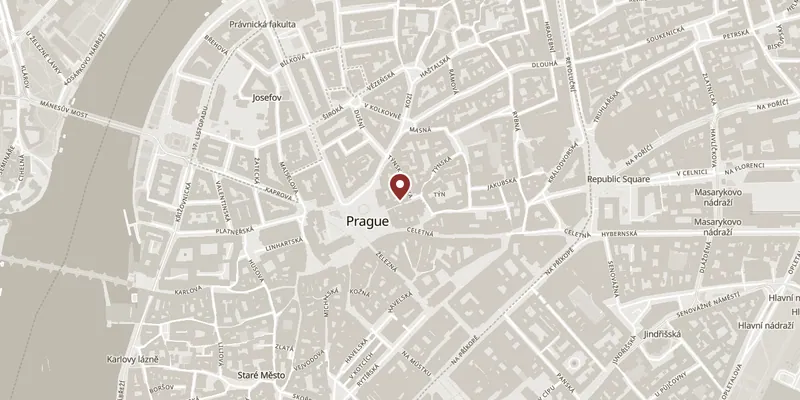
The entrance is not on the square. Go through the passage at Staroměstské náměstí 604 (Týnská ulička) under the arcade of the Týn School; the door is at the back of the courtyard and closes for services without notice.