Medieval Booker

Church ◆ Prague

St Vitus Cathedral (the Wenceslas Chapel)

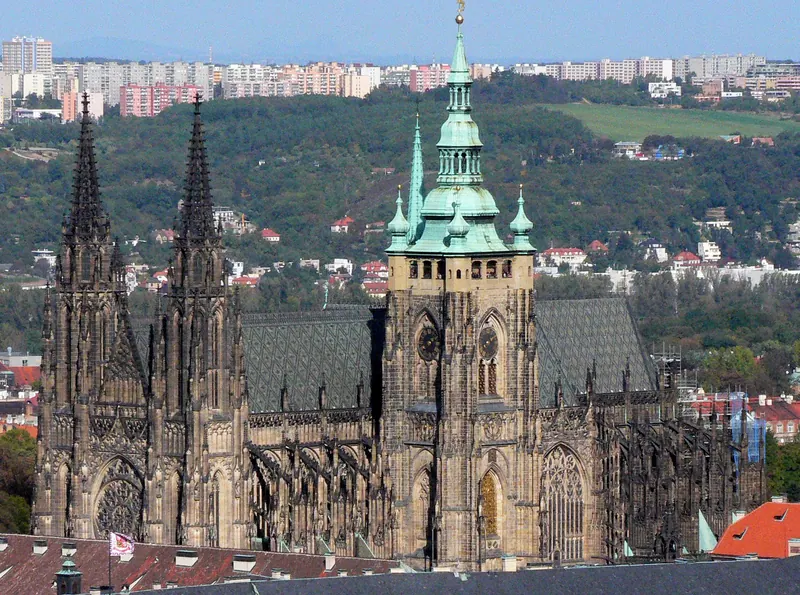
Begun in 1344 by Matthias of Arras and continued by Peter Parler, the coronation and burial church of the kings of Bohemia. Go for one room: the Chapel of St Wenceslas, walled in over a thousand polished Bohemian gemstones, with the door in its corner that has seven locks and holds the crown jewels behind it.

Where and when

Where
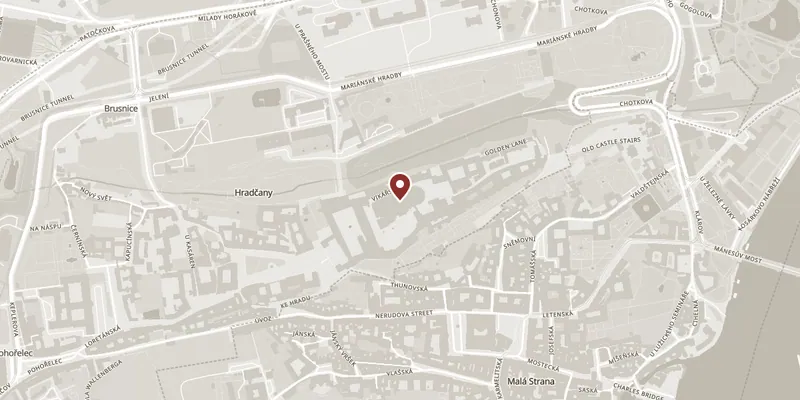
III. nádvoří 48/2, Hradčany, 119 01 Praha 1, Prague, Czechia Open in Google Maps Walking directions
Era
Begun 1344; choir by Matthias of Arras and Peter Parler; west end completed 1929
Opening
Mon–Sat from 09:00, Sunday from 12:00 because of services. Prague Castle lists closing at 17:00 April–October and 16:00 November–March; the cathedral's own site currently lists 16:00 year round, so check on the day (as of August 2026)
Price
Included in the Prague Castle Circuit, CZK 450 adult / 300 reduced / 950 family. Great South Tower separate: CZK 200 / 150 / 500. The rear of the nave is free but shows you almost nothing (as of August 2026)
Best time
Afternoon, when the south-facing windows and the Golden Gate mosaic get direct light. Arrive at opening to see the Wenceslas Chapel without a queue at the doorway.
Good for
Works in the rain
Map showing where St Vitus Cathedral (the Wenceslas Chapel) is
Open in Google Maps Walking directions © MapTiler © OpenStreetMap contributors

Checked

What is St Vitus Cathedral (the Wenceslas Chapel)?

Charles IV won an archbishopric for Prague and laid the foundation stone of a cathedral in 1344. Matthias of Arras built the choir in French style and died in 1352; the 23-year-old Peter Parler took over and did everything that makes the building interesting — the net vault over the choir, the flying buttresses, the sacristy’s hanging pendant boss, and the south transept. Work stopped in the Hussite wars, and the whole western half, the nave and the west front with its rose window, is neo-Gothic work of 1873–1929. The join is visible from inside: stand in the crossing and look east.

The Chapel of St Wenceslas (1344–64) is in the south transept, over the saint’s grave. Its lower walls are set with more than 1,300 polished slabs of Bohemian jasper, amethyst and chalcedony in gilded plaster, with a Passion cycle painted around 1370 above them and a St Wenceslas legend cycle added about 1509. You cannot walk in; you look from the doorway, which is the correct view anyway. In the south-west corner, a small door with seven locks leads to the Crown Chamber above, where the Bohemian coronation regalia of 1347 are kept; the seven keys are held by seven institutions and the crown is shown to the public only rarely. The bronze lion’s-head ring on the north door is pointed out as the handle Wenceslas is said to have clung to when he was killed in 935 — a tradition, not a fact.

Other things worth finding: the Golden Gate on the south side, whose Last Judgement mosaic of 1370–71 was made from Bohemian glass and is best seen in afternoon light from the Third Courtyard, free; the Parler workshop’s tombs of the Přemyslid kings in the ambulatory chapels; and the twenty-one portrait busts in the triforium, including Parler’s own and Matthias’s — high up, and you will need to look hard.

The Great South Tower is a separate ticket: 287 steps to a gallery, past the Sigismund bell of 1549, the largest in the country.
What visitors say

4.8 from 95,694 ratings

  • Chris

    5 out of 5 3 weeks ago

    St. Vitus is perhaps the most impressive structure at Prague Castle. They started building it in 1344 under Charles IV and didn't actually finish until 1929, which is kind of wild when you're standing in it. The stained glass artworks were the thing that really impressed me the most. I went in expecting to be impressed by the scale and instead I kept stopping to look at windows. Deep blues and reds, and the Mucha window on the left as you walk in is worth hunting down. The ceiling is enormous, all those arches going up forever, and the light coming through changes the whole color of the room depending on where the sun is. Plenty of great sculptures, including the silver tomb of St. John of Nepomuk, which is hard to miss and harder to look away from. Two things worth knowing. It was 95 outside the day we went and maybe 65 inside, so it's a good place to cool off. And apparently it wasn't even a busy day, but the inside was still packed. Buy tickets online ahead of time if you can. Standing in that line in the heat is not the memory you want.

    Read this review on Google
  • Adam Maxwell

    5 out of 5 a month ago

    This imo is the most beautiful and mesmerizing cathedral in all of Prague. If you are into history and architecture, this should be at the very top of your list! The Gothic style adds an additional factor for me, as it is probably a favourite, battling it with the Baroque 🙂. The "main/core" ticket is 450 CZK for the Prague castle and it covers 4 buildings. There are no individual options at the moment. However, it is well worth it as they were all quite great. Just allow yourself a few hours of time at least (closes at 17:00 atm) + a few km-s of walking and you will be good 🙂!

    Read this review on Google
  • Olimpiada Vidrascu

    5 out of 5 a month ago

    A huge, impressive, and magnificent cathedral, built in a truly remarkable Gothic style. St. Vitus Cathedral can be considered almost a symbol of Czech identity, representing the country’s history, culture, and spiritual heritage. On the exterior, the cathedral is decorated with gargoyles, fantastic creatures, and strange figures. During the Middle Ages, these elements had two important roles: a practical one, as they helped drain rainwater from the building, and a symbolic one, representing the chaotic and demonic world outside the sacred space. This reflects one of the central ideas of Gothic architecture: inside the cathedral there is divine order and harmony, while outside there is the chaos of the world. The interior is filled with spectacular stained-glass windows, depicting biblical scenes such as the Creation of the World and Adam and Eve, as well as stories connected to Czech history and national identity. An interesting detail is that these stained-glass windows are not medieval creations, but mostly date from the period between 1860 and 1930, when the cathedral was finally completed after centuries of construction. St. Vitus Cathedral was not built during a single period, but developed through different historical eras, which is part of what makes it so fascinating. The cathedral is also the final resting place of many Bohemian kings and queens, making it not only a religious monument but also a place deeply connected with Czech history. Definitely worth visiting, although be prepared for a long queue. Fortunately, it moves quite quickly.

    Read this review on Google

Ratings and reviews from Google. See all on Google Maps

Frequently asked questions

Is St Vitus Cathedral free to enter?

Only the rear section of the nave, which is roped off short of the choir and the chapels. To reach the Wenceslas Chapel and the medieval east end you need the Prague Castle Circuit ticket, CZK 450 for an adult as of August 2026.

Can you go inside the Chapel of St Wenceslas?

No. The chapel is viewed from its doorway in the south transept. That is enough to see the gemstone walls and the 14th-century Passion paintings.

Where are the Bohemian crown jewels kept?

In the Crown Chamber above the Chapel of St Wenceslas, behind a door with seven locks whose keys are held by seven separate office-holders. The regalia are put on public display only on rare occasions.

Who built St Vitus Cathedral?

Charles IV founded it in 1344. Matthias of Arras designed the choir; Peter Parler took over in 1356 and built the vaults, the sacristy and the south side. The nave and west front were finished in neo-Gothic style between 1873 and 1929.

How many steps is the St Vitus tower?

287 steps up the Great South Tower to the viewing gallery, passing the Sigismund bell of 1549. It is ticketed separately at CZK 200 for an adult as of August 2026.

Festivals in Prague

Medieval festivals in Prague
Featured
Living History & Museums Music, Feasts & Theatre +1

Karlštejnské vinobraní (Karlštejn Wine Harvest Festival with Emperor Charles IV)

Prague, Czechia

Karlštejn's wine-harvest festival brings Emperor Charles IV, Empress Elizabeth of Pomerania and a court of more than 150 costumed courtiers back to the castle he built 30 km south-west of Prague to guard the imperial crown jewels. Held on the last weekend of September, it combines ceremonial processions up to the castle, mounted knights' tournaments, period music, crafts and tastings of young wine and burčák; the 28th edition is confirmed for 26–27 September 2026.

2026
Family

More places in Prague

Places in Prague
Castle Start here

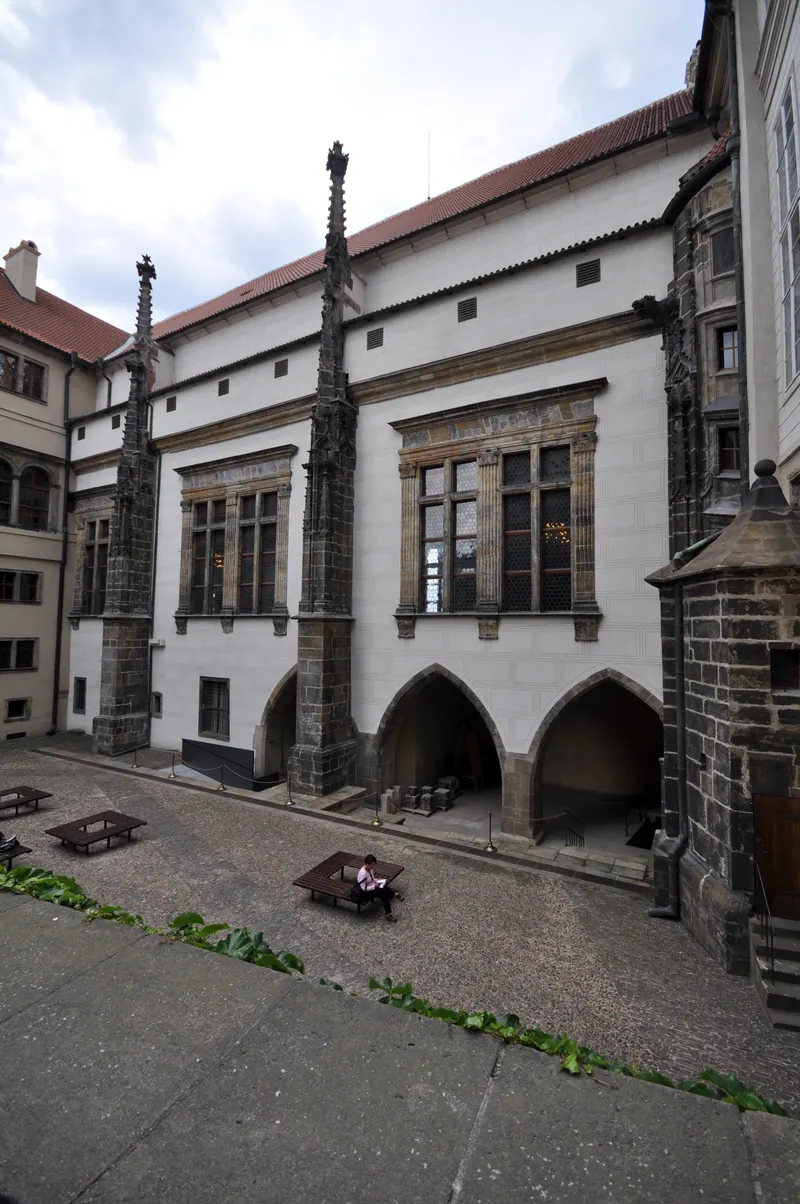
Old Royal Palace and Vladislav Hall

Romanesque core c. 1135; Vladislav Hall 1493–1502 by Benedikt Ried

The medieval seat of the kings of Bohemia at Prague Castle, layered from a Romanesque palace of the 1130s up to Benedikt Ried's Vladislav Hall of 1493–1502 — the largest vaulted secular room in late-medieval Europe, built wide enough to hold tournaments indoors. Find the Riders' Staircase: its vault and shallow treads were made so armoured knights could ride their horses into the hall.

Works in the rain Good with children
Walking directions
Landmark

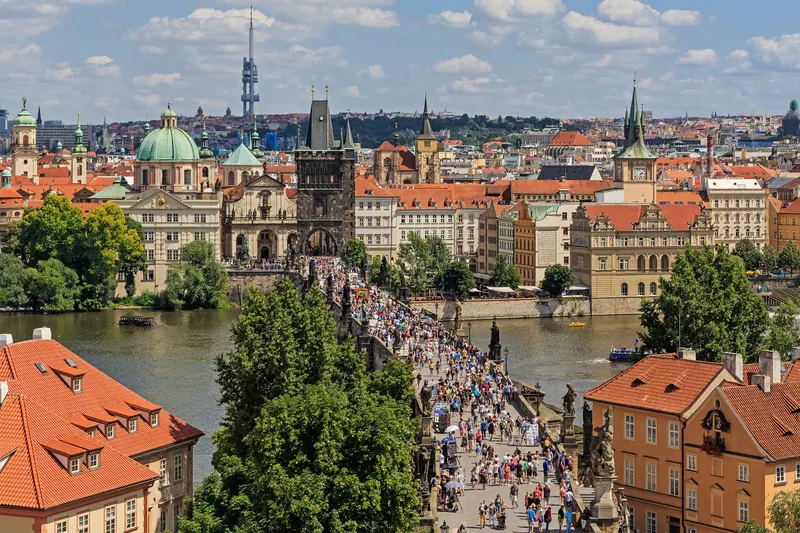
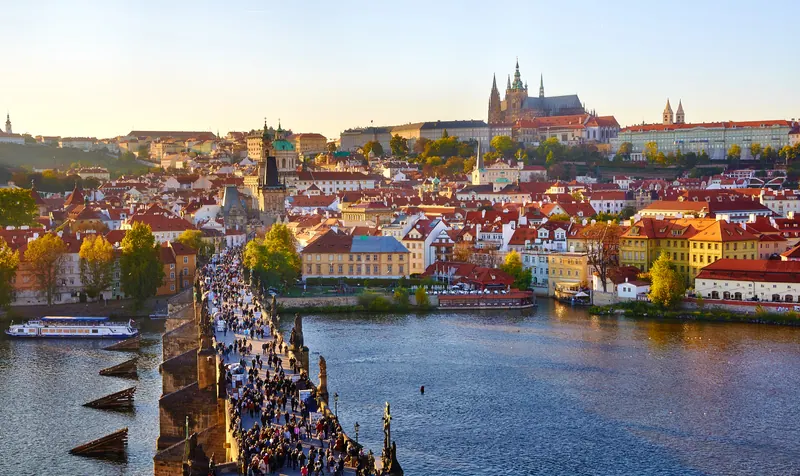
Charles Bridge

Begun 1357 under Charles IV; towers 14th–15th century

The stone bridge Charles IV began in 1357 to replace a flood-wrecked Romanesque crossing, still carrying foot traffic between the Old Town and the castle. Go for the two medieval gate towers at either end and the sculpture on the Old Town tower's east face, not for the statues on the parapet, which are copies.

Free or cheap Best in the evening Good with children
Walking directions
Castle

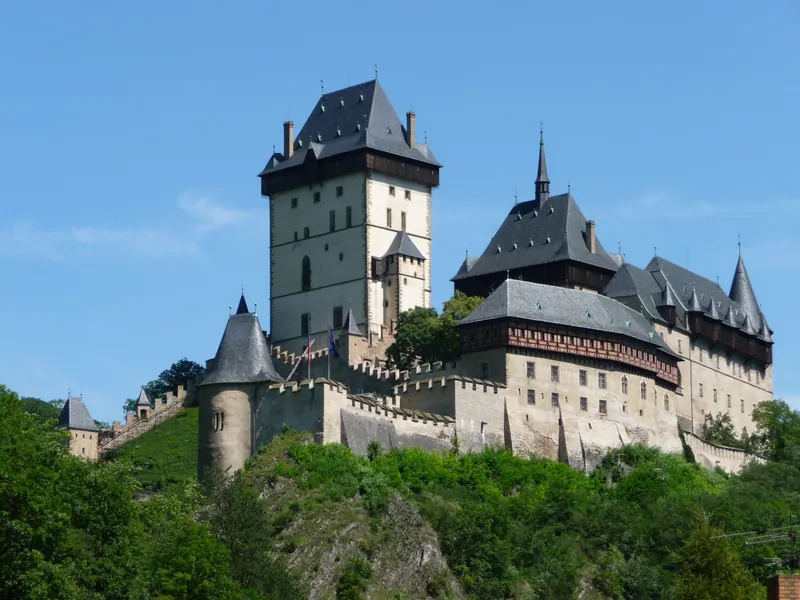
Karlštejn Castle

Founded 1348 by Charles IV, consecrated 1365; rebuilt by Josef Mocker 1887–99

The castle Charles IV built between 1348 and 1365 on a rock above the Berounka, 30 km from Prague, purely to hold the imperial regalia and his relic collection. Book the second route months ahead: it is the only way into the Chapel of the Holy Cross, whose walls carry 129 painted panels by Master Theodoric.

Good with children
Walking directions
All articles