Medieval Booker

Castle ◆ Prague

Old Royal Palace and Vladislav Hall

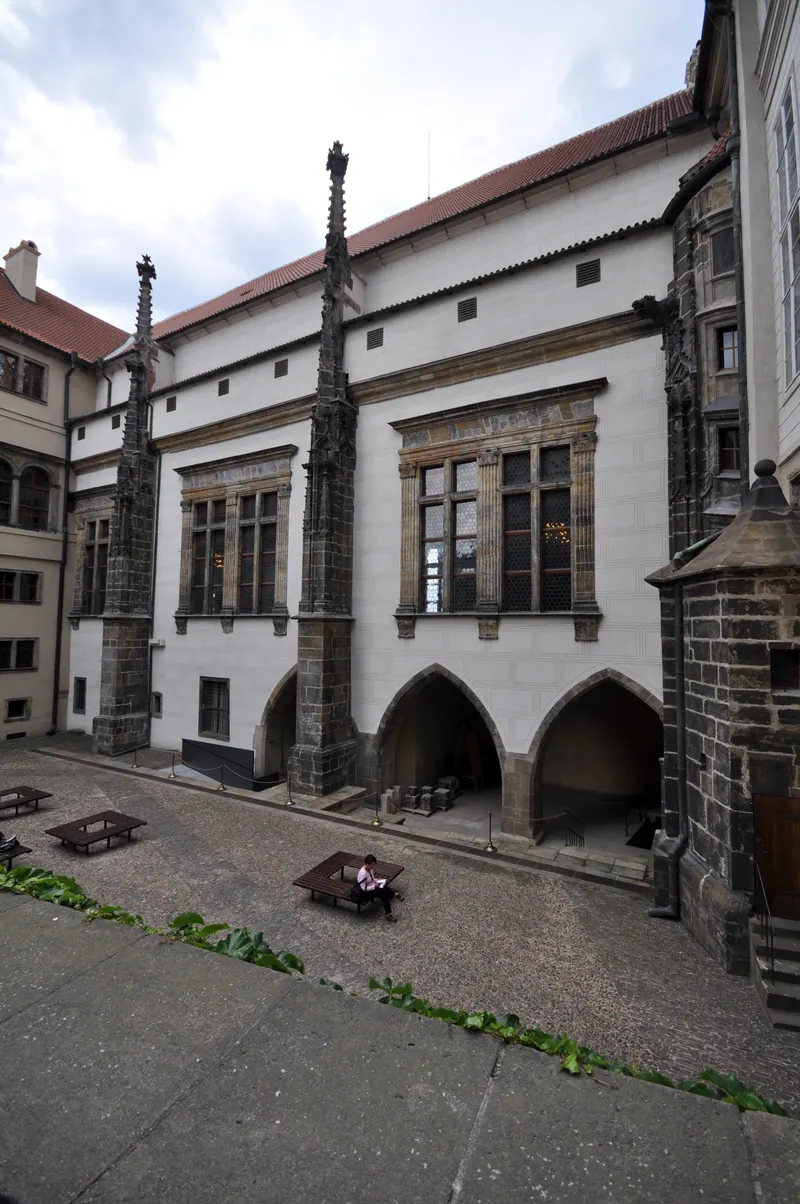
The medieval seat of the kings of Bohemia at Prague Castle, layered from a Romanesque palace of the 1130s up to Benedikt Ried's Vladislav Hall of 1493–1502 — the largest vaulted secular room in late-medieval Europe, built wide enough to hold tournaments indoors. Find the Riders' Staircase: its vault and shallow treads were made so armoured knights could ride their horses into the hall.

Where and when

Where
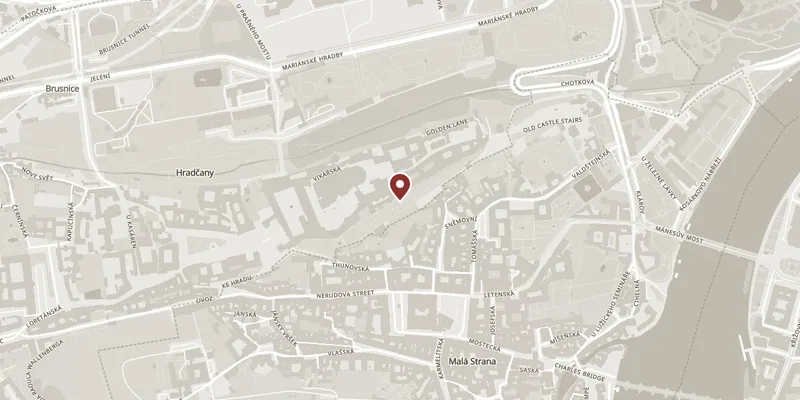
Third Courtyard, Prague Castle, 119 08 Praha 1, Prague, Czechia Open in Google Maps Walking directions
Era
Romanesque core c. 1135; Vladislav Hall 1493–1502 by Benedikt Ried
Opening
Historic buildings daily 09:00–17:00 April–October, 09:00–16:00 November–March; castle grounds 06:00–22:00 (as of August 2026)
Price
Included in the Prague Castle Circuit: CZK 450 adult / 300 reduced / 950 family, valid two days. Story of Prague Castle is on the second circuit, CZK 300 / 200 / 700 (as of August 2026)
Best time
First thing at 09:00, or after about 15:30 when the tour groups have moved on to the cathedral.
Good for
Works in the rainGood with children
Official site
www.hrad.cz
Map showing where Old Royal Palace and Vladislav Hall is
Open in Google Maps Walking directions © MapTiler © OpenStreetMap contributors

Checked

What is Old Royal Palace and Vladislav Hall?

The palace is three buildings stacked on each other. At the bottom is the Romanesque palace of Prince Soběslav I, about 1135. Above that sits the Gothic palace of Charles IV and Wenceslas IV. On top, and open to visitors, is the late-Gothic royal floor of Vladislav II Jagiello.

Vladislav Hall (1493–1502) is the reason to come. Benedikt Ried roofed a room 62 m long, 16 m wide and 13 m high without a single internal column, using ribs that curve, cross and loop free of the structure they pretend to support — decorative rib vaulting pushed as far as it ever went. Look up first, then at the windows: they are square-headed and Renaissance, among the earliest Renaissance detailing north of the Alps, sitting inside a Gothic hall. The room served for coronation feasts, for markets in the arcades, and for tournaments held under the roof; Czech presidents are still sworn in here.

The Riders’ Staircase on the north side is the specific thing to look for. It has a twisted, folded vault and steps deliberately made low and deep, because knights rode up it on horseback to enter the hall for the tournaments. Go down it, not up, and you will see the vault properly.

Off the hall are the Bohemian Chancellery, where two royal governors and a secretary were thrown out of the window on 23 May 1618 and survived the fall — the Second Defenestration that started the Thirty Years’ War — and the Land Rolls Room, whose ceiling and walls are painted with the coats of arms of the clerks who kept the registers of Bohemian estates. All Saints Chapel adjoins the east end.

Under the palace, on a separate ticket, the Story of Prague Castle exhibition uses the Romanesque and Gothic cellars for the castle’s archaeology: graves, weapons, the tomb goods of Přemyslid princes.
What visitors say

4.3 from 87 ratings

  • L brian

    5 out of 5 2 months ago

    Standing in Vladislav Hall is an incredible experience, but the absolute highlight is seeing the exact window where the Second Defenestration of Prague occurred in 1618. Knowing that this singular act of defiance effectively triggered the Thirty Years' War makes the space feel incredibly heavy with history. A must-visit for anyone interested in the pivotal moments that shaped European history

    Read this review on Google
  • North Ice KQ

    5 out of 5 9 months ago

    The window is most of its worth. You must go to the window where the three Defenestrations of Prague happened. The history behind it is insane! If you're like me and love reading the lore, it's a bit of a pain to find all the signs. It takes a while, but it's totally worth it. Highly recommended to those who already know the history and want to enrich themselves, otherwise, it might be boring (like my friends found it).

    Read this review on Google
  • Jiri VFX

    5 out of 5 11 months ago

    I had the pleasure of visiting the exhibition of the Bohemian crown jewels on Wednesday afternoon. The wait time was quite reasonable, approximately 1h and 10min, which was considerably shorter than the potential wait of four to six hours. As opposed to what one might discover through quick Google search, photography is permitted, provided that flash photography is not used. Furthermore, there is a storage area immediately following the entrance and security checkpoint, where larger bags that are not permitted inside may be stored. The queue was progressing at a quick pace, which unfortunately allows for only about two to three minutes to view the jewels, so it is advisable to make the most of the opportunity. The jewels boast a rich history, dating back to the 14th century. The St. Wenceslas Crown was crafted between 1345 and 1346, while the Royal apple and scepter were created later in the 16th century. Seeing the Bohemian crown jewels at least once in their lifetime should be on every Czech's checklist. Even if you are not Czech but are visiting Prague during the exhibition, which usually takes place annually in the latter half of September, you should certainly consider attending. The Vladislav Hall, a remarkable structure, holds the distinction of being the largest hall in Prague during its construction, which spanned from the late 15th to the early 16th century. It is definitely worth a visit, although it might be preferable to schedule it outside of holidays and weekends.

    Read this review on Google

Ratings and reviews from Google. See all on Google Maps

Frequently asked questions

What is Vladislav Hall famous for?

It is the largest vaulted secular space of late-medieval Europe: 62 m by 16 m, 13 m high, roofed by Benedikt Ried between 1493 and 1502 with a looping rib vault and no internal columns. Tournaments were held inside it.

What is the Riders' Staircase at Prague Castle?

A staircase into Vladislav Hall with low, deep steps and a folded vault, built so knights could ride up on horseback for indoor tournaments. It is on the north side of the hall.

Is the Old Royal Palace included in the Prague Castle ticket?

Yes. The Prague Castle Circuit (CZK 450 adult as of August 2026) covers the Old Royal Palace, St Vitus Cathedral, St George's Basilica and Golden Lane with Daliborka, and is valid for two days.

Where did the 1618 defenestration of Prague happen?

In the Bohemian Chancellery, off Vladislav Hall in the Old Royal Palace. On 23 May 1618 two imperial governors and their secretary were thrown from the window and survived; the room is on the visitor route.

How long do you need at the Old Royal Palace?

Twenty to thirty minutes for the palace itself. Add an hour if you also buy the second circuit for the Story of Prague Castle exhibition in the cellars below.

Festivals in Prague

Medieval festivals in Prague
Featured
Living History & Museums Music, Feasts & Theatre +1

Karlštejnské vinobraní (Karlštejn Wine Harvest Festival with Emperor Charles IV)

Prague, Czechia

Karlštejn's wine-harvest festival brings Emperor Charles IV, Empress Elizabeth of Pomerania and a court of more than 150 costumed courtiers back to the castle he built 30 km south-west of Prague to guard the imperial crown jewels. Held on the last weekend of September, it combines ceremonial processions up to the castle, mounted knights' tournaments, period music, crafts and tastings of young wine and burčák; the 28th edition is confirmed for 26–27 September 2026.

2026
Family

More places in Prague

Places in Prague
Church

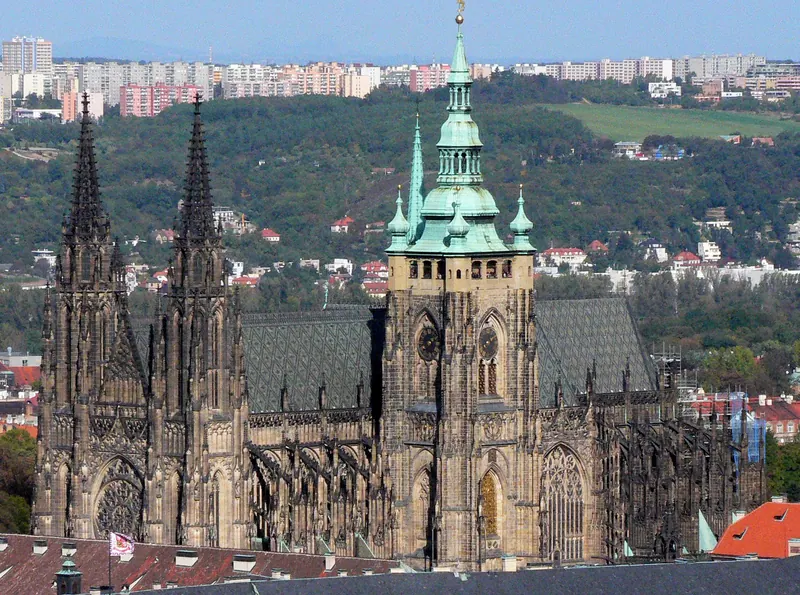
St Vitus Cathedral (the Wenceslas Chapel)

Begun 1344; choir by Matthias of Arras and Peter Parler; west end completed 1929

Begun in 1344 by Matthias of Arras and continued by Peter Parler, the coronation and burial church of the kings of Bohemia. Go for one room: the Chapel of St Wenceslas, walled in over a thousand polished Bohemian gemstones, with the door in its corner that has seven locks and holds the crown jewels behind it.

Works in the rain
Walking directions
Landmark

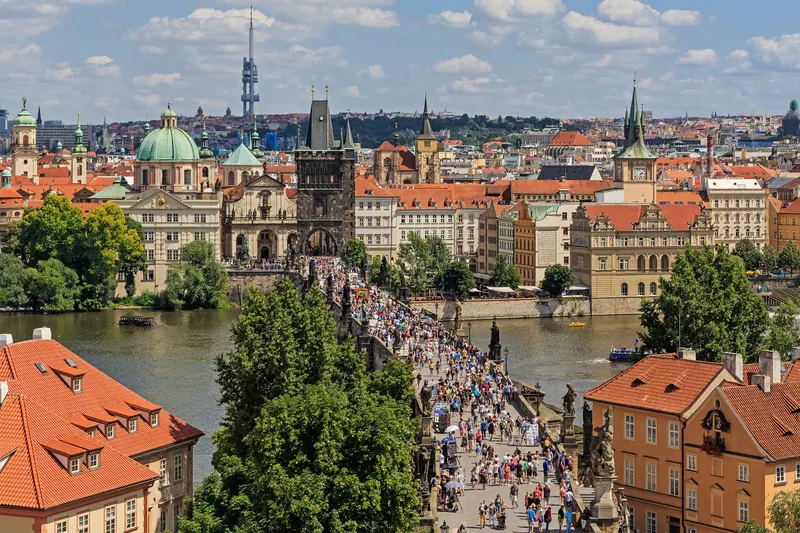
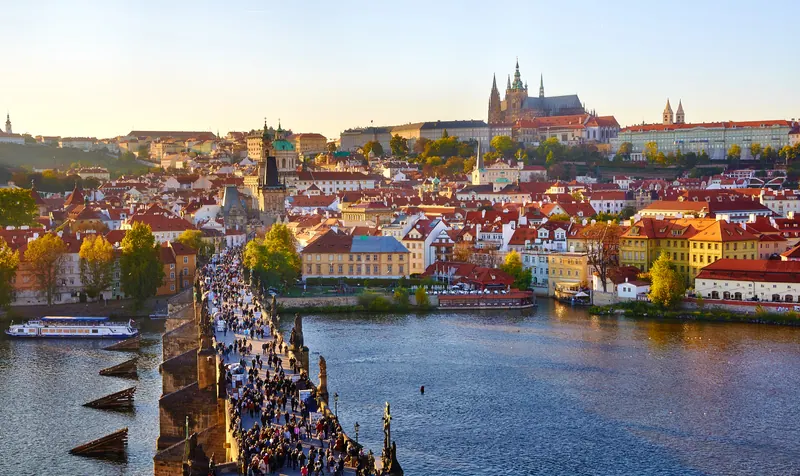
Charles Bridge

Begun 1357 under Charles IV; towers 14th–15th century

The stone bridge Charles IV began in 1357 to replace a flood-wrecked Romanesque crossing, still carrying foot traffic between the Old Town and the castle. Go for the two medieval gate towers at either end and the sculpture on the Old Town tower's east face, not for the statues on the parapet, which are copies.

Free or cheap Best in the evening Good with children
Walking directions
Castle

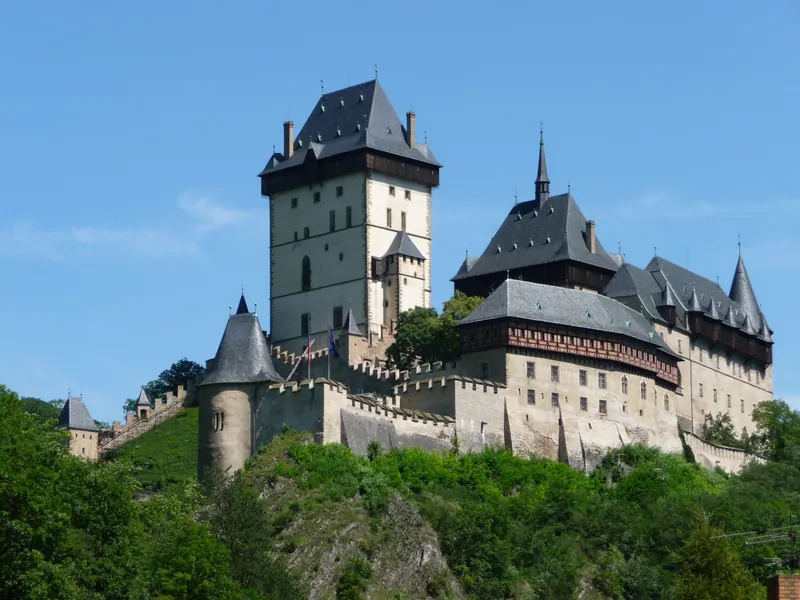
Karlštejn Castle

Founded 1348 by Charles IV, consecrated 1365; rebuilt by Josef Mocker 1887–99

The castle Charles IV built between 1348 and 1365 on a rock above the Berounka, 30 km from Prague, purely to hold the imperial regalia and his relic collection. Book the second route months ahead: it is the only way into the Chapel of the Holy Cross, whose walls carry 129 painted panels by Master Theodoric.

Good with children
Walking directions
All articles