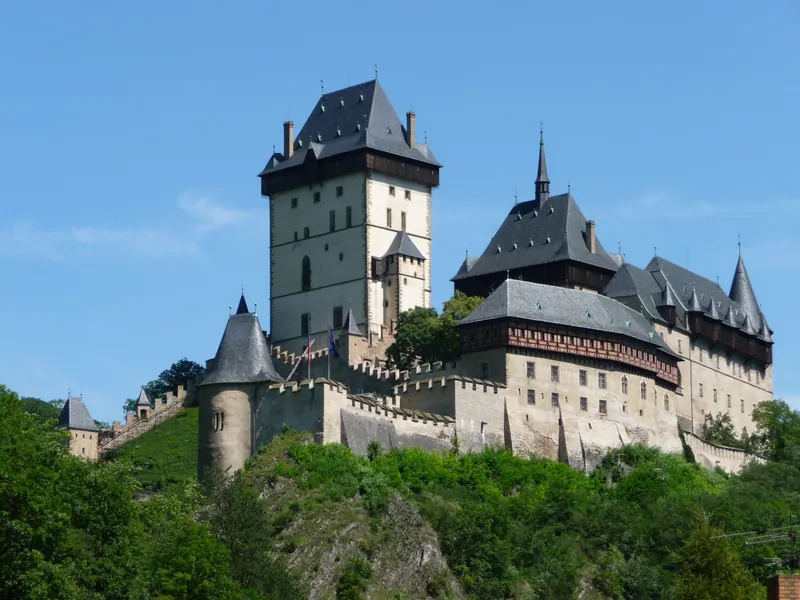
Karlštejn is a hierarchy in stone. The emperor’s residence sits lowest, the Church of Our Lady and the small Chapel of St Catherine in the Marian Tower above it, and at the top, in the Great Tower behind walls up to seven metres thick, the Chapel of the Holy Cross, where the coronation jewels of the Empire and the Bohemian crown were kept from 1365. Charles IV founded the castle in 1348 and it was consecrated in 1365. Its late-Gothic pitched roofs and much of the silhouette are the work of Josef Mocker, who rebuilt the castle in 1887–99; his office is on the tour.
The Chapel of the Holy Cross is the point. Its lower walls are set with more than 2,000 pieces of polished jasper and amethyst; the vault is gilded and studded with glass lenses to read as a starred sky; and around the walls hang 129 painted panels by Master Theodoric, court painter to Charles IV, painted between about 1360 and 1364 — the largest surviving set of medieval panel paintings from a single workshop anywhere. A gilded grille divides the room. To protect the microclimate, entry is capped at 16 people per tour and the route runs seasonally only.
Two routes, and they are not the same castle. Route I, the Imperial Residence, is 55 minutes through the emperor’s palace: the Knights’ Hall with the chapel of St Nicholas, Charles’s bedchamber with the chapel of St Wenceslas, the Audience Hall, the Hall of the Ancestors and a replica of the St Wenceslas crown. Route II, the Castle Chapels, is 100 minutes and takes in the Church of Our Lady, a look into St Catherine’s chapel, the hanging bridge between the towers, the castle lapidarium, the tower staircase with its 14th-century wall paintings, and the Chapel of the Holy Cross.
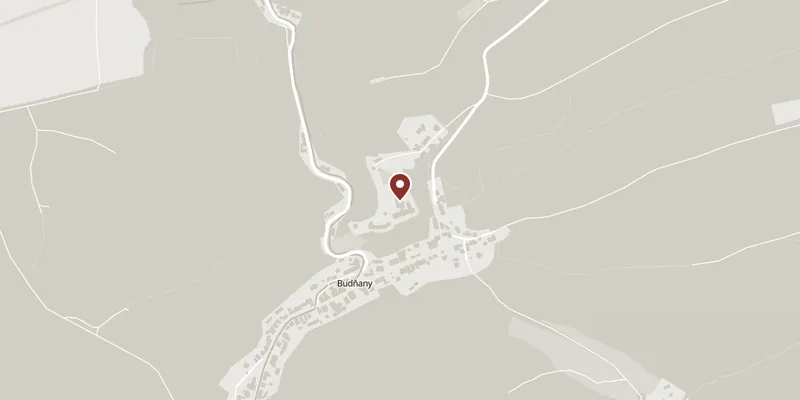
From Prague main station take the S7 towards Beroun to Karlštejn, about 45 minutes, then walk 20–25 minutes up through the village. The last stretch is steep and cobbled. The village street is wall-to-wall souvenir shops; ignore it.