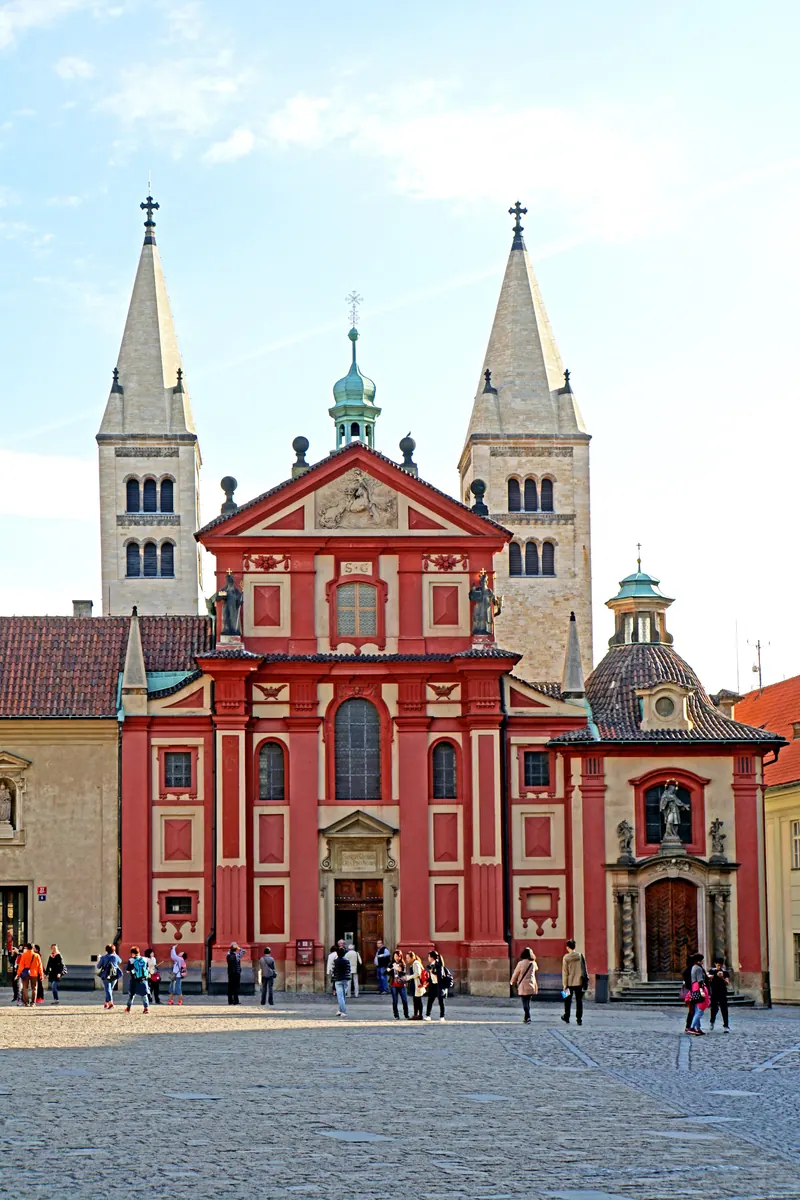
Prince Vratislav I founded a church here around 920, before the castle had a cathedral. His mother-in-law Ludmila, strangled in 921 on the orders of her daughter-in-law Drahomíra and later made the first Czech saint, was brought here in 925. In 973, when Prague got its bishopric, Mlada — sister of Boleslav II — founded the first convent in Bohemia beside the church, and the basilica was rebuilt as a three-aisled Ottonian basilica. It burned in 1142 and the rebuilding that followed gave it the shape you walk into: two square towers (the wider south one called Adam, the leaning north one Eve), a raised choir over a crypt, and a nave with round arches and nothing decorative at all.
It was the burial church of the early Přemyslids until St Vitus took the role in 1055. Vratislav I lies in the nave; the Chapel of St Ludmila, added in the first half of the 13th century off the south aisle, holds her tomb. Fragments of Romanesque wall painting survive on the choir vault and in the Ludmila chapel — faint, and worth standing still for a minute to let your eyes find.
The red-and-cream front on Jiřské náměstí is early Baroque, applied in the 17th century over a 14th-century west façade. The Baroque chapel of St John of Nepomuk on the south side was added by František Maxmilián Kaňka in 1718–22. Ignore both and go in.
The double staircase to the raised choir, the crypt beneath it and the plain masonry make this the clearest picture in Prague of what a church looked like three hundred years before Charles IV. It is on the same ticket as everything else at the castle, it takes ten minutes, and most visitors walk past the door.